
Eight Feet Tall: The Shadow in the White Dress
A forbidden ritual, a village of secrets, and a towering entity that defies reality. Why the legend of Hachishakusama is Japan’s most terrifying psychological nightmare.

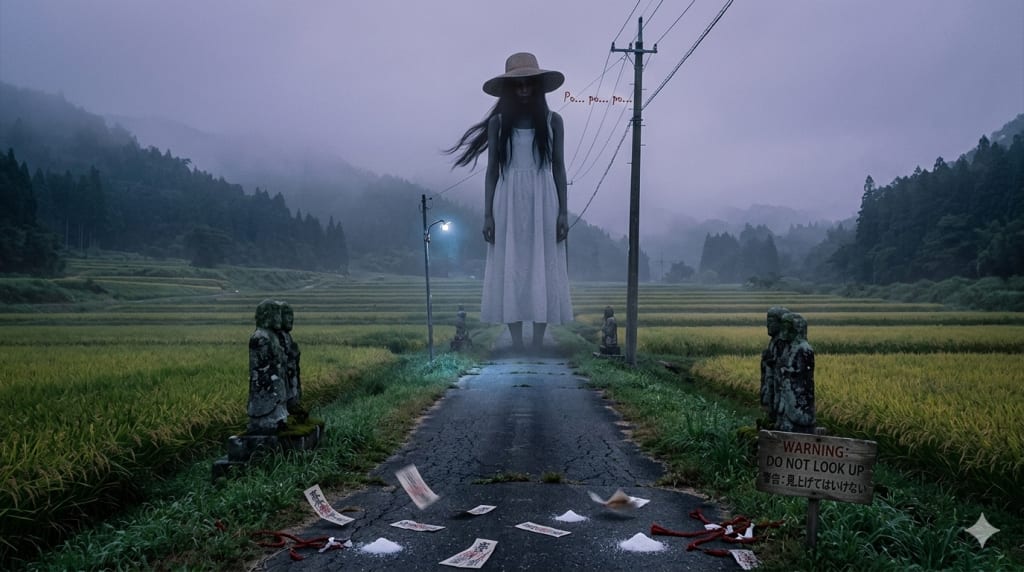
1. The Intruder in the Twilight
Imagine the scene: you are in a quiet, rural Japanese countryside. The sun is dipping below the horizon, and the sky is turning a bruised, deep purple. Everything is peaceful. Then, you see her. Standing over the rice fields, taller than the power lines, stands a woman in a white sundress and a wide-brimmed straw hat. You think it’s a trick of the light. But then, you hear it. A guttural, rhythmic sound echoing across the valley: "Po... po... po... po..." This is Hachishakusama—or "Eight Feet Tall." In the digital age of urban legends, few entities command as much primal, visceral fear as this towering specter. She is not a jump-scare ghost; she is a slow, methodical predator who marks her prey long before she strikes.
2. The Origins: A God of Sacrifice
To understand Hachishakusama, one must look past the internet forums and into the dark heart of rural folk horror. Many believe she is not a ghost in the traditional sense, but a "Local Deity" (a form of Ara-gami or violent god) that was once worshipped by a small, isolated mountain village.
Ancient Japanese folklore often featured deities that demanded a "vessel" to remain pacified. In the legend of Hachishakusama, the village serves as a containment facility. When an outsider arrives, the village's "hospitality" is a trap. They offer the traveler safety and comfort, all while knowing that the traveler has already been "marked" by the entity. By keeping the target within the village, they appease her hunger, allowing the villagers to live their lives in safety—at the cost of the outsider’s soul. It is a chilling reminder of the dark history of Hitobashira (human pillars) and the brutal, sacrificial nature of early agrarian rituals.
3. The Night of Terror: A Masterclass in Psychological Horror
The true brilliance of the Hachishakusama legend lies in its structure. When the boy in the original story realizes he is marked, he is locked in a room by his grandfather. The room is surrounded by protective talismans (Ofuda), salt, and salt-filled bowls.
This is where the story shifts from a creature feature to a psychological cage. For the next several hours, the boy is trapped. He cannot leave. He cannot trust his senses. Hachishakusama manifests at the door, mimicking the voices of his loved ones. She calls out in his grandfather’s voice, begging him to open the door, claiming the ritual is over.
It taps into a universal human fear: The fear of the familiar becoming foreign. When the thing you love—your grandfather, your safety, your home—begins to make the sound of a monster, the world collapses. The reader is forced to ask: "If I were in that room, how long could I withstand the sound of my own family begging me to open the door to death?"
4. The Legacy of the "Po-po-po"
Why does the "Po-po-po" laugh trigger such a deep reaction? In Japanese culture, sounds are often associated with spiritual intent. A rhythmic, inhuman sound like that creates a sense of "Uncanny Valley"—the entity looks almost human, but its sound is distinctly wrong.
In the modern context, Hachishakusama has become a symbol of the "outsider's anxiety." For young people moving to cities, or for those who feel disconnected from their roots, the legend of Eight Feet Tall is a metaphor for the things that hunt us when we stray from the path. She represents the "forgotten" parts of Japan—the old, vengeful traditions that haven't been paved over by high-speed rail and neon lights.
5. Conclusion: The Japan You Weren't Meant to See
Hachishakusama reminds us that folklore is not just a collection of dead stories. It is a living, breathing mechanism for expressing our darkest anxieties. She is the shadow in the corner of your eye, the sound you hear just as you drift off to sleep, and the reason why, when you are in the countryside, you should never, ever look up.
As you navigate the modern world, remember: some borders are meant to stay closed. Some entities are meant to stay in the twilight. And if you ever find yourself in a place where the rice fields are too quiet and the wind sounds like a guttural laugh... do not answer. Just keep walking.
About the Creator
Takashi Nagaya
I want everyone to know about Japanese culture, history, food, anime, manga, etc.
Keep reading
More stories from Takashi Nagaya and writers in Horror and other communities.
The Gluttony of Blackwood Manor
The Gluttony of Blackwood Manor The fog that clung to the Blackwood estate was not weather; it was breath. It sat heavy on the lungs, tasting of copper and wet ash, wrapping the Victorian spires in a shroud that never lifted, even at noon.
By Mohammad Hamida day ago in Horror



Comments
There are no comments for this story
Be the first to respond and start the conversation.