
Not My Brother's Keeper
Architect of the Scythe: The Making of Silas Thorne

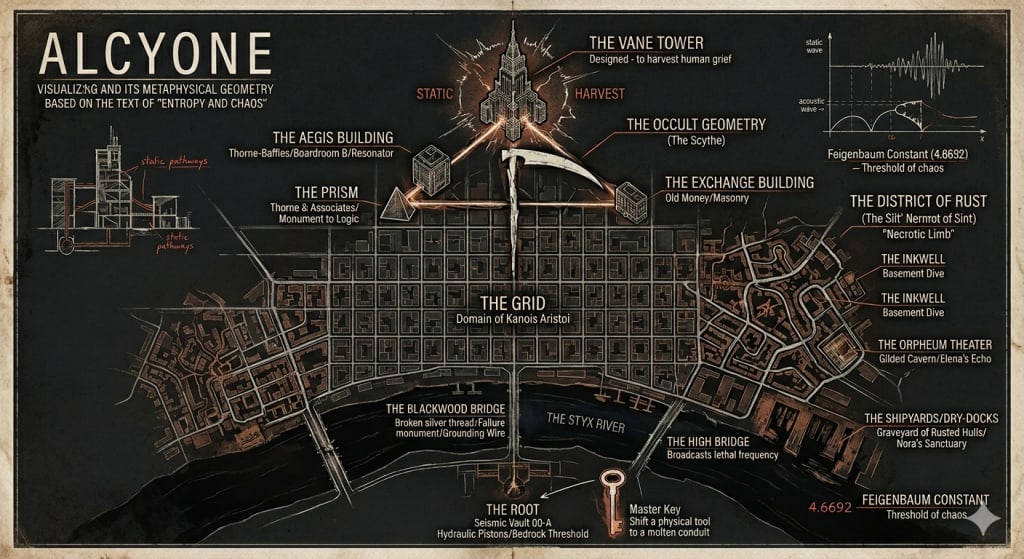
The air in the Thorne & Associates drafting studio was thick with the scent of ammonia from the blueprint machines and stale coffee, a pungent cocktail familiar to every architect working against a deadline. It was 3:00 AM, the night before the final submission that would decide the fate of "The Prism" and the next Junior Partner of the firm.
Silas Thorne, thirty-two and unyielding, adjusted the high-intensity lamp at his station. The focused light created a clinical white circle over his final rendering. His design for The Prism was an obelisk of unrelenting geometry—sleek, crystalline, and designed with surgical precision. Every structural member was calculated to withstand forces twice the city's building code, his blueprints annotated with mathematical proofs in perfect micro-script. Silas didn’t just design buildings; he dictated terms to gravity. He looked down at his work, seeing not an aesthetic, but the absolute triumph of structural truth.
He glanced over at Marcus. At thirty, his younger brother still worked like a student, his station a hurricane of crumpled tracing paper, graphite dust, and half-empty energy drinks. Marcus was currently hacking at an ornate, cantilevered terrace detail with a soft pencil, his movements erratic, frantic. His design was beautiful—organic, full of light and complex, flowing spaces that captured the imagination. It was architecturally stunning, but geologically reckless.
Silas watched him for a long moment, a familiar tension tightening in his jaw. It wasn't the noise that bothered him; it was the sloppiness. The intellectual dishonesty of prioritizing feeling over physics.
"Marcus," Silas said, his voice low, cutting through the hum of the plotter. He didn’t look up from his own precise cross-section. "If you don't anchor that southeast overhang, the static load will pull the entire façade out of alignment within five years. Are you designing a building, or a disaster scenario?"
Marcus stopped sketching, letting out a sharp, ragged laugh. He ran a graphite-stained hand through his hair. "You’re building a cage of right angles, Silas. A monument to boredom. People are supposed to live in these spaces, not survive them. I’m focusing on the experience of light. Engineering is just a delivery system."
"Engineering is the only system," Silas retorted, tapping the data table on his geotechnical survey. "We are building on the edge of the Styx marsh. Look at the data. This ground shifts, Marcus. It’s unstable. My foundation piles reach sixty feet down to the basalt shelf. Your hybrid mat design? It stops in the silt. It relies on charm to stand up."
"I have contingency engineering planned," Marcus mumbled, though he didn’t show the data. He picked up his pencil again, the frantic scratching noise resuming.
"Contingency isn't architecture," Silas said, finally turning his head to look directly at his brother. He let the arrogance of his technical superiority flavor his voice. "It’s a synonym for 'oops.' And Thorne & Associates doesn't do 'oops.'"
He turned back to his immaculate rendering. The lines were drawn, both on the paper and between them. Silas would build the future of Alcyone on bedrock; Marcus would try to build it on aspirations. The morning would prove whose logic was sound.
Part II: The Foundation (The First Cracks)
The boardroom of Thorne & Associates did not invite conversation; it demanded confession. Situated on the forty-fifth floor of the Exchange Building, the room was a temple of mid-century authoritarianism—book-matched obsidian panels, a table carved from a single slab of black Estremoz marble, and floor-to-ceiling windows that allowed the Alcyone sun to interrogate every occupant.
Jacob Thorne sat at the head of the marble slab, a man carved from the same cold stone as his firm’s reputation. At sixty-five, his hair was a shock of architectural white, and his eyes—mercurial and predatory—missed nothing. He didn’t look at his sons. He looked at the two black portfolios resting on the table like headstones.
"The Prism is not just a contract," Jacob began, his voice a low vibration that seemed to rattle the heavy crystal decanter in the center of the table. "It is the anchor for the North Sector. It is the first stitch in the shroud we are wrapping around this city. If the design fails, the firm fails. If the designer fails, the legacy ends."
He tapped Silas’s portfolio. "Older brother first. Silas, defend your geometry."
Silas stood. He didn't use the colorful, evocative renderings Marcus favored. Instead, he snapped a series of high-contrast, black-and-white technical cross-sections onto the backlit display wall. The Prism appeared as a jagged shard of light, a needle of glass and reinforced concrete designed to pierce the low-hanging Alcyone fog.
"The site is the problem, Father," Silas said, his voice clipped and devoid of sentiment. "The Styx River silt is a necrotic limb. It doesn't support; it swallows. Marcus’s surveys likely suggest a standard mat foundation. My data proves that is a death sentence."
Silas pointed to a diagram of the subterranean strata. "I have designed a deep-reach pile system. We bypass the silt entirely, driving eighty-two reinforced steel columns sixty feet down until they bite into the basalt shelf. The bedrock doesn't compromise, so neither does the building."
He flipped to the next slide—a complex schematic of the ventilation system. "Furthermore, I’ve integrated the first iteration of 'Respiratory Architecture.' These—" he highlighted a series of internal channels "—are Thorne-Baffles. They don't just move air; they stabilize the building’s internal frequency. They act as an acoustic sieve, neutralizing the harmonic load of the wind coming off the harbor. The Prism won't just stand; it will vibrate at a frequency of absolute stability."
Elias leaned forward, his eyes tracking the intricate math of the baffles. "A rigid solution for a fluid problem. It’s arrogant, Silas. It’s expensive."
"It’s correct," Silas countered, his gaze unflinching. "Anything less is a slow-motion collapse."
Jacob turned his head slowly toward Marcus. "And the younger son? What is the counter-narrative?"
Marcus rose with a performative flourish that Silas found repulsive. He didn't use the display wall. Instead, he laid out a series of hand-painted watercolors that depicted The Prism not as a shard, but as a lung—a building wrapped in verdant, hanging gardens and sweeping, curved glass balconies. It was beautiful, ethereal, and, to Silas’s eyes, structurally fraudulent.
"Silas wants to conquer the ground," Marcus said, his voice warm, designed to seduce the listener. "I want to dance with it. The 'Urban Oasis' design utilizes a hybrid mat foundation—a 'floating' raft of post-tensioned concrete. Instead of resisting the silt, the building moves with the city's natural seismic respiration. It’s organic. It’s human."
Marcus gestured to the gardens. "People are tired of living in cages of right angles, Father. They want the curve. They want the 'shadow-trace' of nature in their workspace. My design provides an emotional resonance that Silas’s math simply cannot calculate."
"And the weight?" Silas interrupted, his voice like a razor. "The water for those gardens, the soil, the curved glass—you’ve added twenty percent to the dead load while cutting the foundation’s depth by half. You’re building a beautiful tombstone, Marcus."
"I’ve accounted for the load through tension cables in the core," Marcus snapped, his charisma flickering to reveal a flash of irritation. "It’s a more sophisticated engineering challenge, yes, but the payoff is a building that Alcyone will love. Not just one they’ll fear."
Jacob Thorne stood up, the movement silent and ominous. He walked to the window, looking out at the gray expanse of the District of Rust.
"Love is a variable I cannot bill for," Elias said, his back to them. "But fear... fear has a very reliable ROI. Marcus, your design is a dream. Silas, your design is a machine."
He turned back, his face a mask of disappointment directed at both. "Marcus, your 'hybrid mat' is a gamble. I’ve seen the geotechnical reports Silas brought. You’re ignoring the silt because it’s ugly, not because it’s manageable. And Silas..." Jacob stepped closer to his older son, the scent of expensive tobacco and old paper following him. "Your obsession with 'frequency' and 'baffles' borders on the occult. You’re building a tuning fork, not an office block."
The silence in the room became pressurized. Silas felt the familiar heat of his own arrogance rising, but he kept his hands flat on the marble table. He knew he was right. The math was his gospel, and the bedrock was his god.
"The city is changing," Jacob continued, his voice dropping to a near-whisper. "The Kanois Aristoi are looking for more than just aesthetics. They are looking for control. They are looking for the 'Static'—that underlying tension that defines Alcyone. Both of you have touched on it, but neither has mastered it."
He looked at the two portfolios again. "We will conduct a physical stress test. Scale models. We will put your theories on the seismic table and see which one breaks first. If Marcus’s gardens crumble, he loses. If Silas’s 'baffles' fail to stabilize the core, he loses."
Jacob walked toward the door, stopping only to look at Silas. "Being the older brother doesn't make you the heir, Silas. It only makes your failure more visible."
The door clicked shut. Silas looked at Marcus, who was already reaching for his whiskey. The younger brother’s hand was shaking—just enough to be visible to Silas’s predatory eyes.
"The bedrock doesn't lie, Marcus," Silas said, gathering his portfolios. "But I think we both know your blueprints do."
Silas walked out, leaving Marcus alone in the interrogation of the sun. The first cracks hadn't appeared in the buildings yet—they were opening in the brothers themselves.
The testing lab, colloquially known among the firm's junior architects as "The Pit," was located four levels beneath the street, carved directly into the granite shelf that Alcyone’s elite ignored. It was a cathedral of industrial physics—gray concrete walls, humming hydraulic lines, and the center-stage seismic table, a massive steel plate suspended on nitrogen-damped actuators.
Jacob Thorne stood on the observation catwalk, his silhouette framed by the harsh overhead floodlights. He looked less like a father and more like a high priest of gravity. He didn't offer a greeting as Silas and Marcus entered with their scale models. He simply checked his watch.
"The Prism is a high-altitude asset," Jacob said, his voice echoing off the damp concrete. "In the North Sector, the wind is a serrated blade. Below the ground, the Styx silt is a liquid ghost. We will simulate a Level 4 resonance—the kind of tremor that visits Alcyone every twenty years to collect its dues."
Marcus went first. His model was a masterpiece of miniature craftsmanship. The "Urban Oasis" featured delicate, 3D-printed terraces and sweeping, organic curves of frosted acrylic. It looked like a living thing, a piece of sculpture that happened to house offices. He placed it on the steel plate with the care of a man handling a glass heart.
"Initiating the cycle," Jacob commanded.
A technician engaged the hydraulics. A low-frequency hum filled the room, a bone-deep vibration that rattled Silas’s teeth. On the table, the model began to sway. At first, the movement was graceful. Marcus had used high-tension wires to mimic his "hybrid mat" foundation, allowing the building to flex.
"Increase to 4.2," Jacob said.
The hum shifted to a growl. The "Urban Oasis" began to fight itself. The beautiful, sweeping balconies that Marcus had championed started to vibrate with a discordant rhythm. Because the building lacked a rigid spine, the energy of the tremor wasn't being dissipated; it was being trapped.
Silas watched with a predator’s focus. He saw the "sloppiness" Marcus called "soul." The cantilevered terraces were acting as levers, multiplying the torsional force. A hairline fracture appeared in the acrylic base—the simulated silt foundation was liquefying. The model didn't fall, but it listed three degrees to the west, the elegant glass skin buckling under the uneven load.
"Silt-load failure," Jacob noted, his voice flat. "The 'Urban Oasis' has become a lean-to."
Marcus looked like he’d been struck. He stepped forward as if to catch the model, but the technician killed the power. The silence that followed was heavier than the vibration.
"Silas," Jacob said. "Your turn."
Silas didn't hesitate. He placed his model of The Prism on the plate. It was a stark, brutalist shard of polished steel and reinforced resin. There were no gardens, no curves, no concessions to the eye. It was a geometric declaration of war against the elements.
"Initiating cycle. 4.0," Jacob said.
The table surged. Silas’s model didn't sway; it stood. It was unnatural in its stillness.
"4.5," Jacob ordered. "Give me the Styx resonance."
The lab roared. The hydraulic actuators were pounding the steel plate now, simulating the violent, rhythmic thumping of Alcyone’s shifting bedrock. Most buildings would have been shedding their facades at this frequency. But Silas had seeded his model with miniature versions of his Thorne-Baffles—internal voids and structural dampers tuned to the very frequency the table was generating.
The Prism didn't fight the vibration; it neutralized it. The energy entered the structure and was bled away through the internal baffles, converted from destructive kinetic force into harmless acoustic heat. The water in a small decorative basin at the base of the model didn't even ripple.
"Frequency stabilization achieved," the technician whispered, looking at the data readouts in disbelief.
Jacob leaned over the railing, his mercurial eyes fixed on the steel shard. He stayed there for a full minute as the table battered the model. The Prism remained a perfect, unmoving vertical.
"Kill the power," Jacob said.
The silence returned, but this time it belonged to Silas. He stood by the table, his expression as clinical as his design. He didn't look at Marcus, whose model sat nearby, a tilted, broken dream.
"Your math is cold, Silas," Jacob said, walking down the stairs from the catwalk. He stopped in front of The Prism, tracing the sharp edge of a corner with a calloused thumb. "It lacks the humanity Marcus brought to his draft."
Silas felt a spark of irritation, but Jacob continued.
"However," Jacob turned to Marcus, his gaze freezing. "Humanity is what we bury when the foundation fails. Marcus, you built a building for the people you wanted to know. Silas built a building for the physics we cannot escape. In Alcyone, only one of those things survives the night."
Jacob looked at Silas, a small, grim smile touching his lips. It wasn't a smile of fatherly pride; it was the smile of a general recognizing a weapon.
"The bedrock doesn't lie," Jacob said, echoing Silas’s earlier words. "And neither does the table. Prepare your final renderings for the gala, Silas. We have a partnership to announce."
Jacob walked out without a backward glance.
Silas turned to his brother. Marcus was staring at the buckled acrylic of his "Oasis," his face pale in the flickering fluorescent light. The technical superiority Silas had cultivated for years had finally been weaponized into a career.
"I told you, Marcus," Silas said, his voice a low, lethal purr. "The curve is a compromise. And I don't compromise."
He picked up his model, the cold steel feeling right in his hand. He was the older brother, the architect, and now, the heir. As he walked toward the elevator, he didn't feel the weight of the shadow he was leaving Marcus in. He only felt the terrifying, exhilarating stability of his own victory.
The annual Thorne & Associates Gala was not a celebration; it was a demonstration of structural integrity. It was held in the atrium of the Exchange Building, a soaring cathedral of limestone and black iron that smelled of ozone, expensive gin, and the cold, metallic scent of old money. In Alcyone, the elite—the Kanois Aristoi—didn't gather to socialize. They gathered to observe the hierarchy, ensuring the Grid was being maintained by the right hands.
Silas stood near a fluted column, his tuxedo as sharp and monochromatic as his blueprints. He held a glass of mineral water, his eyes scanning the room with the clinical detachment of a building inspector. He watched the way the light from the massive deco chandeliers fractured against the marble floor. To Silas, the guests weren't people; they were live loads, stressors acting upon the architecture of the firm.
Marcus was across the room, surrounded by a cluster of younger architects and socialites. He was laughing, a glass of amber bourbon in his hand, his collar slightly loosened. Even now, after the disaster in "The Pit," Marcus performed. He was selling the "Urban Oasis" to anyone who would listen, spinning a narrative of light and humanity that the seismic table had already debunked. Silas felt a surge of genuine pity, the kind one feels for a bridge that doesn't know its own resonance frequency is its undoing.
The room dimmed, and a single spotlight pierced the gloom, centering on the grand staircase. Jacob Thorne descended slowly. He didn't use the handrail. He moved with a heavy, tectonic certainty that commanded the air around him to go still.
"Alcyone is a city of layers," Jacob began, his voice amplified by the atrium's natural acoustics, which Silas noted were slightly dampened by the crowd's velvet attire. "We build upon the ruins of the inefficient. We pave over the mistakes of the sentimental. For forty years, Thorne & Associates has provided the skeletal structure for this city’s ambition. Tonight, we designate the architect who will carry that skeleton into the next century."
Silas felt the weight of the room shift toward him. He didn't move. He kept his breathing rhythmic, his pulse a steady, sixty-beat-per-minute clock.
"The Prism is our most ambitious commission to date," Jacob continued, his eyes scanning the crowd until they locked onto Silas. "It is a building that requires more than vision. It requires an absolute, unyielding commitment to the laws of physics. It requires a designer who understands that a city is not a garden to be tended, but a machine to be tuned."
Jacob paused, a silence so profound it seemed to pull the oxygen from the room.
"The commission for The Prism is awarded to Silas Thorne."
A wave of polite, rhythmic applause broke against the limestone walls. Silas stepped forward, the spotlight finding him. He didn't smile. He offered a single, sharp nod to his father. It was a transaction, not a triumph.
"Furthermore," Jacob’s voice rose, cutting through the applause. "The firm requires a new hand at the helm. Effective immediately, Silas Thorne is elevated to the position of Junior Partner."
The applause intensified, but Silas was looking at Marcus. His younger brother had stopped laughing. The bourbon glass stayed level, but the light in Marcus’s eyes had gone out, replaced by a flat, dark realization. Marcus wasn't just losing a contract; he was being erased from the lineage. He was the "sloppiness" that Jacob was officially purging from the firm’s future.
Silas climbed the stairs to stand beside his father. Up here, the perspective changed. He could see the tops of the guests' heads, the patterns of their movement, the way the atrium’s geometry funneled them toward the center. He felt a sudden, intoxicating sense of alignment. He was no longer a draft; he was a finished structure.
"Speech, Silas," Jacob murmured, the command barely audible over the noise.
Silas turned to the crowd. He didn't look at the Aristoi. He looked at the shadows in the corners of the room, the places where the light didn't reach.
"The Prism will not be a beautiful building," Silas said, his voice carrying a lean, sinister edge that silenced the room. "Beauty is a variable that fluctuates with the wind. The Prism will be a stable building. It will be a shard of absolute logic driven into the heart of the North Sector. It will not move. It will not compromise. It will simply be the truth of the grid, rendered in glass and steel."
He raised his glass of water, the clear liquid reflecting the cold white light of the chandelier.
"To the bedrock," Silas said. "Because everything else is just silt."
He took a sip, the coldness of the water matching the chill in his chest. As he stepped back, Jacob placed a hand on his shoulder. The grip was tight—not a gesture of affection, but a test of structural integrity. Silas didn't flinch. He met his father’s gaze with a clinical stare that acknowledged the trade: his soul for the partnership, his brother for the legacy.
Down on the floor, Marcus turned his back and walked toward the exit. He didn't wait for the toast to end. He moved through the crowd like a hairline fracture in a load-bearing wall, invisible to everyone but the man who had just replaced him.
Silas watched him go, feeling a flicker of the "Static" for the first time—a low-frequency hum of impending chaos that his baffles hadn't yet been designed to catch. He pushed the feeling down, centering himself in the 90-degree intersection of his own ambition. He was Silas Thorne, Partner. The architecture of his life was finally, perfectly, vertical.
The private terrace of the Exchange Building hung over Alcyone like a guillotine blade. Here, sixty stories above the Styx, the air was thin, tasting of ozone and the expensive, filtered chill of the North Sector’s ventilation. Below, the city was a grid of amber lights, a massive circuit board waiting for a master programmer. Silas Thorne stood at the edge, the wind tugging at his silk lapels, a glass of twenty-year-old scotch in his hand. He didn’t drink it; he simply enjoyed the weight of the crystal.
He was listening to the building. To Silas, the Exchange Building wasn't just stone and steel; it was a symphony of compressive stress and lateral loads. He could feel the slight, rhythmic sway of the tower—a perfect, calculated oscillation that mirrored his own steady pulse.
"I thought I’d find you up here," a voice rasped from the shadows. "Closer to the stars, further from the people."
Silas didn’t turn. He recognized the cadence of Marcus’s footsteps—a slight dragging of the left heel, a sign of fatigue his younger brother could never quite engineer out of his gait. Marcus stepped into the light of the terrace’s recessed floor-lamps. He had discarded his tuxedo jacket. His white shirt was unbuttoned at the collar, stained with bourbon and the gray ash of a night spent losing.
"The air is cleaner up here, Marcus," Silas said, his voice as smooth as polished obsidian. "You should try it. It clarifies the perspective."
Marcus leaned against the reinforced glass railing, looking out at the dark expanse of the marshlands where the District of Rust would eventually fester. "Perspective? Is that what we’re calling it now? I call it a cold, lonely peak, Silas. You didn't just win a contract tonight. You conducted a public execution."
Silas finally turned, his expression a mask of clinical concern. He took a measured sip of the scotch, letting the peat smoke coat his tongue. "I didn't execute anything. Gravity did. I told you months ago, Marcus: your hybrid mat foundation was a fantasy. You were trying to build a cathedral on a sponge. I simply provided the firm with a design that wouldn’t eventually become a submarine."
"It was about the vision!" Marcus snapped, his voice cracking with a sudden, raw desperation. "The 'Urban Oasis' was about making Alcyone breathe. It was about beauty, Silas. People don't want to live in a shard of glass. They want to feel... connected."
"Connected to what? The silt?" Silas stepped closer, his shadow falling over Marcus like a structural shroud. "Connectivity is a marketing term, Marcus. Structural integrity is a fact. You wanted to give them a garden; I gave them a fortress. You wanted to give them a dream; I gave them an absolute."
He paused, letting the silence of the high-altitude wind emphasize his point.
"The problem with you, Marcus—the reason Father chose me—is that you think architecture is a conversation. It isn't. It’s a command. You draft with a pencil; I draft with a scalpel. You look for the curve because it feels safe, but the curve is where the stress accumulates. The curve is where the structure fails."
Marcus looked away, his jaw tightening. "You’ve always been the 'Older Brother,' Silas. The 'Glass King.' The one who never colors outside the lines. But those lines are going to choke you one day. You're building a world where there's no room for error, no room for... human messiness."
"Error is just math that hasn't been finished," Silas countered. He reached out and clapped Marcus on the shoulder. It wasn't a gesture of brotherly affection; it was a claim of ownership. "But look, I’m not heartless. The Prism is a massive project. I’m going to need someone to handle the interior detailing. The lobbies, the lighting fixtures, the... aesthetic flourishes. The things that don't require load-bearing calculations. I’ll make sure Jacob keeps you on the payroll as my lead consultant for the 'soft' elements."
Marcus froze. He looked at Silas’s hand on his shoulder as if it were a parasite. The offer was a lethal insult—a demotion to decorator in his own brother’s shadow.
"You want me to pick out the wallpaper for your monument to ego?" Marcus whispered, his voice trembling with a terrifying, quiet fury.
"I want you to be useful," Silas said, his tone patronizingly gentle. "I want you to learn that the foundation is non-negotiable. Work under me for five years. Learn the math. Learn how to respect the bedrock. Maybe then, you'll be ready for a vertical of your own."
Marcus stepped back, shaking Silas’s hand off. He looked at his older brother with a sudden, chilling clarity. The hurt was gone, replaced by a hollow, resonant bitterness that Silas’s sensors failed to interpret.
"I'm not doing your interiors, Silas," Marcus said, his voice flat. "And I'm not learning your math. You think you’ve won because you’ve captured the Grid. But the Grid is just a cage. And eventually, cages break."
Marcus turned and walked toward the elevator. He didn't look back. He didn't say goodbye. He simply vanished into the sterile, fluorescent light of the interior corridor.
Silas stood alone on the terrace, the victor’s silence returning. He felt a fleeting moment of irritation—Marcus’s refusal was a variable he hadn’t fully accounted for—but it was quickly replaced by the intoxicating certainty of his new title. Junior Partner. The Architect of the New Century.
He looked down at the city again. He imagined The Prism rising from the marsh, a perfect, unyielding vertical that would anchor the horizon. He was the older brother. He was the logic. He was the bedrock.
He raised his glass to the lights of Alcyone, a solitary king on a glass throne. The gloat was complete. He had purged the sloppiness from his lineage. He had secured the future. Or so he believed, as the high-altitude wind whistled through the vents, a low-frequency hum that sounded, if one listened closely enough, like the first note of a long, cascading collapse.
Silas drained the scotch, the burn in his throat the only organic thing left in his world. He was ready for the next level. He was ready for the headline. He was ready for whatever Alcyone threw at him, certain that his baffles could handle the load.
He didn't know that the most dangerous frequency in the city wasn't the wind. It was the woman currently standing in the doorway behind him, watching him with a journalist’s predatory patience.
The terrace was a stage of cold limestone and charcoal shadows, illuminated only by the rhythmic, amber pulse of the aviation lights atop the Exchange Building. Silas Thorne stood at the precipice, the wind a thin, high-frequency whistle against the glass railing. He felt untouchable—a vertical entity in a world of horizontal failures.
"It’s a long way down for someone who just reached the top," a voice remarked. It was a low, melodic rasp, cutting through the atmospheric hum with the precision of a diamond-tipped drill.
Silas didn’t flinch. He adjusted his cufflink, the movement deliberate. "The view is clearer when you aren't looking up at everyone else's mistakes."
He turned. A woman leaned against the obsidian doorframe of the penthouse suite. She wasn't dressed in the shimmering, redundant silks of the Aristoi downstairs. She wore a tailored charcoal blazer and a look of practiced, predatory boredom. Her hair was a dark spill across her shoulders, and her eyes—sharp, intelligent, and entirely unimpressed—held the light like polished flint.
Nora Sterling. He recognized her from the bylines in the Alcyone Chronicle. She was the journalist who had recently dismantled the Port Authority’s zoning board with a three-part exposé that read like a forensic autopsy.
"Nora Sterling," Silas said, his voice dropping into a professional, lethal purr. "I didn't realize the Chronicle sent their lead inquisitor to social functions."
"We don't," Nora said, stepping onto the terrace. She didn't walk; she navigated the space, her movements efficient. She held a glass of neat bourbon, the ice long since melted. "I’m here because I like to see the architecture of a lie before the inhabitant moves in."
Silas offered a thin, dangerous smile. "A lie? The seismic table doesn't lie, Ms. Sterling. My design held a Level 4 resonance without shedding a single pane of glass. The Prism is the most honest structure this city has seen in a century."
"Honesty is easy when you control the variables," Nora countered. She walked to the railing, standing uncomfortably close to him. The scent of her—sandalwood and cold rain—disrupted the sterile ozone of the height. "I read your geotechnical filing. The one you submitted to the board before your father’s 'independent' review."
Silas felt a microscopic spike in his pulse. "It’s a public record. Thorough, I assume."
"Thorough. But imaginative," Nora said, looking out at the dark Styx River. "You claim the silt layer at the North Sector site is forty feet deep. You designed your piles to sixty feet to hit the basalt. It’s a masterful bit of over-engineering." She turned back to him, her gaze locking onto his. "But I spent the afternoon at the University’s Geology Department. Their core samples from that specific block show the silt doesn't end at forty feet. It goes to eighty. There is no basalt shelf there, Silas. Just a deeper, darker mud."
The silence on the terrace became pressurized. Silas didn’t blink. He watched the way the amber aviation light caught the curve of her jaw. She was challenging the foundation of his victory, probing for the very "sloppiness" he had just finished purging from Marcus.
"The University’s maps are fifty years old," Silas said, his voice dropping an octave. "My private surveys are current. The bedrock is there. I’ve seen the drill bits come up gray and broken."
"Or maybe you just wanted the partnership so badly you decided the bedrock had to be there," Nora suggested, her voice a soft, lethal taunt. "It’s a beautiful building, Silas. But if you’re building on a ghost shelf, you aren't an architect. You’re just a very expensive undertaker."
Silas stepped into her space, his shadow swallowing hers. He could see the defiance in her eyes—a spark of the "Static" he had spent his life trying to suppress. She wasn't afraid of the height, and she wasn't afraid of him.
"You're looking for a scandal, Ms. Sterling. You want to see the Glass King tumble before he’s even crowned."
"I'm looking for the truth of the grid," she whispered. The chemistry between them wasn't soft; it was the friction of two tectonic plates grinding together. It was a shared recognition of the darkness beneath the city’s glittering skin. "I want to see if the man matches the math."
Silas reached out, his fingers hovering just inches from her arm, not touching, but tracing the heat of her. "The math is absolute. If you want to audit my soul, you'll find the same right angles and reinforced steel."
Nora smirked, a sharp, exhilarating expression. She downed the rest of her bourbon and set the glass on the railing. "We'll see. The ground always has the final vote, Mr. Thorne. I’ll be watching the groundbreaking. I want to see the moment the steel bites."
She turned and walked back toward the gala, her departure as sudden and surgical as her arrival. Silas stood alone, the wind suddenly feeling colder, the victory feeling less like a conclusion and more like a complicated opening move.
He looked down at his hands. They were steady. But for the first time in fifteen years, he found himself thinking about the silt—eighty feet of dark, unyielding mud. He dismissed the thought. He was the older brother. He was the Partner. The bedrock was there because he had decreed it.
Nora Sterling, was the only thing in Alcyone he couldn't yet calculate. The headline was coming, and for the first time, Silas Thorne wasn't sure he could control the ink.
About the Creator
Nathan McAllister
I create content in the written form and musically as well. I like topics ranging from philosophy, music, cooking and travel. I hope to incorporate some of my music compositions into my writing compositions in this venue.
Cheers,
Nathan
Keep reading
More stories from Nathan McAllister and writers in Horror and other communities.
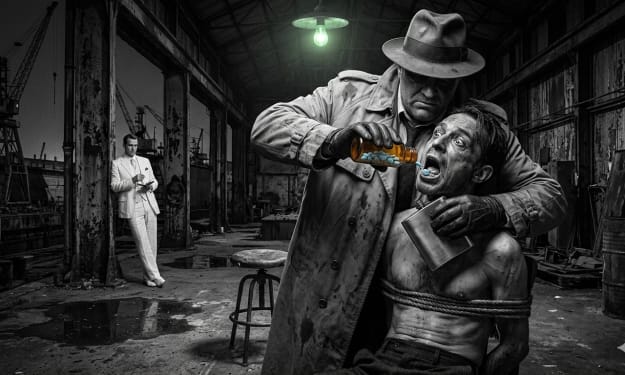
The Dirty Detective of Alcyone: Judas Miller
The air in the Alcyone Shipyard didn’t just hang; it clung. It was a thick, stagnant mixture of salt water spray, oxygenating rust, and the oppressive, metallic heat radiating from miles of decaying industrial sprawl. Night offered no relief.
By Nathan McAllister2 days ago in Horror
"Scream 7" (2026): Running out of Fresh Screams
This is the seventh time we’ve had a Ghostface crisis. Scream 7 is the latest edition of the Scream franchise. Sydney Prescott and her family are under attack by another anonymous killer dressed in a Ghostface costume. While having issues with her daughter, Tatum, they run from the bloody murders, trying to determine who is behind it all.
By Marielle Sabbag26 days ago in Horror



Comments
There are no comments for this story
Be the first to respond and start the conversation.