
Shady Vale
Architecture of the Scythe Lore: Of Entropy & Chaos

The Vane Foundation’s "Resilience Zone" campaign hit the streets of Alcyone at 0800 hours. It was a saturation-level event. Digital billboards across transit hubs flickered to life, displaying high-resolution renderings of a sanitized future. The District of Rust was slated for "structural optimization." The ads featured architectural schematics of new housing blocks—monolithic, white-concrete structures. The copy was written in a precise, drafting-stencil font: Harmonic Alignment for a Stable Future. Order is our Foundation.
By 0830, the city’s municipal feed was choked with the Foundation’s propaganda. It promised an end to the "Hum" through the installation of new sub-surface "stabilizers." It promised jobs, safety, and a final solution to urban rot that defined the sector since the St. Jude Tenement fire.
Nora sat in the bullpen of the Alcyone Ledger, the glow of three monitors reflecting off her glasses. The air in the office tasted like stale coffee. She didn't look at the Foundation’s renderings. She looked at the raw data she’d been clawing out of the city’s dark-web archives for three weeks.
At 0900, she hit "Publish."
The Alcyone Ledger’s digital edition didn't just report the news; it dismantled the Vane narrative with precision. The headline was blunt: THE CAPACITOR PROTOCOL: THE TRUTH BEHIND THE RESILIENCE ZONE.
Nora’s piece was 5,000 words of cold, hard evidence. She started with the casualty list from the St. Jude Tenement fire—names, ages, and specific "resonance-trauma" listed on their death certificates. She followed it with leaked soil toxicity reports from the O’Malley Street construction site. The samples showed a concentration of lead-lined copper particles that made the ground technically classified as industrial waste.
Then she dropped the kill-shot: the actual reinforcement specs for the "housing blocks."
She provided a side-by-side comparison. On the left, the public permits for residential dwellings. On the right, the internal Vane Foundation blueprints for "Primary Resonance Sinks." The housing wasn't designed for people; the people were designed to be machinery inside the walls. The "stabilizers" weren't there to stop the Hum. They were there to harvest it.
"The Vane Foundation isn't rebuilding Sector 4," Nora wrote. "They’re turning it into a battery. They are installing the wiring now. You're an electrolyte."
The effect was tectonic.
By 1000, the "Resilience Zone" campaign wasn't just a failure; it was a target. In the District of Rust, the reaction moved faster than the Grid could calculate. A group of local hackers, calling themselves "Dissonance," bypassed the Foundation’s firewalls. They didn't take the billboards down. They modified them.
Julian Vane’s face, which had been smiling benevolently over the Sector 4 transit hub, began to glitch. The hackers ran a script that mapped the St. Jude casualty list directly onto his features. Every five seconds, his skin would dissolve into a flickering, red-lined map of the fire’s spread. The "Order is our Foundation" slogan was replaced with a scrolling ticker of the copper-mesh costs.
Physical riots didn't break out immediately; the silence was worse. People stopped moving. They stood in the streets, staring up at the screens, watching the math fail in real-time. The "Gospel" had been exposed as a ledger of human debt.
In the Sector 4 construction sites, workers walked off the job. They left the heavy lead-lined coils sitting in the anaerobic mud. The foremen, usually quick to enforce Vane’s rigid schedule, looked at the blueprints in their hands and saw the "construction errors" Nora had highlighted. They saw the traps they were building for their own families.
By noon, the Vane Foundation’s holding company's stock began a marked descent on the Exchange. The "Resilience Zone" was no longer a symbol of progress; it was a brand of liquidation.
Julian Vane’s PR team went silent. The official feeds stopped updating. The only thing coming out of the Vane Spire was a high-frequency static that made the nearby streetlamps hum at a threatening pitch.
Nora watched the metrics on her screen climb. She didn't celebrate. She knew how the math worked in this city. When a variable disrupted the equation, the architect didn't just delete the variable. He reinforced the structure.
She picked up her jacket and checked the charge on her recorder. The Alcyone Ledger office was vibrating. The Hum was reaching a new, aggressive frequency. The city was annoyed. And Julian Vane was about to make it personal.
She headed for the elevators. It was time for a drink in the basement of Thorne & Associates. She wanted to see the look on Julian's face when the noise finally reached his ears.
The elevator in the Thorne & Associates Building didn't just descend; it pressurized. Nora felt the shift in her inner ear, a sharp, metallic pop that signaled her exit from the frantic frequency of the street. As the floor indicator hit 'B4', the "Hum" of Alcyone wasn't just muffled—it was surgically removed.
The doors slid open into a hallway of matte-black composite. No light fixtures broke the ceiling's plane; the walls themselves emitted a cold, sourceless luminescence. Two security contractors stood flanking the entrance to the Obsidian Room. They wore the grey, unbranded tactical gear of the Foundation’s internal security. They didn't reach for weapons. They didn't have to. Their presence was a structural barrier.
Nora walked between them. She didn't offer an ID. She didn't wait for a biometric scan. She moved with the reckless confidence of a woman who had already burnt the bridge behind her.
The Obsidian Room was an acoustic tomb. Every surface—the floor, the walls, the vaulted ceiling—was constructed from high-density volcanic glass, polished to a mirror finish. There were no windows, no vents, and no soft edges. The air was recycled, chilled, and stripped of scent. It felt like breathing through a filter.
Julian Vane sat at the center of the room. He wasn't behind a desk. He sat at a long, slab-like table of the same black glass, his silhouette nearly indistinguishable from the shadows. The only light in the room pooled directly over the table, illuminating a single crystal glass of water.
Nora pulled out a chair. The sound of heavy metal legs scraping against the obsidian floor was a violent intrusion. It sounded like a scream in a cathedral. She sat down, leaning forward until she entered the circle of light.
Julian didn't look up. He was staring at the water. The surface was a perfect, unbroken plane. In any other part of the city, the liquid would be dancing to the tectonic rhythm of the Grid. Here, the stabilization was so absolute that physics seemed to have surrendered.
"The Obsidian Room was designed to be the quietest place in the hemisphere," Julian said. His voice didn't echo. The walls swallowed the sound as soon as it left his lips. "It is the only place where the math is audible."
"Then you must be hearing a lot of screaming today, Julian," Nora said. She tossed a physical copy of the Alcyone Ledger onto the table. It slid across the glass with a dry, rhythmic hiss, stopping inches from his hand. "The 'Resilience Zone' is dead. Even the hackers are laughing at you."
Julian finally shifted his gaze. His eyes were the color of wet slate—analytical, cold, and entirely devoid of irritation. He didn't look like a man who had just lost a multi-million dollar PR war. He looked like an architect contemplating a hairline fracture in a blueprint.
"You think you’ve won a victory, Nora. You think you’ve disrupted a narrative." He reached out, his long, thin fingers hovering over the newspaper but never touching it. "You haven't. You’ve simply increased the friction. And in a closed system, Expansion leads to failure."
"I've given the people the truth," Nora countered. "They know about the lead-lined copper. They know they’re the electrolyte in your battery. You can’t build a city on top of people who know they’re the fuel."
Julian leaned back into the shadows. "People are not the fuel, Nora. They are the vibration. They are the chaotic energy that the Grid is designed to harmonize. Your little article hasn't stopped the project. It has only forced me to adjust."
The "Hum" suddenly returned, but not from the walls. It came from the floor—a low, bowel-shaking thrum that made the crystal glass of water finally ripple. The circles moved outward from the center in perfect, concentric rings.
"The District of Rust is a variable that refuses to be solved," Julian continued. "I tried the 'Resilience' approach. I tried the lie. It was an elegant solution, but the system rejected it. So now, we move to a more... forceful derivation."
"Is that a threat?"
"A threat is a chaotic variable," Julian said, standing up. He seemed to grow in the dim light, his shadow stretching across the ceiling like a structural beam. "This is a statement of fact. When a rivet decides it wants to be a needle, the bridge shears."
He walked around the table, stopping inches from her. Nora didn't flinch, but she felt the cold radiating off him.
"You are currently a needle, Nora." He leaned down, his voice dropping to a whisper that vibrated in her jaw. " I suggest you find a way to become a rivet before the next surge."
Julian turned and walked toward the far wall. A hidden door slid open with a pressurized hiss. He stepped through, leaving her alone in the absolute, suffocating silence of the vault.
Nora looked back at the glass of water. The ripples had stopped. The surface was flat again. But as she stood up to leave, she noticed a faint, hairline crack spreading across the base of the crystal.
She headed for the elevator. She had the data. She had the threat. Now she needed the man who knew how to make the cracks wider. She needed Percy Vance.
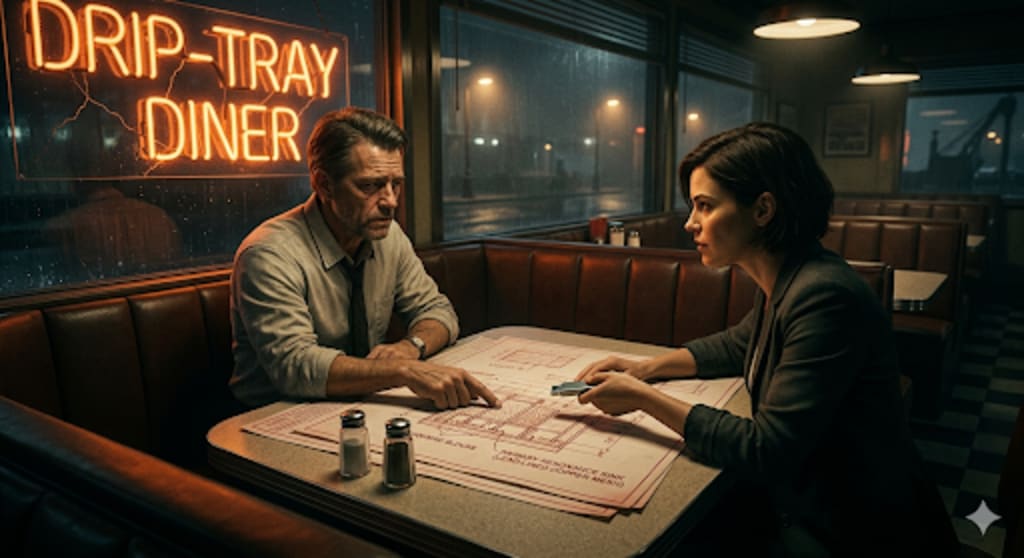
The Docks smelled like industrial grease and dead fish. The "Hum" here was a low-frequency vibration that rattled the silverware in the Drip-Tray Diner.
Percy Vance sat in a corner booth, his back to the wall. He looked like a man who hadn’t slept since the St. Jude fire. His eyes were bloodshot, and his fingers had a rhythmic, metronomic twitch that matched the flickering of the diner’s neon "Open" sign. In front of him sat a cup of coffee that had developed a greasy film.
Nora slid into the booth opposite him. She didn't say hello. She just dropped a encrypted thumb drive onto the Formica table.
"I pulled this from the Thorne internal network," Nora said. "Julian Vane thinks it’s noise. I think it’s a death warrant."
Percy didn't touch the drive. Instead, he reached under the table and pulled out a roll of heavy-duty drafting vellum. He spread it across the table, pinning the corners down with the salt and pepper shakers. The blueprints were red-lined, covered in jagged, aggressive corrections in Percy’s own cramped handwriting.
"I’ve been comparing your leaked data to the official permits for Sector 4," Percy said. His voice was a dry rasp, the sound of sandpaper on concrete. "The Foundation told the City Council they were installing 'sub-surface stabilizers' to quiet the District of Rust. They said the lead-lined copper was for electromagnetic shielding."
He pointed a calloused finger at a specific cross-section of the O'Malley Street cul-de-sac.
"Look at the geometry, Nora. This isn't a stabilization grid. See these 90-degree elbows? They aren't designed to muffle the Hum. They’re designed to funnel it. It’s a series of cascading psychic capacitors. Every building in the 'Resilience Zone' is being wired into a central nexus."
Nora leaned in, her eyes tracing the lines. "A battery."
"Worse," Percy grunted. "A Primary Resonance Sink. A battery stores energy. A sink draws it. They aren't waiting for the Hum to happen. They’re creating a vacuum to pull the Static out of the entire sector at once."
Nora felt a chill that had nothing to do with the diner’s struggling AC. "Julian told me the system rejected the 'Resilience' lie. He said he was moving to a more forceful derivation. What happens when they flip the switch, Percy?"
Percy finally looked up. His expression was one of absolute, structural exhaustion.
"The human nervous system is a conductive medium, Nora. We’re mostly water and electricity. If you create a resonance spike this large, the lead-lined copper will catch the energy, sure. But the people living inside the grid? They’re the insulation. And when insulation can’t handle the voltage, it melts."
He tapped a set of coordinates on the map—the Thorne & Associates Building, sitting directly atop the primary discharge vent.
"They’ve accelerated the schedule," Percy continued. "The 'Resilience Zone' isn't a ten-year plan anymore. According to the internal logs you pulled, the final alignment happens in 48 hours. They’re going to initiate a full-scale harvest."
"And the District of Rust?"
"Liquidated," Percy said. "The Static will hit a frequency that the human brain can’t process. Best case scenario? Mass hemorrhaging and permanent neurological collapse. Worst case? Sector 4 becomes a dead zone. A silent, perfect square on the map where nothing lives because the math won't allow it."
Nora grabbed the drive back. "We have to stop the surge. If I publish the schematics, if I show the people the literal wiring under their floorboards—"
"Julian won't care about the news cycle anymore," Percy interrupted. He reached into his jacket and pulled out a small, handheld frequency scanner. The needle was pinned in the red, vibrating so hard it looked like a blur. "The City is already responding to him. He’s not just building a machine; he’s tuning the environment. He’s already started the countdown, Nora. Look at the lights."
Nora looked out the diner window. The streetlamps along the Docks weren't just flickering. they were pulsing in perfect unison, a rhythmic, strobe-like beat that felt like a countdown.
"He called me a needle," Nora whispered. "He said the bridge shears when the rivet decides to be a needle."
"Then we stop being needles," Percy said, standing up and rolling his blueprints. "And we start being the structural failure he didn't calculate for. I have the municipal override codes for the O’Malley substation. But I can't get past the Order’s security detail alone."
"I know some people who don't like the Foundation's math," Nora said, thinking of the hackers and the rioters in the District of Rust. "And I know where Julian keeps the kill-switch. It’s in the Obsidian Room."
The diner’s neon sign finally blew, showering the table in a brief spray of orange sparks. The silence that followed was heavy, expectant, and hungry.
"48 hours," Percy said.
"Then let's go break some math," Nora replied.
They stepped out into the copper-tasting night. The Hum was no longer a drone; it was a growl. The harvest was coming, and Alcyone was ready to feed.
The elevator ride up from the B4 basement of Thorne & Associates felt like surfacing from a deep-water trench.
Nora’s ears popped violently as the pressurized, absolute zero of the Obsidian Room gave way to the low, grinding baseline of the city above.
The heavy brass doors slid open at the lobby level. The grey-suited security contractors watched her pass. They didn't move. They were just meat-based extensions of the architecture.
Nora pushed through the revolving glass doors and hit the pavement. The air outside tasted of raw ozone and exhausted exhaust.
But the frequency of the street had changed.
The usual chaotic noise of Alcyone—the erratic hum of gridlocked traffic, the random buzz of failing neon—was gone. In its place was a forced, unnatural rhythm. Nora stopped on the curb. She looked down the avenue toward the District of Rust.
The streetlamps weren't just flickering. They were pulsing.
A sharp, brilliant amber flash. Then absolute darkness. Flash. Darkness. The intervals were mathematically perfect. A metronomic beat that cut through the fog like a strobe light in a slaughterhouse.
Nora felt the vibration through the thick rubber soles of her boots. It crawled up her shins and settled in her chest. She checked her own pulse against her throat.
The lights were syncing with her heartbeat.
She turned and looked back up at the sheer, black-glass face of the Thorne & Associates building. It vanished into the low-hanging smog. Julian wasn’t sitting in the B4 basement licking his wounds over a failed PR campaign. He was at the controls. The synchronization of the street wasn't a municipal error. It was a demonstration.
He was showing the needle exactly how much weight the bridge could drop on it.
The Grid wasn't just a static cage; it was an active, predatory system, and Julian Vane was currently tuning it to her exact frequency. The "Resilience Zone" wasn't a future threat. It was an active weapon, and Julian had just taken the safety off.
A wave of nausea hit her, a byproduct of the calculated electromagnetic spike rolling off the pavement. She swallowed it down, pulled the collar of her jacket up against the toxic chill, and started walking toward the Docks.
The math of the city was turning against her. She needed Percy Vance, and she needed his blueprints, before the rhythm of the street decided to tell her heart to stop beating entirely.The O’Malley Street substation wasn't a building; it was a concrete tumor growing out of the pavement.
Nora and Percy stood in the narrow alley behind it. The "Hum" here wasn't a vibration anymore. It was a physical pressure, a high-frequency whine that tasted of battery acid and copper. The walls of the substation were bleeding static—small, blue arcs of electricity snapping across the brutalist mortar joints.
"It’s already spooling up," Percy grunted. He pulled a heavy, municipal-issue bypass key from his coat. "Julian isn't waiting forty-eight hours. He’s priming the capacitor now."
Percy jammed the key into the heavy steel access panel. He didn't use finesse. He used his shoulder, driving his weight into the metal until the municipal tumblers snapped. The door gave way with a pressurized hiss, venting a cloud of hot, ozone-scented air.
They stepped inside.
The interior was a cathedral of lead and copper. Massive, 90-degree coils climbed the walls, converging at a central relay point in the ceiling. The air was so thick with electromagnetic interference that Nora’s digital recorder sparked and died in her pocket.
At the center of the room stood a single operator from the Order. He wore the standard grey municipal coveralls, his hands resting on a polished obsidian control console.
He didn't turn around. "You are out of bounds, Inspector Vance. The grid requires alignment."
Percy didn't argue. He didn't offer a monologue. He pulled his city-issued sidearm and fired a single, deafening round into the operator’s knee.
The operator collapsed, a rigid fall that adhered strictly to gravity. He uttered no cry of pain, his face a blank mask of geometric shock.
Percy stepped over him and reached the console. He didn't look at the digital readouts. He looked at the physical architecture of the machine. He pulled a heavy, forged-steel wrench from his belt.
"The Foundation thinks every variable can be calculated," Percy said. He raised the wrench. "They forgot about blunt force trauma."
He brought the steel down on the primary alignment housing. Glass shattered. Lead-lined copper mesh sheared.
The reaction was instantaneous. The high-frequency whine pitched up into a violent shriek, then abruptly snapped. The blue static arcs died. The heavy, oppressive weight in the room evaporated, replaced by the sudden, chaotic draft of cold night air pouring in from the alley.
The lights in the substation blew out. Outside, through the open door, Nora watched the streetlamps of the District of Rust spark and die. The pulsing stopped. Entire city blocks went black in a cascading wave of failing infrastructure.
The "Hum" was gone.
In its place was something Alcyone hadn't heard in a decade: actual, unregulated silence. The organic sound of wind rattling a loose chain-link fence. The distant, chaotic bark of a stray dog.
Nora pulled a backup mechanical camera from her bag. She framed the shattered console, the downed operator, and Percy Vance standing in the dark. The shutter clicked, the flash illuminating the destruction in a harsh, unforgiving burst of white light.
"Front page," Nora said.
Percy stared out at the darkened skyline. Far in the distance, the Vane Spire still loomed, a black needle against the clouds. Its lights were still burning.
"We bought Sector 4 some time," Percy said, his voice a low rasp in the sudden quiet. "But Julian felt that. We just broke his math. And architects hate a broken equation."
They turned their backs on the dead machinery and walked out of the bunker. The harvest was delayed, and for tonight, the District of Rust belonged to the dark.
About the Creator
Nathan McAllister
I create content in the written form and musically as well. I like topics ranging from philosophy, music, cooking and travel. I hope to incorporate some of my music compositions into my writing compositions in this venue.
Cheers,
Nathan
Keep reading
More stories from Nathan McAllister and writers in Horror and other communities.
GRANDMA NELSON
Daddy pulled off the interstate, and I saw the all familiar red barn, and I knew we had arrived at Grandma Nelson's farm. I always had mixed feelings about seeing my Grandmother. It seemed she had as many Grandchildren as the old Mother in the shoe nursery rhyme. I saw her as different, but that is not why I hestiated. The truth be known I always got in trouble at her house, and ended up sitting in the car after I had been scolded.
By Susan Payton4 days ago in Fiction


Comments
There are no comments for this story
Be the first to respond and start the conversation.