
The Beast of Bray Road
Something Still Walks the Road at Night...

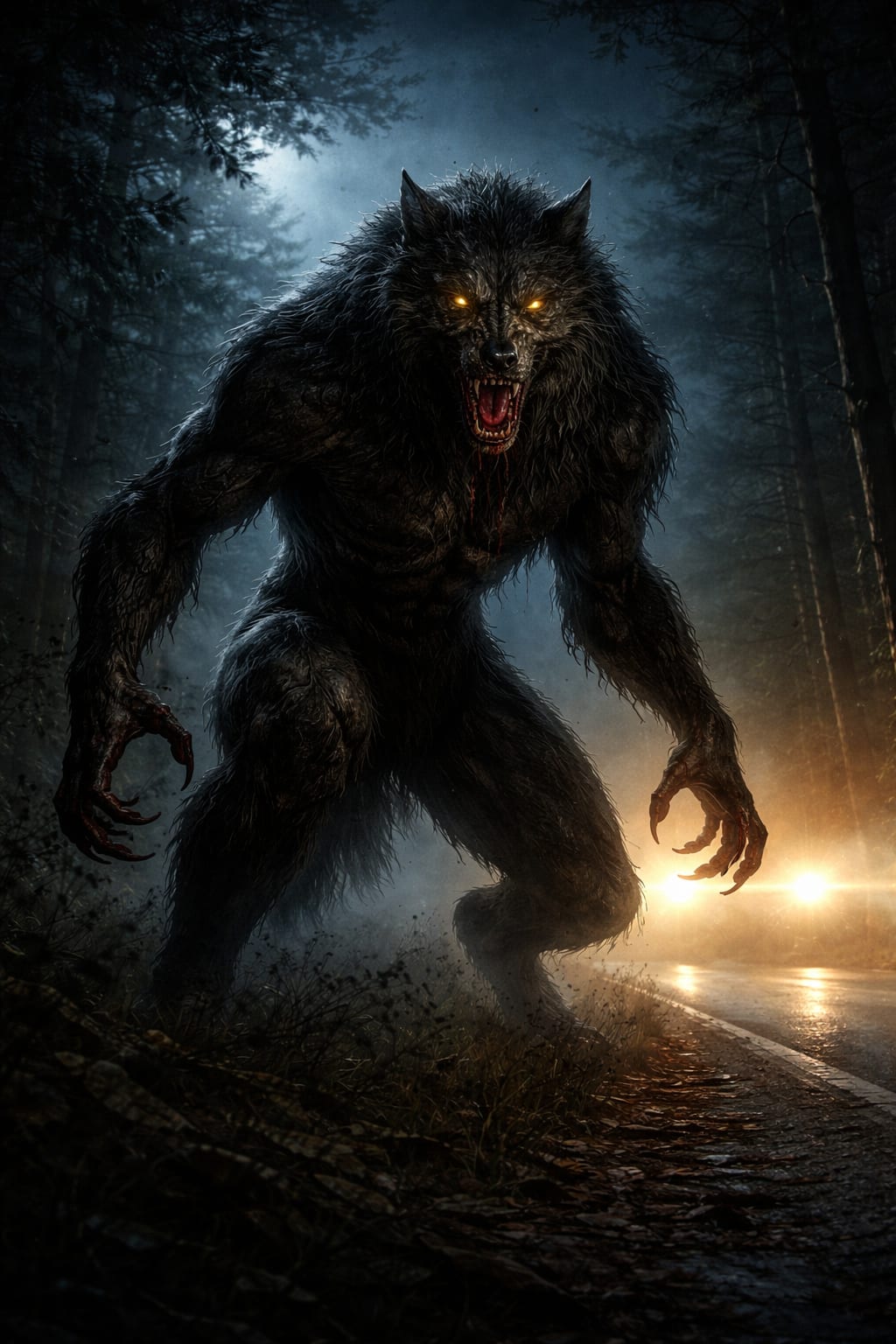
There are roads you take to get somewhere. And then there are roads that seem to take you through the dark, mile by quiet mile, until something at the edge of your headlights makes you wish you'd chosen another route. Bray Road is one of those roads.
It runs just outside the quiet town of Elkhorn, Wisconsin, a narrow corridor of cracked asphalt flanked by trees that lean inward like they're listening. On a map, it's unremarkable. Just another rural stretch connecting farmland to farmland, the kind of road that barely merits a name. But locals know better.
When they talk about Bray Road at all, and many of them choose not to, their stories tend to sound the same. Too similar. Too specific. Too consistent to be a coincidence and too strange to be comfortably explained. They all end the same way. Something is out there. And it walks on two legs.
The Reporter Who Couldn't Walk Away
In the early 1990s, a journalist named Linda Godfrey was handed what sounded like a throwaway assignment. Residents of Walworth County reported sightings of a large, unidentified animal along a rural stretch known as Bray Road. Her editor probably expected a human-interest fluff piece. A quirky rural legend, a few nervous neighbors, maybe a misidentified German Shepherd. A story to fill column inches in a slow news week. What Godfrey found instead would consume years of her life.
The witnesses she interviewed weren't hazy or vague. They weren't drunk college kids or attention-hungry conspiracy theorists. They were farmers, drivers, and ordinary people going about ordinary nights, people who had stumbled onto something they couldn't explain and hadn't asked to see. When she compared their accounts, the details aligned with an unsettling precision.
Different nights. Different stretches of road. Different witnesses who had no contact with one another. Same creature.
What They Saw
The descriptions that emerged from Godfrey's investigation formed a portrait unlike anything in the wildlife record. The creature stood between six and seven feet tall, not hunched, not loping, but fully upright, its frame filling the space between treeline and roadside in a way that no known animal should. Its body was covered in dark, coarse fur, matted and thick. The head was distinctly canine... a long muzzle, pointed ears angled sharply skyward, and eyes that caught the light in a way that headlights don't quite explain: not the flat reflective gleam of deer or raccoon, but something brighter. More aware. More deliberate.
What struck witnesses most was not the size, nor the fur, nor even the head. It was the way the creature moved. Not like an animal making the awkward, compensating effort of walking upright. Not like a bear trying its hind legs. But with the fluid, unhurried ease of something that had always walked this way, something for which two legs were not an adaptation, but a birthright. A steady, controlled stride. Like it belonged there.
The Night It Rose
One woman's account has become the most cited in the Bray Road canon, and for good reason: it strips away all ambiguity. She was driving home late, headlights cutting through the dark, when she spotted a shape crouched at the side of the road. Low to the ground. Still. Her first instinct was human, a man, hunched over something, perhaps injured. She slowed the car. She was preparing to stop. Then it moved.
What rose from the roadside did not stand the way a man stands. It unfolded. Shoulders rolling back, spine straightening, reaching a height that no man could reach. Muscles moved beneath the fur like something massive working beneath the dark water's surface. Its head turned toward her, slowly, deliberately, and its eyes caught the glow of her headlights with that cold, terrible brightness.
Then, without urgency and without panic, it stepped into the tree line. Not fleeing. Not startled. Simply done with being seen. She sat alone on the road for a long moment before she drove away.
Something at the Carcass
If the standing encounters are chilling, the feeding reports are something else entirely. Multiple witnesses described finding the creature not wandering, but kneeling. Crouched over roadkill, tearing into the carcass with an almost methodical thoroughness. It wasn't frantic, the way a scavenging animal is frantic. It wasn't cautious, the way prey animals eat, always ready to bolt. It was unhurried. Focused. It owned the road and everything on it.
When one witness's headlights swept across the scene, the creature did not bolt on all fours. It stood. Wiped its muzzle with the back of a forearm, a gesture so startlingly human that the witness initially questioned whether they had seen an animal at all. Then it walked, unhurried, into the dark.
The detail that lingers isn't the feeding. It's the pause. The deliberate acknowledgment of being watched, and the complete indifference to it.
The Problem That Refuses to Go Away
Skeptics have done what skeptics do. Large wolf, they say. Bear on hind legs. Misidentified shadow. The darkness plays tricks; memory fills in gaps; fear magnifies the unfamiliar. It's a reasonable framework, right up until the details refuse to cooperate.
Bears rise on their hind legs. But bears don't walk on them. Not with that kind of sustained, balanced stride. Bears don't turn their heads with that quality of deliberate attention. Bears don't wipe their muzzles and walk away like something that knows it's being watched and simply doesn't care.
Wolves? Wolves are magnificent animals. But no wolf has ever stood six and a half feet tall on two legs and stepped calmly through a car's high beams as though the driver were the trespasser.
The harder problem, the one that keeps researchers circling this case, is the consistency. Hoaxes degrade. Rumors drift and mutate, gaining embellishments with each retelling, losing precision, sprouting contradictions. That's what false stories do over time.
The Bray Road accounts don't do that. Different people, separated by months or years, with no known connection to each other, describing the same features in the same language: tall, dark fur, canine head, upright posture, unafraid. That's not the signature of a rumor spreading through a community. That's the signature of people describing something real.
Physical Evidence and Its Disappearance
In the aftermath of several sightings, physical evidence was recovered, or nearly recovered. Tracks. Large, canine in general shape, but wrong in one critical way: the stride length. The distance between prints was too great for any four-legged animal, the pressure points consistent with something heavy walking bipedally, not bounding or trotting. Something that applied its full weight with each measured step.
Investigators who examined the impressions noted the abnormality and noted that the prints matched no species in the regional wildlife record. Casts were discussed. Measurements were taken.
And then, as happens with troubling frequency in cases like this, the evidence dissolved. Rain moved through. Time passed. The ground returned to ordinary ground. All that remained were the accounts of the people who had stood over those tracks, staring down, before the world erased them.
Before the Creature - the Silence
Ask enough witnesses about their encounters and a secondary detail emerges, quieter than the sighting itself, but in some ways more disturbing.
Before the creature appeared, before the shape resolved in the headlights, the world went still. Not the ordinary quiet of a rural night, which has its own texture: insects, wind, the distant sounds of farm equipment or highway traffic. This was different. Total. A silence that had weight to it, like pressure behind the ears. The kind of stillness that the natural world produces only in one specific circumstance: when something at the top of the food chain is close. Insects know. Birds know. Every animal with a functioning fear response knows. The silence is not only a warning, but deafening...
Shadows in the Trees
Not all accounts confine themselves to a single creature. Several witnesses have described peripheral movement in the tree line during or after a primary sighting — shapes that didn't quite resolve, that suggested depth and size without committing to a silhouette. Movement where movement shouldn't be, at a scale inconsistent with small woodland animals.
If accurate, this detail opens a door that most researchers find uncomfortable to step through. A solitary cryptid is unsettling. An unknown creature with territory, behaviors, and perhaps social structure, that is something different. That raises questions about what else moves through those woods at night that has never been seen clearly enough to be reported. Bray Road may not be the territory of a lone anomaly. It may be something's home.
The Dogman: Not a Werewolf. Something Worse.
Over time, the Bray Road creature has been categorized as a broader, far older phenomenon: the Dogman. This requires a distinction. The Dogman is not a werewolf. The distinction matters.
Werewolves are a transformation myth. A human cursed to shift form under the full moon, driven mad, restored at dawn. The horror is in the oscillation, in the loss of self, in the tragedy of a person trapped inside a monster.
The Dogman carries none of that narrative comfort. There is no transformation. No curse. No human inside struggling to get out. No moon-dependency, no silver bullet mythology, no reassuring framework that makes the creature an aberration from a normal world. The Dogman simply is.
Part canine. Part human. Entirely itself. A predator that exists outside any taxonomy we've established, not because it's supernatural, but because we may not yet understand what natural actually encompasses. It doesn't fit our categories because our categories were built without accounting for it.
That, in a way, is the most unsettling possibility of all. Not a monster from folklore. Not a misidentified animal. Something real, and coherent, and completely unknown.
The Sightings Never Stopped
The wave of reports that first drew Linda Godfrey's attention eventually subsided. The story moved from local news to the broader world of cryptozoology, generating books, documentaries, and a growing archive of testimony. The media moved on. But the sightings didn't stop.
They became quieter, less frequently reported, less likely to make their way into any record at all. Because what people learned, after watching the public ridicule that followed early witnesses, is what most people already instinctively know: if you see something that shouldn't exist, the safest thing is to say nothing.
The reports that do surface follow the same template. A driver on a late-night road. Something in the headlights. A shape that doesn't belong to any animal they've ever seen. A moment of stillness. And then the dark closes back over it like water over a stone.
Most of those people never file a report. They drive home. They don't mention it to their families. They turn it over privately for years, the way you turn over something that can't be resolved, something that won't quite fit back into the world you thought you understood.
Drive It Yourself
If you want to test what Elkhorn's locals have quietly known for decades, the route is straightforward.
Take Bray Road after midnight. Kill the radio. Roll the windows down and let the air in, cold and carrying the smell of soil and tree bark and something you can't quite identify. Your headlights will reach maybe fifty feet ahead of you. Beyond that: dark. For a while, there will be nothing. Just the road surface, the treeline on either side, the night going about its ancient business. You'll feel slightly foolish. You'll wonder what you were afraid of.
And then, maybe, something at the edge of the light. Low at first. Still. Watching. And as your car draws closer, it rises. Slowly. With terrible deliberateness. To its full height. Eyes bright with that unnatural, non-reflective glow. And in that moment, before it turns and steps into the trees, you'll understand two things that no story quite prepares you for.
The first is that you are being seen. Assessed. Considered as something that has every reason to believe the road belongs to it and not to you. The second is why the people of Elkhorn don't talk about this. Because talking about it makes it more real. And a world where this is real operates by different rules than the one most of us have agreed to live in.
It Was Never Caught. It Was Never Explained. It's Still Out There.
The Beast of Bray Road has never been captured. Never photographed cleanly enough to compel scientific acknowledgment. Never explained to the satisfaction of anyone who has actually studied the case.
But it has been seen, by farmers, by night-shift workers, by teenagers, grandmothers, and people with no interest in cryptids and no desire to become witnesses. People who saw something and then spent years wishing they hadn't. People who still hesitate before driving that road alone after dark.
And somewhere in the stretch of tree and shadow between Elkhorn and the next quiet town, something still moves through the night on two legs. Unhurried. Aware. Patient in the way that apex predators are patient, knowing, without urgency, that it has outlasted every explanation offered for its existence. Waiting... Watching... And completely unbothered by the question of whether you believe in it or not.
Whether you call it the Beast of Bray Road, the Wisconsin Dogman, or simply something that doesn't have a name yet, the encounters continue. And the road is still there, if you're willing to take it...
About the Creator
Veil of Shadows
Ghost towns, lost agents, unsolved vanishings, and whispers from the dark. New anomalies every Monday and Friday. The veil is thinner than you think....
Keep reading
More stories from Veil of Shadows and writers in Horror and other communities.
The Man from Taured: The Traveler from a Country That Doesn’t Exist
Some travelers arrive late... Some arrive early. And then there are those who arrive… from places that don’t exist! In the summer of 1954, a man stepped off an international flight into Tokyo’s Haneda Airport. He carried a suitcase, spoke calmly, and presented a passport like any other traveler. But within minutes, airport officials realized something was wrong. Because, according to his documents, the man was from a country called Taured. A country that had never existed.
By Veil of Shadows10 days ago in Horror
A Visitor's Guide To Victorian England
A Book Review Being interested in all things Victorian, I am constantly looking for books on the Victorian Era. In fact, I should admit that I am obsessed about ‘all things Victorian’. From the clothes worn by men and women, rich or poor, to how they lived, where they lived, what they ate and would (or would not ) drink, what kind of transport there was, who worked where, who went to school (and who didn’t), the list really is endless.
By Ruth Elizabeth Stiff6 days ago in BookClub


Comments
There are no comments for this story
Be the first to respond and start the conversation.