
Life Is Not the Problem. What Happens in It Is
Life is simple at its core while its experiences feel complex unfair and intense. Growth comes from facing those moments honestly then choosing to adapt and move forward.


Life is often described as complex, unpredictable, sometimes unfair. Yet, if we take a step back and observe it with a bit of distance, a paradoxical idea begins to emerge: life itself is simple. It is the things in life that are not.
To be born, to breathe, to feel, to move forward, to die — the fundamental structure of existence doesn’t change. It is universal, almost stripped down to its essence. What complicates everything are the layers we add: social expectations, personal ambitions, fears, comparisons, past wounds. Life itself does not lie. It simply unfolds. The turbulence comes from how we interpret and confront what happens to us.
Saying “life is unfair” is a deeply human reaction. It comes from the gap between what we believe we deserve and what we actually experience. But if we think about it carefully, life has no moral intention. It does not consciously distribute rewards or punishments. It is raw. Neutral. What can be unfair, however, are the circumstances, the events and the human interactions we encounter.
This is where nuance matters: life is not necessarily unfair but the things in life often are. A sudden loss, a betrayal, a failure despite effort — these are not “simple” experiences. They shake us, disturb us and leave marks. And in front of that, it is legitimate to react. To say “fuck this.” To say “go to hell.” To refuse, for a moment, to accept what feels unacceptable.
That reaction is not weakness. On the contrary, it is a sign of being alive. It marks a boundary, an inner resistance against what feels wrong. In simple psychological terms, this is the phase where raw emotion needs to be expressed before any form of rational processing can take place. Ignoring it would mean denying a fundamental part of being human.
But stopping there is not enough. Because after the emotion comes a crucial skill: adaptation.
Adapting does not mean submitting or passively accepting everything. It means recognizing reality as it is, even when it does not match our expectations. It is an active, almost strategic movement. We do not always choose what happens to us, but we do choose what we do with it.
Adaptation is a form of intelligence. It relies on mental flexibility, on the ability to adjust our reference points, our goals, sometimes even parts of our identity. In a constantly changing world, those who move forward are not necessarily the strongest but the ones most capable of transforming themselves.
From a philosophical perspective, this echoes an old idea: it is not the event itself that defines us but our relationship to it. Two people can go through the same situation and draw completely different conclusions. One collapses, the other rebuilds. The difference does not lie in life itself but in the way it is lived.
This does not mean we should minimize pain or pretend that perspective alone can fix everything. Some experiences are deeply impactful, and it would be dishonest to claim that a simple shift in mindset is always enough. But even then, there is always some room to respond. Sometimes small, sometimes significant.
Saying “life is simple” is not an invitation to be naive. It is a reminder: beneath the apparent chaos, there is a stable structure. To breathe. To move forward. To seek meaning. To create connection. Everything else — the complications, the obstacles, the injustices — belongs to the things in life. And those, indeed, can be profoundly complex.
So we complain. We push back. We use harsh words. And then, little by little, we adjust.
Because in the end, living is not about avoiding difficulty, but about learning how to navigate through it.
About the Creator
Baptiste Monnet
Baptiste Monnet is a freelance author and thought leader. Focusing on social impact, he examines how personal growth and professional development drive meaningful change in today’s world.
Keep reading
More stories from Baptiste Monnet and writers in Humans and other communities.
The Fragile Balance of Inner Silences
Nowadays, it almost seems inappropriate not to be doing well. As if lucidity had to remain silent in favor of a constant, polished, presentable optimism. We are told to look on the bright side, to smile no matter what, to move forward without trembling. And yet, there exists a quieter, less comfortable truth: the one that admits we can falter without giving up, that strength does not always reside in light, but sometimes in the ability to remain standing within a grey zone.
By Baptiste Monnet12 days ago in Humans
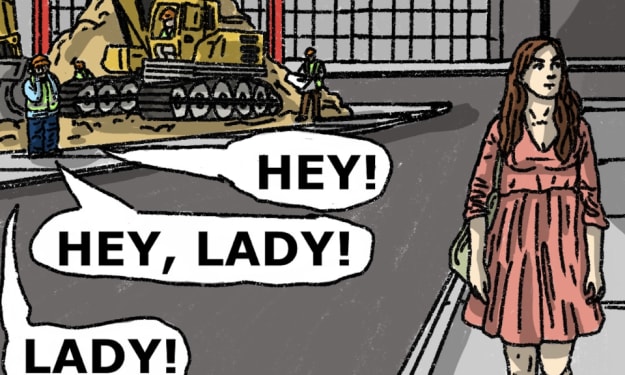
getting catcalled on is more confusing and annoying than it is scary.
So One time I was on a run, and I think I was trying to find the usual place where my team worked out but I got lost...cuz u know I have like no sense of direction...eventually I gave up trying to find the place and so I just started walking right? So I was thinking about going into target right? And thats when a car in the in and out drive thru line, they open their window and say "Hi kiddie" and I was like "Hi?" and in my mind I was like who the fuck says "Hi kiddie Hi kiddo" thats like confessing your a pedophile. And when I said Hi, they just laughed and closed their window, like no explanation or anything. So then after five minutes of thinking about it, it hit me. Ohh he was saying "ki-Tty" not "kiddie" like as in "hi pussy" ohhhhhhhhh. And I was like damn it why'd I say hi back I should've just stayed silent. But the thing is here was that it wasn't even scary or anything because I didn't even know I was being catcalled on I thought they were just saying hi to say hi to a kid running.
By Nicole Leeabout 8 hours ago in Humans
Side Quest Goal Achieved: Placing an Alien Claim
This is a post that has me quite ecstatic. It's funny, I thought it was going to be one of my usual, "Hey, I achieved another one of my goals and checked it off" type deals. And it sort of is. But it sort of isn't. And it's also one of my greatest writing accomplishments of late.
By Stephen Kramer Avitabile4 days ago in Writers


Comments