
Mockery, Judgment, and the Way We Treat People


Mockery has been part of human behavior for as long as people have gathered in groups. It shows up in ancient texts, public rituals, political life, and entertainment. It is not a new problem, and it is not unique to the modern world. What has changed is the reach and speed with which cruelty can spread. Social media has been around long enough now to shape entire generations, and it has turned public humiliation into a daily practice. People can mock someone they have never met, never spoken to, and never seen in person, and they can do it with no sense of consequence. The distance between the speaker and the target creates the illusion that the target is not fully human. Fame becomes a shield that people believe gives them permission to say anything they want. But fame does not erase vulnerability, and it does not protect anyone from the impact of ridicule.
Mockery is not harmless. It is a form of judgment, and judgment is something the Bible treats with caution. Even when we disagree with someone, even when we see hypocrisy or corruption, we are not given permission to attack their dignity. Calling out harmful behavior is one thing. Condemning a person’s worth is another. One is accountability. The other is judgment, and judgment does not belong to us. The Bible makes this distinction repeatedly, and it does so because human beings have a long history of confusing righteous judgment with personal condemnation.
People often point to certain passages in scripture as justification for sarcasm or ridicule. They claim Jesus mocked the Pharisees, so it must be acceptable. But that interpretation reflects human ego more than divine intention. Jesus confronted systems that harmed people. He exposed corruption. He challenged those who used religion as a shield for their own power. But He did not belittle individuals for amusement, and He did not model cruelty as a form of righteousness. Over time, some of His words have been interpreted in ways that make people feel justified in mocking others. That does not mean the interpretation is correct. It means human beings have always been skilled at bending scripture to fit their own impulses.
The Bible contains satire, but it is not the kind of satire people use today. Biblical satire is directed at hypocrisy, injustice, and the misuse of power. It is not directed at someone’s appearance, personal life, or private struggles. It is not used to humiliate someone for entertainment. It is not used to elevate the speaker by tearing someone else down. When the prophets used sharp language, they did it to expose systems that harmed the vulnerable. They did it to call people back to integrity. They did it to confront leaders who had abandoned their responsibilities. They did not do it to score points or gain applause.
Jesus’ confrontations with the Pharisees are often cited as examples of mockery, but a closer reading shows something different. His words were direct, but they were not cruel. He named their behavior, but He did not attack their humanity. He challenged their actions, not their worth. He confronted their misuse of authority because it harmed the people they were supposed to serve. His purpose was correction, not humiliation. The idea that Jesus mocked people for sport is a misunderstanding shaped by human tendencies, not divine example.
Mockery is a form of judgment because it places the speaker above the target. It says, “I am better than you,” even if the words are disguised as humor. It reduces the target to an object. It strips away dignity. It treats someone’s life as entertainment. And it does all of this without acknowledging the full complexity of the person being mocked. The Bible warns against this because it damages both the speaker and the target. It hardens the heart of the one who mocks, and it wounds the one who is mocked. Even if the target is famous, wealthy, or powerful, the impact is real. Public visibility does not erase private pain.
The rise of social media has made this problem more visible, but it did not create it. People mocked public figures long before the internet existed. Ancient Roman crowds jeered at gladiators and performers. Medieval courts used jesters to ridicule the vulnerable. Newspapers in the nineteenth century built entire industries on public humiliation. The difference today is that the audience is global, and the cruelty is permanent. A single comment can be shared, repeated, and amplified thousands of times. The target may never escape it. The speaker may never face consequences. The imbalance is profound.
The Bible’s warnings about judgment are not abstract. They are practical. They recognize that human beings are quick to condemn and slow to understand. They recognize that people often use judgment to elevate themselves. They recognize that judgment can become a habit, and that habit can shape a person’s character. When Jesus said, “Judge not, that you be not judged,” He was not telling people to abandon discernment. He was telling them to abandon condemnation. He was telling them to stop using judgment as a weapon. He was telling them to stop assuming they understood the full truth of someone else’s life.
Righteous judgment is not ridicule. It is clarity, integrity, and truthfulness. It is the ability to see a situation without cruelty. It is the ability to call out harmful behavior without attacking the person. It is the ability to hold someone accountable without stripping away their dignity. It is the ability to speak truth without using that truth to wound. The Bible calls this kind of judgment wisdom. It calls it discernment. It calls it justice. It does not call it mockery.
Mockery does not correct hypocrisy. Sarcasm does not heal corruption. Ridicule does not bring truth to light. These behaviors may feel powerful in the moment, but they do not create change. They do not elevate anyone. They do not strengthen communities. They do not bring people closer to understanding. They only harden the heart of the one doing them. They create distance, not clarity. They create division, not accountability.
The danger of mockery is not only what it does to the person being mocked. It is what it does to the person who chooses to mock. It shapes the speaker into someone who sees others as objects. It trains the mind to look for flaws. It encourages the heart to take pleasure in someone else’s pain. It builds a habit of superiority. And once that habit is formed, it becomes difficult to break. The Bible warns against this because it erodes compassion. It erodes humility. It erodes the ability to see others as human beings.
Celebrities are easy targets because they are visible. Their lives are public. Their mistakes are magnified. Their struggles are documented. But visibility does not erase humanity. A person can be famous and still feel pain. A person can be wealthy and still feel humiliation. A person can be admired and still feel alone. The idea that fame protects someone from the impact of mockery is a convenient fiction. It allows people to say things they would never say to someone standing in front of them. It allows them to forget that the target is a person with a history, a family, and a private life.
The Bible’s teachings on love and respect are not sentimental. They are practical instructions for how to live in community. They recognize that people will disagree. They recognize that people will fail. They recognize that people will act in ways that cause harm. But they also recognize that cruelty does not correct harm. They recognize that compassion is not weakness. They recognize that dignity is not optional. They recognize that judgment, when used carelessly, becomes a form of violence.
We can disagree without dehumanizing. We can call out wrongdoing without tearing someone apart. We can hold to the teachings we claim to believe without using them as a shield for behavior that contradicts them. The Bible does not ask us to ignore corruption. It does not ask us to pretend that harmful behavior is acceptable. It asks us to confront these things with integrity. It asks us to speak truth without cruelty. It asks us to remember that every person, even the ones we disagree with, carries the image of God.
Mockery is not discernment. Cruelty is not strength. And judgment is not our job.
References
Holy Bible, Matthew 7:1–5.
Holy Bible, Matthew 23.
Holy Bible, Luke 6:37.
Holy Bible, James 4:11–12.
Holy Bible, Proverbs 11:12.
Holy Bible, Proverbs 17:5.
Holy Bible, Romans 14:10–13.
Holy Bible, Galatians 6:1.
About the Creator
Julie O'Hara - Author, Poet and Spiritual Warrior
Thank you for reading my work. Feel free to contact me with your thoughts or if you want to chat. [email protected]
Keep reading
More stories from Julie O'Hara - Author, Poet and Spiritual Warrior and writers in Humans and other communities.
The Fifth Anniversary of a Life I Almost Lost
Five years ago today — April 1, 2021 — my life split in two. Late that night, driving home to Plano, Texas from Houston, Texas, I was involved in a violent car accident that fractured my T7, shattered five ribs, cracked my sternum, broke my nose, and left both of my eyes blackened. The police report estimated the impact at 11:11 p.m. — a detail that still lands with a strange, unmistakable weight.
By Julie O'Hara - Author, Poet and Spiritual Warrior2 days ago in Humans
Why Wicked: For Good is Undeservingly the ‘worse movie’
So… off the bat, we’re about to delve into something ridiculous. Just so we’re clear on that, ok? The first thing anyone that knows a thing about these dual movies… knows… is the original movie and sequel were shot together.
By Gabriel Shames5 days ago in Humans
Elderly Woman Behind the Table in a Large Town
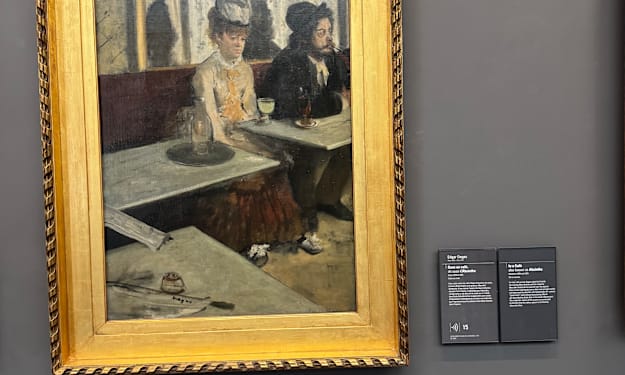
The glass of Absinthe sat before me. It’s quite amazing how despite such terror rendered upon their stones in the preceding decades, these streets still held the beauty I first read about as a girl. I never dreamed I’d set foot on these cobbles, at least not safely.
By Matthew J. Fromma day ago in Art


Comments
There are no comments for this story
Be the first to respond and start the conversation.