
The Black Scotland I Never Knew
For Sam Spinelli's inspiring Unofficial Challenge: Black History Celebration


As most will know who follow my work, I’m rather fond of being Scottish. While it’s not a kind of horrific patriotism that puts other nations down, it is a sense of pride that I was born here.
One of the many things (and there are many—which may be ironic really, but don’t we have as many complaints about the places we love as things we love?) that wrong-footed me in life was the fact that, in the small suburban town of Stepps, outside Glasgow, where I spent most of my formative years, there weren’t many Black people. I was raised Catholic, went to Catholic school for both primary and secondary, and most people I encountered were Scottish white or Western European white.
I learned about Black people and Black culture from television, music, films, and books. I loved hip-hop, Eddie Murphy, Spike Lee, John Singleton, Jimi Hendrix, and far too many others to mention. But I had very little real-life experience, year to year, with Black people in my life, which I find rather strange—but it is what it is.
So when approaching this, rather than choosing some of the big names, I thought I would educate myself on some Black Scottish people of importance and what they achieved.
Joseph Knight (fl. 1769–1778)
Joseph Knight was born in Guinea, the general name once used for West Africa. He was seized as a slave and taken to Jamaica, where he was sold to a Scottish man known as John Wedderburn of Ballindean. He first served in Jamaica and then, when Wedderburn returned to Scotland, Knight went with him.
In Scotland, he was baptised and married another servant of the Wedderburn household, called Ann Thompson.
Knight requested permission to live with his wife as a family, but this was refused. He then chose to leave the Wedderburns’ service, which angered Wedderburn, who saw it as unappreciative and disrespectful after all he had done for Knight. So he had him arrested.
I know, right? Insane. Fancy someone wanting to live with their wife.
Hang him immediately.
Unfortunately for Wedderburn, this didn’t turn out quite how he likely thought it would.
Although it was a lengthy legal battle, in which Knight objected to Wedderburn’s claims that he was his permanent property, the local courts in Perth, and then the Court of Session in Edinburgh, ruled that slavery was not compatible with Scottish law, and he was granted his freedom. The case was then used as a clear denunciation of slavery and became a turning point in its abolition in Scotland.
Jackie Kay (born November 9th, 1961)
From legal battles over freedom to questions of identity and belonging, Joseph Knight leads me nicely into Jackie Kay. Jacqueline Margaret Kay is a Scottish poet, playwright, and novelist who was born in Edinburgh.
She was born to a Scottish mother and Nigerian father, and then adopted by a Scottish couple, who also adopted her brother.
She is notable for a number of reasons, but primarily for her exploration of what might be considered the “in-between spaces” of identity. Much of her work draws on her own experiences as a Black child adopted by white Scottish parents.
Intersectionality is a huge part of her work, as she addresses her own intersections as Black, adopted, Scottish, and lesbian. Her work, in terms of published poetry collections, novels, and her academic and activist roles, challenges traditional, often white-focused ideas of Scottishness.
She was given the honour of serving as the Makar, or national poet of Scotland, from 2016 to 2021.
Her writing voice is also notable for her goal of keeping older languages alive by using Scottish dialect and a Glaswegian lilt, blending them with standard English and Igbo influences.
As is the case with most in this piece, I was unfamiliar with Jackie Kay beyond knowing her name and that she was a writer. Needless to say, I will be investing in some of her books.
Notable works include: The Adoption Papers (1991), Trumpet (1998), Other Lovers (1993)
Maud Sulter (September 19th, 1960 – February 27th, 2008)
Sticking with the world of the creative arts, I want to highlight another African-Scottish woman, Maud Sulter.
Maud was a Scottish writer, poet, contemporary fine artist, photographer, educator, cultural historian, feminist, and curator of Ghanaian heritage.
She was born to a Scottish mother and Ghanaian father, and played a crucial part in the Black British Arts Movement. She is most notably recognised for putting Black women back at the centre of things. She challenged the historical erasure of Black women in Western photography and art.
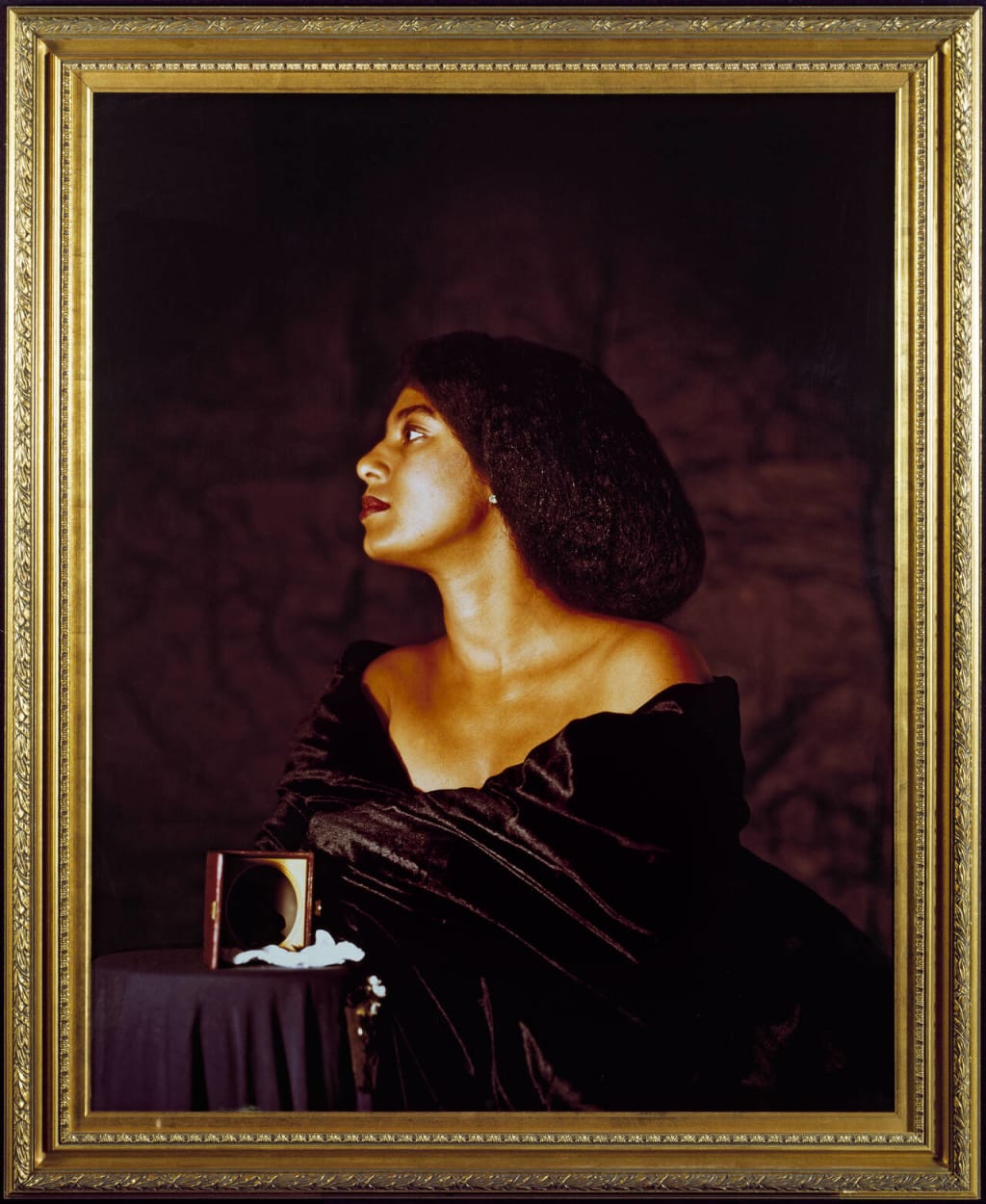
Her most famous work is arguably Zabat (1989). This was a series of nine large photographic portraits that depicted contemporary Black women taking on the roles of the nine Muses from Greek mythology. It was created to celebrate the anniversary of photography and was a direct challenge to the lack of a Black presence in visual art institutions.
She also made strides to decolonise art history. With Twa Blak Wimmin, a photomontage from 1997, she highlighted the presence of Black women in the 16th-century court of King James IV of Scotland. This contests the long-held, racist belief that Black presence in Scotland and the wider UK is a recent phenomenon.
She used her position, influence, and art to redefine Scottish identity, calling out what she saw as a quieter, more insidious racism in Scottish society, and pushing for Black Scotland to be recognised. She often drew comparisons between Ghanaian and Scottish culture, seeing both as shaped by diaspora and long cultural memory.
She passed away at 47 in 2008 after a long illness, but leaves behind an impressive and important legacy.
Notable works include: Zabat (1989), Syrcas (1993), Twa Blak Wimmin (1997), As a Blackwoman (1985)
Emeli Sandé (born March 10th, 1987)
Next, it’s Emeli Sandé, a British singer-songwriter who was born in Sunderland, England, but was brought up in Alford, Aberdeenshire. She is one of Scotland’s most successful female artists.
Her debut album, Our Version of Events, was released in 2012 and was the biggest-selling UK album of both 2012 and 2013. The album spent a total of 63 weeks in the Top 10, breaking a record that The Beatles had held for 50 years.
As she was the only Black child in her school class in Alford, she has spoken openly about how isolated she felt and the racism she faced.
Her success makes her a high-profile representative of Black Scotland.
Notable works include: Our Version of Events (2012), Long Live the Angels (2016), How Were We to Know (2023), How Were We to Know (2023).
Sir Geoff Palmer (April 9th, 1940 – June 11th, 2025)
Another important figure in Black Scottish history is the pioneering scientist Sir Geoff Palmer. Though he was born in Jamaica, he later moved to London as a teenager to live with his mother, and eventually settled in Edinburgh, where he served as a professor emeritus at Heriot-Watt University in the School of Life Sciences.
As well as being a foremost expert in grain and brewing science, he invented the barley abrasion process. He was also the first Black person to serve in a professorial role in Scotland.
A member of the Windrush generation, he was vocal about the various barriers he faced because of his background, and advocated on behalf of Black and minority students.
He used his position further to become a crucial voice in uncovering the historical links Scotland had to the transatlantic slave trade. He famously argued that “we cannot change history, but we can change the consequences of history through education.”
He was the chairperson of the Edinburgh Slavery and Colonialism Legacy Review Group, and led a successful campaign to have a plaque added to Edinburgh’s Melville Monument. The additional plaque provides a more honest recontextualisation of the role Henry Dundas played in delaying the abolition of slavery.
Sir Geoff also served as an Honorary President of ELREC (Edinburgh and Lothians Regional Equality Council). In this role, he spent decades working to tackle discrimination throughout Scottish society.
He was awarded a knighthood in 2014 for his contributions and services to human rights, science, and charity.
What I Learned
From researching and writing this piece, I learned that perhaps it wasn’t just my own experience growing up in what felt like a predominantly white Scotland. Fortunately, thanks to the amazing people highlighted above, Black Scotland enjoys better and stronger representation, with much of the whitewashing of the past being challenged and, in some cases, reversed.
Black Scotland was never absent—just absent from my view.
*
Thanks for reading!
Author's Notes: This is for Sam Spinelli's inspiring Unofficial Challenge: Black History Celebration, which you still have plenty of time to enter.
About the Creator
Paul Stewart
Award-Winning Writer, Poet, Scottish-Italian, Subversive.
The Accidental Poet - Poetry Collection out now!
Streams and Scratches in My Mind coming soon!
Keep reading
More stories from Paul Stewart and writers in Humans and other communities.



Comments (19)
Congratulations on top story and the wealth of information you contributed to the audience!!
Congratulations
very informative - Emily Sande is brill!
I'm sorry I missed this when you posted it. I knew it was coming out and I was watching for it, I thought. But I'm just barely seeing it, and as Top Story! (Yay!) You did a wonderful job with this. You addressed the topic with reverence and humility without shaming your reader. You simply celebrated several amazing people who have had to overcome a history of hatred. I love that you chose less known figures from your own beloved country. Maybe I'll still have time to put together something for this. I already know who I'll write about. I suppose even if I don't write it on time for Sam's challenge, I should still write it. These voices all need to be heard.
Thank you for this informative story
Thank you for this, Paul. I went down a Zabat rabbit hole and enjoyed the portraits.
Congratulations on Top Story. I love Jackie Kay's work and have been fortunate to hear her read her poetry and excerpts from her autobiography Red Dust Road. She is a really warm presence. ❤️
Excellent piece. Thanks for sharing, Scottish beverage industry itself probably owes a lot to Geoff Palmer for revolutionising the barley process, as we know this is a major part and identity of Scottish culture. I lived up in Scotland briefly in Glencoe for 3 years and worked at the Glencoe SYHA, I was also one of the very few Ethnic minorities in the area but it did not make any difference into my everyday life and I was treated as respectfully and equally as anyone, but lets face it if you are tough enough to live all year round in Highlands you gain the respect of the locals either way.
Very admirable of you to put this together. I'm terrible when it comes to knowing history outside of where I live. This opened my eyes to many great people doing amazing things.
WOW I am a member of the Scottish Night's Templar. I have no idea what that means. We are fighting in a distant land? During my cancer they initiated me. LOL
This is awesome, thank you for sharing it with us.
I love how you explore your own experiences while highlighting the incredible contributions of Black Scots throughout history and today. It’s inspiring, educational, and really makes me want to learn more about these amazing figures.
Brilliant introspection my friend. I applaud you for your self awareness. I should spin something up for this challenge
nice and informative-being in Canada we have a diverse place so the history is rich
Thank you for sharing your country’s Black History. Interesting. I was very lucky, I went to a Catholic School as well but we had a diverse class. We had Asian Indian, Italian, Scottish, Latinos, Canadian, Black, and Russian etc. It was normal for me. I love learning more about Scottish culture . I love Scottish accents. I think that’s why I love interviewing people. I just love learning about people in general. Thanks again.
Well done!! I learned about some folks I was previously unfamiliar with.
Wonderful information! Thank you for sharing - I’m looking forward to checking out Jackie Kay
Excellent historical piece, especially for me. I am Scottish as well (my original surname is Johnston), but I’ve never been to Scotland. So this was a treasure trove for my learning. This reminds me of James Baldwin’s 1953 essay, “Stranger in the Village,” about his experience being the only black person in this Swiss town. It’s amazing how segregated places were not so long ago. Anyway, thanks for the read. I’m partaking in some of Jackie Kay’s work. Phenomenal.
Thanks for this Paul. Very informative and now found a new singer I just added to my Spotify playlist. Emeli Sande's voice is amazing.