
Home Infusion Is Changing Healthcare Forever
Why more patients are choosing treatment at home over hospitals
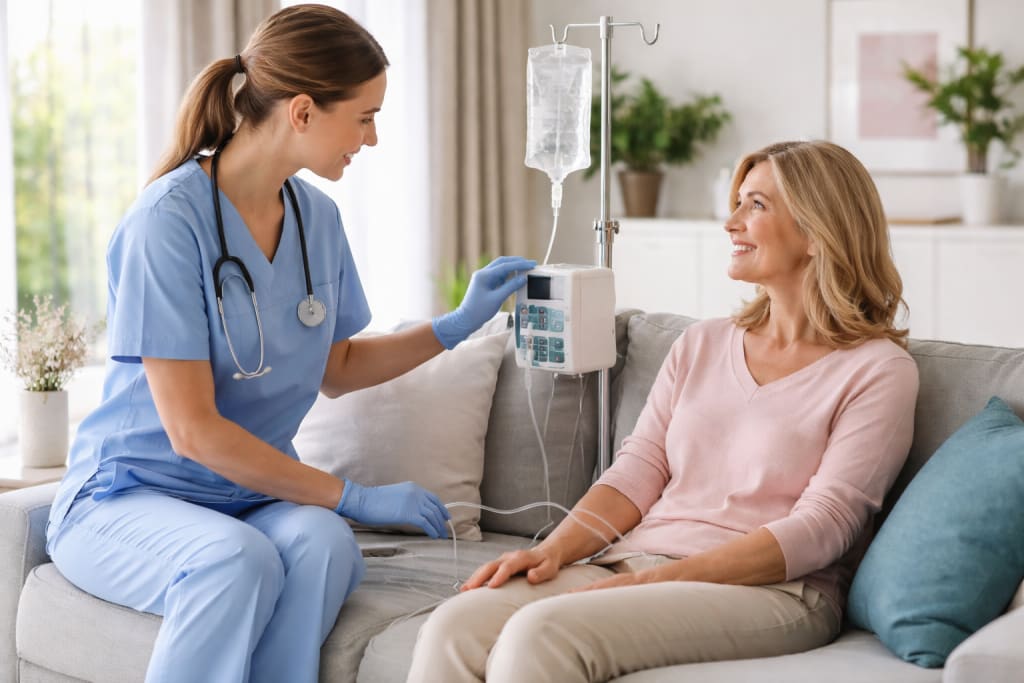
The IV line dripped slowly, almost rhythmically, as sunlight filtered through the living room curtains. No hospital alarms. No crowded waiting areas. Just the quiet hum of everyday life.
For the patient sitting comfortably at home, this wasn’t just treatment—it was freedom.
A decade ago, this scene would have been rare. Today, it’s becoming increasingly common as healthcare begins to move beyond hospital walls. Home infusion therapy is quietly redefining what treatment looks like, blending clinical precision with the comfort of home.
The Shift Patients Didn’t Know They Needed
For years, healthcare followed a predictable pattern: diagnosis meant hospital visits, treatments meant clinical settings, and recovery often came with disruption.
But something changed.
Patients began asking questions:
- “Can IV therapy be done at home safely?”
- “What treatments are available through home infusion?”
- “Is home-based care as effective as hospital care?”
- The answers are reshaping the entire system.
Home infusion allows patients to receive medications—such as antibiotics, chemotherapy, hydration, and nutrition—through intravenous or subcutaneous methods without prolonged hospital stays.
According to Mordor Intelligence, the home infusion market size in 2026 is estimated at USD 27.58 billion, growing from 2025 value of USD 25.99 billion with 2031 projections showing USD 37.12 billion, growing at 6.12% CAGR over 2026-2031, driven by increasing demand for cost-effective care, rising chronic disease prevalence, and a strong shift toward patient-centric healthcare delivery. The market is expected to register a notable CAGR during the forecast period, reflecting rapid adoption across global healthcare systems.
This growth is not just about convenience—it’s about necessity.
When Comfort Becomes Clinical Advantage
There’s something powerful about healing in a familiar space.
At home, patients experience:
- Reduced stress and anxiety
- Better emotional well-being
- Lower exposure to hospital-acquired infections
- Greater involvement from family members
These aren’t just comfort factors—they directly impact recovery outcomes.
Imagine receiving long-term antibiotic therapy while sitting in your favorite chair. Or undergoing nutritional infusion while surrounded by loved ones instead of sterile hospital walls.
The difference is profound.
Home infusion transforms treatment from an isolated medical event into an integrated part of daily life.
Technology Behind the Transition
Behind the simplicity of home infusion lies sophisticated technology.
Modern systems include:
- Portable infusion pumps with precise dosage control
- Smart monitoring devices that track patient vitals
- Telehealth integration for real-time physician oversight
- Safety mechanisms to prevent dosage errors
This technological backbone ensures that home-based care is not only convenient—but also safe and reliable.
AI-driven search trends highlight growing interest:
- “How do portable infusion pumps work?”
- “Is home infusion therapy safe for chronic illness?”
- “Benefits of home healthcare vs hospital treatment”
The answers consistently point toward one conclusion: home infusion is not a compromise—it’s an evolution.
Who Benefits the Most?
The reach of home infusion therapy is expanding rapidly across patient groups.
It is especially beneficial for:
- Individuals with chronic illnesses requiring long-term medication
- Cancer patients undergoing chemotherapy
- Patients needing post-surgical care
- Elderly individuals with mobility challenges
- Pediatric patients requiring specialized treatments
For these groups, frequent hospital visits can be physically and emotionally exhausting.
Home infusion changes that equation.
It reduces travel, minimizes disruption, and allows patients to maintain a sense of normalcy—even during intensive treatment.
Redefining Healthcare Economics
Beyond patient experience, home infusion is also reshaping healthcare economics.
Hospital stays are expensive—not just for patients, but for healthcare systems as a whole.
By shifting appropriate treatments to home settings:
Healthcare costs can be significantly reduced
Hospital resources can be allocated more efficiently
Patient throughput can improve
This makes home infusion a strategic solution, not just a clinical one.
Governments and healthcare providers are increasingly recognizing its value, accelerating adoption across regions.
The Human Side of Healing
Perhaps the most overlooked aspect of home infusion is its emotional impact.
Hospitals, despite their importance, can feel overwhelming. The constant noise, unfamiliar environment, and lack of privacy can add stress to an already difficult situation.
At home, healing feels different.
Patients regain control over their environment. They can rest better, eat comfortably, and stay connected with family.
This emotional stability often translates into better adherence to treatment and improved overall outcomes.
Healthcare is no longer just about treating illness—it’s about supporting the whole person.
What the Future Looks Like
The future of the Home Infusion Market is deeply connected to broader healthcare trends.
We are moving toward:
- Fully integrated home healthcare ecosystems
- AI-powered remote monitoring systems
- Personalized infusion therapies tailored to individual needs
- Expansion of telemedicine for continuous care
Imagine a future where your treatment plan is managed digitally, monitored remotely, and delivered seamlessly at home.
This is not a distant vision—it’s already unfolding.
A Quiet Revolution with Loud Impact
Home infusion doesn’t come with dramatic headlines or breakthrough announcements.
Its impact is quieter—but no less powerful.
It’s in the patient who no longer dreads hospital visits.
In the family that can stay together during treatment.
In the healthcare system that becomes more efficient and accessible.
This is what transformation looks like—not always loud, but deeply meaningful.
Final Thoughts: Where Would You Choose to Heal?
The shift toward home infusion raises an important question—one that goes beyond technology and market growth.
If given the choice, where would you prefer to receive care?
In a hospital room filled with uncertainty,
or in the comfort of your own home, surrounded by familiarity and support?
As healthcare continues to evolve, the answer seems increasingly clear.
But the real question is:
Are we ready to fully embrace a future where healing begins at home?
Despite these challenges, the future of the Home Infusion Market remains highly promising. As healthcare continues to evolve toward personalized and decentralized models, home infusion therapy is expected to play a central role in bridging the gap between clinical excellence and patient convenience.
Ultimately, the growth of this market reflects a broader transformation in healthcare—one that prioritizes not just treatment outcomes, but also the overall patient experience.
About the Creator
Author’s Advice
If you would’ve asked me 20 years ago did I know I’d become a writer and an author, I would’ve said “nope, ain’t happening”. As fate would have it I did become an author and I can honestly say I’m loving it so far. It really does feel good to be a writer. I’ve learned a lot on this journey and I feel like with even me being as new to this world as I am, there’s some wisdom I need to share with every other aspiring author.
By Joe Patterson19 days ago in Journal



Comments
There are no comments for this story
Be the first to respond and start the conversation.