
Why Your Office Building Is Becoming a Power Plant ?
The quiet revolution in commercial distributed energy generation is rewiring how businesses think about electricity - and profit.
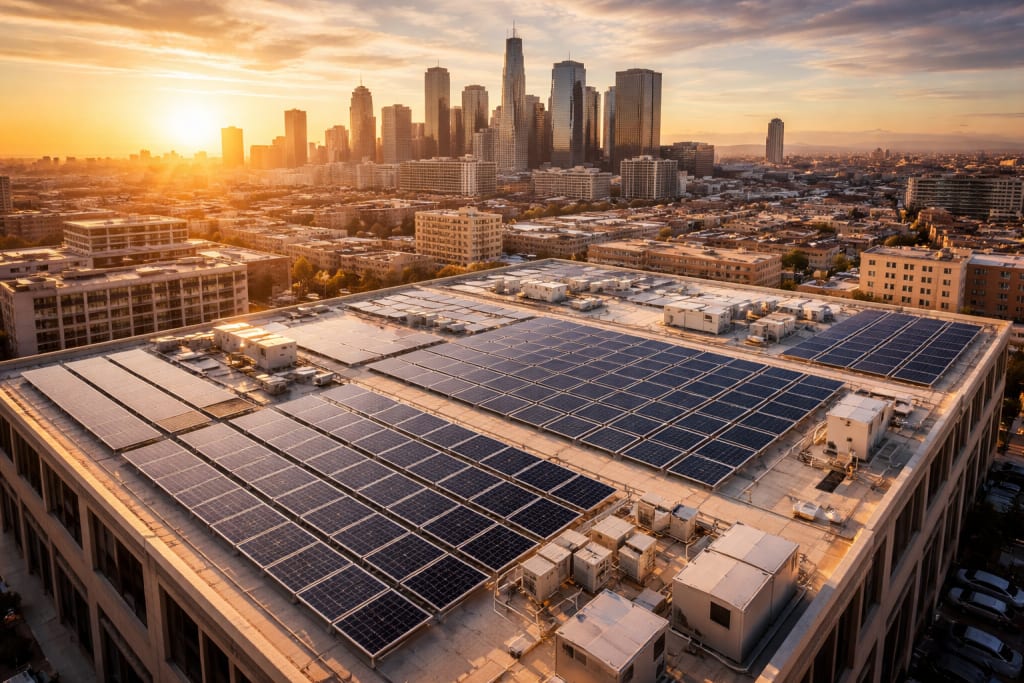
The electricity bill arrived on a Tuesday, like it always does. But this time, the CFO of a mid-sized logistics firm in Phoenix didn't flinch. She smiled. The number on that bill - after months of watching her building's rooftop solar array soak up the desert sun and push surplus electrons back into the grid - was negative. Her office building was no longer just overhead. It had quietly, methodically, become a source of revenue. A power plant wearing a corporate address.
This is not a Silicon Valley fantasy reserved for tech giants with billion-dollar sustainability budgets. It is happening across commercial real estate, retail chains, hospital networks, data centers, and airport hubs on every inhabited continent. The phenomenon has a name -commercial distributed energy generation - and its scale is no longer a projection. It is a measurable, accelerating reality reshaping how business itself is powered.
- From Cost Center to Power Center
The old model was simple and expensive: a utility company burned fuel somewhere far away, sent electrons down aging wires, and charged you for the privilege of powering your lights. Businesses had no say, no leverage, and no alternative. That era is ending - not with a press release, but with millions of quiet decisions made on rooftops, in parking lots, and in equipment rooms across the world.
Distributed energy generation means producing electricity close to where it's consumed. Solar panels on warehouse roofs. Wind turbines on corporate campuses. Fuel cells humming in hospital basements. Battery storage systems absorbing excess midday solar and releasing it during evening peak-price windows. Each system is modest in isolation. Together, they are reshaping the commercial distributed energy generation market share in ways even utilities are scrambling to understand.
- The Solar-Storage Combination That's Changing the Math
According to Mordor Intelligence data, solar PV is set to register a 14.6% CAGR through 2030 - making it the fastest-growing technology segment within the commercial distributed energy generation market size projections. The reason is elegantly simple: the cost to install a commercial-scale solar array has dropped so dramatically that in over 140 countries, generating your own solar power is cheaper than buying from the utility. Pair that with a battery storage system and you've built an arbitrage machine - charge cheap, discharge expensive, print savings.
Fuel cells, meanwhile, currently lead in revenue share at 37.9% of the commercial distributed energy generation market, offering the kind of always-on reliability that solar, with its nighttime and cloudy-day limitations, cannot match alone. For hospitals that cannot afford a millisecond of downtime, or data centers running AI workloads around the clock, fuel cells aren't an option - they're a necessity.
- Fuel cells: highest reliability, all-weather operation, hydrogen-transition pathway
- Solar PV: fastest cost decline, most scalable deployment, highest CAGR forecast
- Battery storage: the integrating layer that turns intermittent generation into dispatchable power
- Combined Heat and Power (CHP): thermal recovery doubles the efficiency equation for manufacturers
- Wind turbines: lower-wind innovations opening campus and industrial sites previously deemed unsuitable
Mordor Intelligence confirms the five major players: Siemens AG, Schneider Electric, General Electric (GE Vernova), Caterpillar Inc., and Bloom Energy are the major companies operating in the commercial distributed energy generation market.
The Asia-Pacific region currently commands 45.5% of the commercial distributed energy generation market share globally, driven by aggressive government mandates and a manufacturing ecosystem that has driven component costs to historic lows. North America and Europe are accelerating fast behind, pushed by corporate net-zero pledges and energy security anxieties that the past few winters have made viscerally real.
But here's the question worth sitting with: if your competitor's building is already producing its own electricity - cutting overhead, insulating against utility price spikes, and earning green credentials that attract clients - what does your energy strategy say about your business strategy?
- Applications: The Sectors Driving Demand
Data centers account for 20.1% of the commercial distributed energy generation market share by application - a figure that will only grow as AI infrastructure requires ever-more-reliable, ever-cleaner power. But the sleeper story in the Mordor Intelligence data is warehouses and logistics centers, forecast to expand at a 15.8% CAGR through 2030. The e-commerce explosion has built millions of square meters of flat, sun-drenched rooftop space across suburban logistics parks — and forward-thinking operators are turning that idle real estate into power plants.
Hospitals, airports, educational institutions, retail chains - each sector has its own economic logic for embracing distributed generation. For retail, it's margin protection against utility volatility. For educational institutions, it's budget certainty over multi-decade planning horizons. For airports, it's resilience: a grounded flight costs more per hour than most small businesses earn in a month.
Conclusion
The buildings that generate their own power are not the future of commercial real estate. They are, quietly and without ceremony, already the present. The only question any business leader needs to answer now is the same one that CFO answered three years ago, on a Tuesday afternoon, looking at a rooftop that everyone else was still using only for HVAC units and drainage pipes
About the Creator
Keep reading
More stories from efingutthomas and writers in Journal and other communities.
Why Your Roof is Quietly Killing the Planet ?
Stand on any rooftop in Phoenix, Chennai, or Lagos on a summer afternoon and you will feel it before you see it - a wall of radiated heat bouncing off the black asphalt beneath your feet, hot enough to fry an egg, hot enough to push the ambient air temperature of an entire neighborhood two degrees higher than the surrounding countryside. You didn't build the heat island. But you're living inside one.
By efingutthomas5 days ago in Journal
Author’s Advice
If you would’ve asked me 20 years ago did I know I’d become a writer and an author, I would’ve said “nope, ain’t happening”. As fate would have it I did become an author and I can honestly say I’m loving it so far. It really does feel good to be a writer. I’ve learned a lot on this journey and I feel like with even me being as new to this world as I am, there’s some wisdom I need to share with every other aspiring author.
By Joe Patterson19 days ago in Journal
How to organise a beach escape in Mui Ne
Think emerald waters, long stretches of golden sands, and tourist-friendly destinations with high vibes. Welcome to Mui Ne, Vietnam’s charming beach resort town, where you can find an abundance of things to do other than simply unwinding in the sands. Check out these tips to have an enchanting beach vacation in Vietnam.
By Jeewanthi Armstrong6 days ago in Journal




Comments
There are no comments for this story
Be the first to respond and start the conversation.