
🚀 The 5-Minute Rule: How to Trick Your Brain into Doing Hard Things
Why Motivation Fails—And What to Do Instead

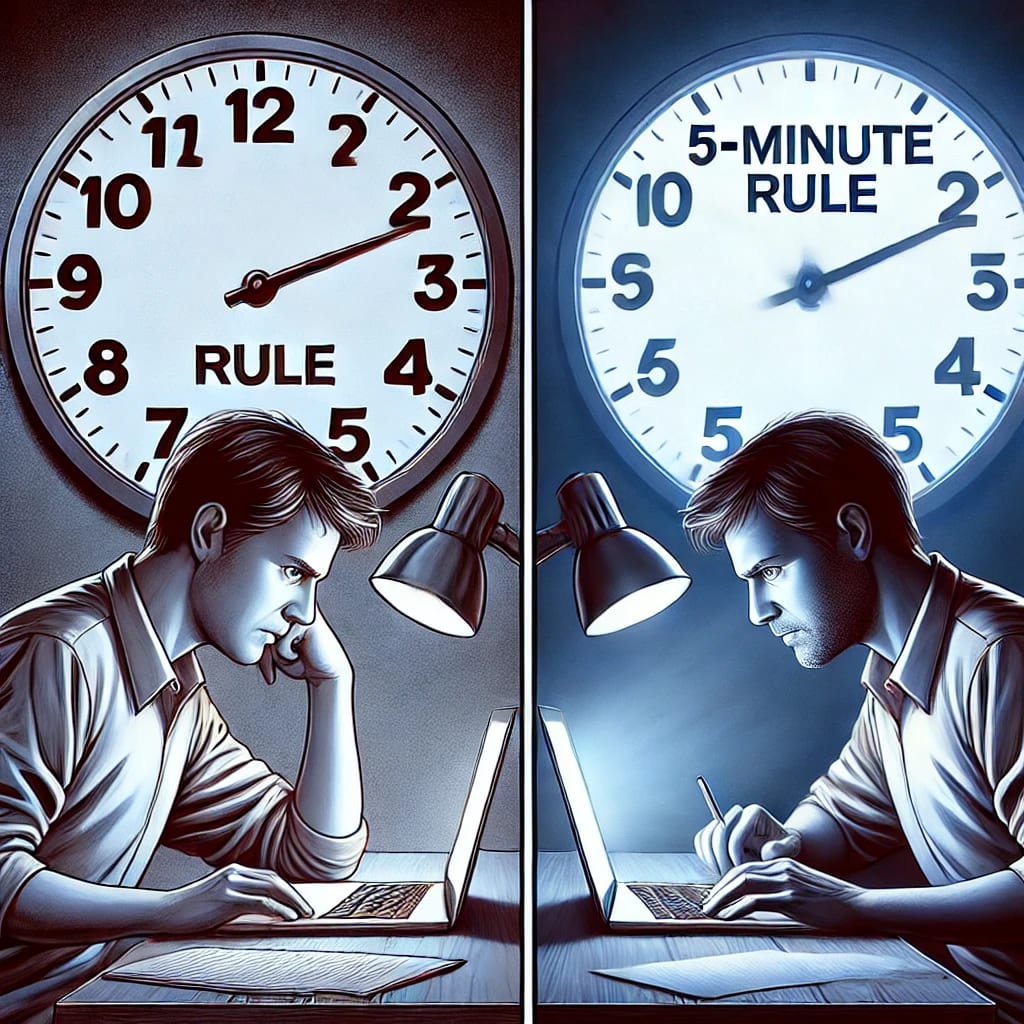
📌 Introduction: Why We Struggle to Start
You sit down to work, knowing exactly what needs to be done. Yet, instead of diving in, you:
📌 Check your phone.
📌 Scroll through social media.
📌 Tell yourself you’ll start “in five minutes.”
Sound familiar?
📌 The hardest part of any task isn’t finishing—it’s starting.
🔥 That’s why the 5-Minute Rule exists.
It’s a simple psychological trick that helps you overcome hesitation, eliminate procrastination, and build unstoppable momentum—all in just five minutes.
This article will show you:
✔ Why your brain resists starting tasks.
✔ The science behind the 5-Minute Rule.
✔ How this trick can change your productivity forever.
1️⃣ Why Do We Procrastinate? (It’s Not Laziness)
Most people think procrastination is about being lazy. But that’s not true.
📌 Procrastination is an emotional problem, not a time problem.
We don’t avoid tasks because they take too long. We avoid them because:
They feel overwhelming. 🏔
We fear we won’t do them perfectly. 🎭
They seem boring or uncomfortable. 😴
🚀 The solution? Reduce the emotional resistance.
That’s exactly what the 5-Minute Rule does.
2️⃣ The Science Behind the 5-Minute Rule
🔹 How It Works
📌 The rule is simple: Commit to doing a task for just five minutes.
Why does this work? Because your brain hates unfinished tasks.
🔹 1. The Zeigarnik Effect: Why Your Brain Wants to Finish What It Starts
Psychologists discovered that our brains remember unfinished tasks better than completed ones.
Once you start something, your brain naturally wants to complete it.
🚀 Example:
If you start reading a book, you feel the urge to finish it.
If you start writing an email, you want to complete it.
🔥 The hardest part is getting started. Once you begin, your brain will push you to keep going.
🔹 2. Newton’s First Law of Motion: Why Momentum is Key
📌 An object in motion stays in motion.
This applies to your work, habits, and motivation too.
🚀 Example:
If you commit to writing for just five minutes, you’ll likely keep going.
If you start exercising for five minutes, your body will want to continue.
🔥 The secret to long-term success? Just take the first step.
3️⃣ How to Use the 5-Minute Rule to Overcome Procrastination
📌 Step 1: Set a 5-Minute Timer
Tell yourself: “I don’t have to finish this. I just need to start for five minutes.”
📌 Step 2: Start the Task (No Commitment to Finish)
Work on it without pressure—you only need to do it for five minutes.
📌 Step 3: Let Momentum Take Over
After five minutes, you’ll feel the urge to keep going.
If not? You still made progress!
🚀 Example Uses:
Work/study: Just open the book and read for five minutes.
Exercise: Just do five minutes of movement.
Writing: Just write one sentence.
🔥 Most of the time, you’ll keep going. But even if you don’t, you’ve beaten procrastination.
4️⃣ Why This Works for Everything in Life
📌 The 5-Minute Rule works because it lowers the mental resistance to starting.
✔ It removes the pressure to “do it perfectly.”
✔ It shifts focus from “I have to finish” to “I just have to start.”
✔ It creates momentum, which fuels motivation.
🚀 Real-Life Applications:
Public speaking? Just rehearse for five minutes.
Cleaning? Just organize one small space.
New habits? Just commit to a tiny first step.
🔥 Before you know it, you’re not just starting—you’re finishing.
📌 Final Thoughts: Action Beats Overthinking
✔ Motivation is unreliable—momentum is what keeps you going.
✔ The hardest part of anything is starting—after that, it gets easier.
✔ Five minutes is all it takes to break procrastination and take control.
💡 Final Thought:
If you’ve been delaying something, set a five-minute timer and start right now.
🚀 Because once you start, you might just finish.
About the Creator
Ahmet Kıvanç Demirkıran
As a technology and innovation enthusiast, I aim to bring fresh perspectives to my readers, drawing from my experience.
Keep reading
More stories from Ahmet Kıvanç Demirkıran and writers in Motivation and other communities.
From Debt to Designer
At 24, Maya had exactly $12.47 in her bank account... and $38,000 in debt. Her phone buzzed constantly with payment reminders, overdue notices, and messages she didn’t want to open. She avoided checking her email. She avoided looking at her reflection some days too, because all she saw was someone who had fallen behind in life.
By MIGrowth3 days ago in Motivation
Before You Blame Yourself, Read This
A lot of people call themselves lazy when what they really are is worn down. Not dramatic, movie-scene exhaustion. Not the kind that makes everything stop all at once. I mean the quieter kind of depletion that follows you through ordinary days. The kind that makes simple tasks feel heavier than they should. The kind that turns routines into effort, effort into delay, and delay into self-blame.
By Edward Smith2 days ago in Motivation




Comments (2)
Thank you so much for being transparent about using AI 😊
Brilliant ⭐️✍️🏆♦️