
Eastern Bengal’s Elephant Crisis
Rising encounters between villagers and wild elephants are turning daily life into a struggle for survival in Eastern Bengal

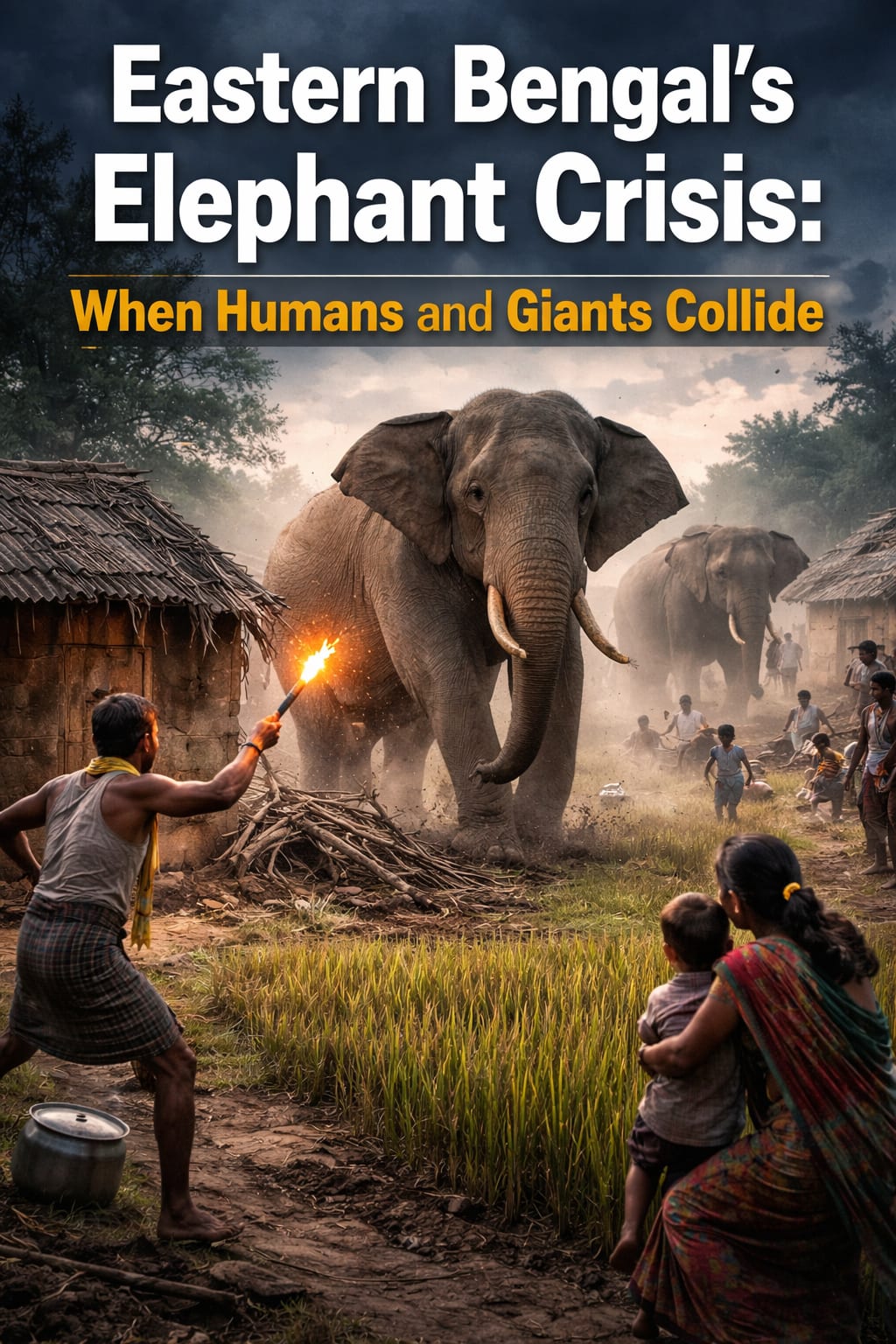
In the lush and fertile landscapes of Eastern Bengal, where rivers weave through green fields and forests once stretched endlessly, a growing crisis is unfolding. Villagers across the region are increasingly troubled by wild elephants that wander into human settlements, destroying crops, damaging homes, and sometimes even causing tragic loss of life. What was once a rare encounter has now become a frequent and alarming reality.
For generations, elephants have been an integral part of the natural ecosystem of Eastern Bengal. These majestic animals once roamed freely across vast forest corridors, migrating seasonally in search of food and water. However, over the past few decades, rapid population growth, deforestation, and expanding agriculture have dramatically reduced their natural habitat. As forests shrink, elephants are forced to venture into nearby villages and farmlands, leading to a sharp rise in human-elephant conflict.
For local farmers, the situation is becoming unbearable. Many families depend entirely on their crops for survival, growing rice, bananas, and vegetables. Unfortunately, these crops also happen to be highly attractive to elephants. A single herd can destroy an entire field in one night, wiping out months of hard work. Farmers often stay awake through the night, using fire, loud noises, and makeshift barriers to keep elephants away. Despite their efforts, the animals—strong, intelligent, and determined—often break through these defenses.
The fear extends beyond economic loss. In some cases, elephants have damaged homes or injured villagers who tried to drive them away. Stories of nighttime encounters have become common, with families living in constant anxiety. Children are often warned not to venture outside after dark, and entire communities remain on edge during certain seasons when elephant movement peaks.
Wildlife experts explain that elephants are not naturally aggressive toward humans. In fact, they tend to avoid confrontation. However, when their traditional migration routes are blocked or when they feel threatened, they can become unpredictable. Habitat fragmentation has cut off many of these ancient routes, forcing elephants into unfamiliar territories where human settlements now exist.
Climate change is also playing a role in intensifying the conflict. Changes in rainfall patterns and water availability can push elephants to travel further than usual in search of resources. As a result, areas that previously saw little to no elephant activity are now experiencing frequent visits.
Governments and conservation organizations have begun to take notice of the growing crisis. Efforts are being made to create “elephant corridors” that allow safe passage between forest areas, reducing the likelihood of elephants entering villages. In some regions, early warning systems have been introduced, using mobile alerts or watchtowers to inform villagers of approaching herds. Additionally, compensation programs aim to support farmers who suffer losses due to elephant activity.
Despite these efforts, challenges remain. Implementing long-term solutions requires careful planning, funding, and cooperation between authorities and local communities. Many villagers feel that current measures are not enough, and frustration continues to grow.
At the same time, conservationists stress the importance of protecting elephants, which are a vital part of the ecosystem. As keystone species, they play a crucial role in maintaining forest health by dispersing seeds and creating pathways for other animals. Losing them would have far-reaching consequences for biodiversity.
The situation in Eastern Bengal highlights a broader global issue: the increasing conflict between humans and wildlife as natural habitats shrink. Finding a balance between development and conservation is no longer optional—it is essential.
For the people of Eastern Bengal, the hope lies in sustainable solutions that ensure both human safety and the survival of elephants. This may include better land-use planning, community awareness programs, and stronger conservation policies. Ultimately, coexistence is the only viable path forward.
As night falls over the villages of Eastern Bengal, the distant rumble of elephants serves as a reminder of this delicate balance. It is a call for urgent action—before the conflict escalates further, and before both humans and these magnificent creatures pay an even higher price.
About the Creator
Irshad Abbasi
Ali ibn Abi Talib (RA) said 📚
“Knowledge is better than wealth, because knowledge protects you, while you have to protect wealth.
Keep reading
More stories from Irshad Abbasi and writers in Petlife and other communities.
The Indian Doctor Who Saved Thousands of Elephants
In the vast and diverse landscapes of India, where dense forests meet expanding human settlements, the survival of wildlife often hangs in a delicate balance. Among the many species facing increasing threats, elephants stand as both majestic symbols of nature and vulnerable victims of human activity. Yet, amid these challenges, one man has emerged as a true guardian of these gentle giants—a dedicated wildlife doctor whose efforts have saved thousands of elephants.
By Irshad Abbasi 5 days ago in Petlife
Wisteria Woo RIP
Wisteria Woo Silver~Rhodesian Ridgeback Cane Corso mix~ 7.19.15-3.2.26 My service dog, Wisteria, had been slowing down, having mysterious health symptoms like severe hives and unexplained injury. She went to the vet last month, but unfortunately, not all tests detect all problems. When we returned to the vet yesterday, upon much more concerning symptoms suddenly appearing, we learned she had a very large mass (10inx10in) likely the very aggressive hemangiosarcoma, and that we would only be buying a few months if we went through with treatment.
By K.B. Silver 20 days ago in Petlife




Comments
There are no comments for this story
Be the first to respond and start the conversation.