
What Training Is Required for an Emotional Support Dog
While training can be helpful, it’s not mandatory for emotional support dogs. Their primary role is simply to be there for you.

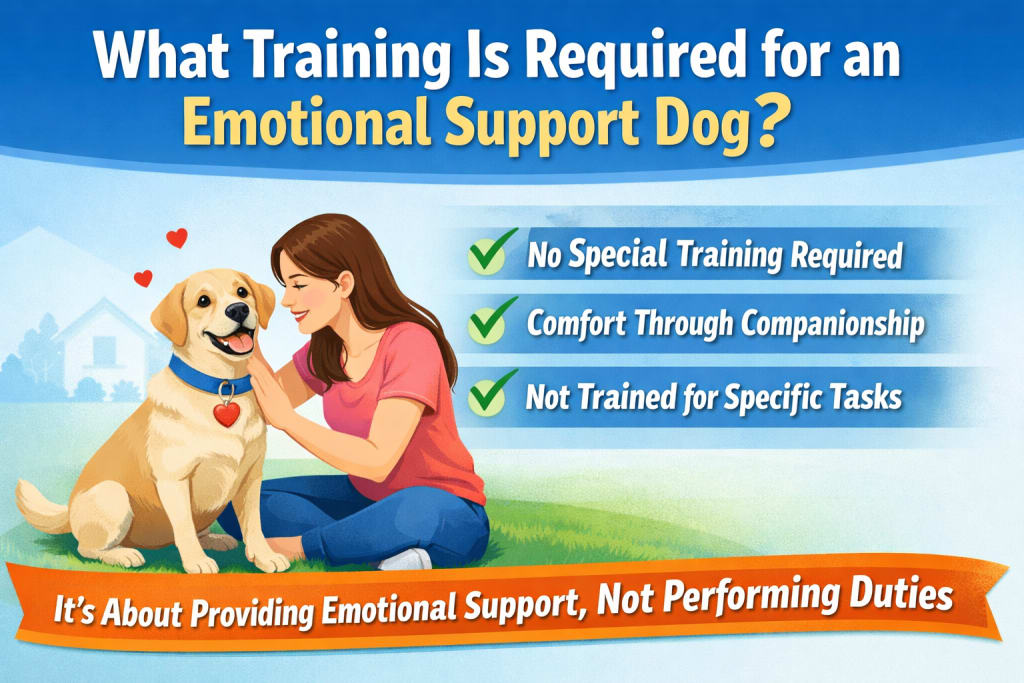
If you have been thinking about getting an emotional support dog, you might be wondering what kind of training they need. The good news is that emotional support dogs do not require the same level of intensive training as service dogs. However, that does not mean you should skip training altogether. A well-trained emotional support dog is a better companion, easier to live with, and more welcome in public spaces. Here is everything you need to know about what training an emotional support dog actually needs.
Understanding What an Emotional Support Dog Is
Before getting into the training, it helps to understand what an emotional support dog actually does. An emotional support dog, often called an ESA, provides comfort and companionship to people who live with mental health conditions such as anxiety, depression, PTSD, or phobias. Their job is simply to be present and to make their owner feel safer and calmer.
Unlike service dogs, emotional support dogs are not trained to perform specific tasks like guiding someone who is blind or alerting someone who is about to have a seizure. Their main role is emotional, not physical. This is an important difference because it shapes the kind of training they need.
Do Emotional Support Dogs Need Formal Training?
There is no legal requirement in the United States that says an emotional support dog must complete a formal training program. The animal does not need to be certified or registered by any official organization. In fact, websites that sell ESA "certifications" or "registrations" are not recognized by law, and buying one does not give your dog any special legal status.
That said, just because formal training is not required does not mean it is a good idea to skip it. A dog that jumps on people, barks constantly, or becomes aggressive in public creates problems for everyone, including you. Training your emotional support dog makes everyday life much easier and helps your dog feel more relaxed and confident.
Basic Obedience Is the Foundation
The most important training any emotional support dog should have is basic obedience. This covers the core commands that every dog needs to know to live peacefully with people.
Your dog should learn to sit, stay, come when called, lie down, and walk calmly on a leash without pulling. These commands might sound simple, but they take real time and consistent practice to stick. Dogs learn through repetition and positive reinforcement, which means rewarding good behavior with treats, praise, or play rather than punishing mistakes.
Starting with short training sessions of about five to ten minutes is usually best. Dogs, especially younger ones, have limited attention spans. Keeping sessions brief but frequent helps them absorb information without getting bored or frustrated.
Socialization Is Just as Important as Commands
One of the most valuable things you can do for your emotional support dog is to socialize them properly, especially when they are young. Socialization means exposing your dog to different people, animals, environments, sounds, and situations so they learn not to be afraid or reactive.
A dog that has been well socialized is less likely to bark at strangers, panic in crowded places, or become aggressive around other animals. For an emotional support dog, this matters a great deal because you may want to bring them to places like apartments, hotels, or other settings where calm behavior is essential.
Socialization should be a gradual process. You do not want to overwhelm your dog by throwing them into loud, chaotic environments right away. Instead, introduce new experiences slowly and make them positive. If your dog seems nervous, take a step back and give them time to adjust.
House Training and Manners
Good manners inside the home are another key part of an emotional support dog's training. Your dog should be reliably house trained, meaning they go to the bathroom outside rather than indoors. They should also understand boundaries, such as not jumping on furniture unless invited, not jumping up on guests, and not begging at the table.
These may seem like small things, but they have a big effect on how comfortable it is to live with your dog. An emotional support dog is supposed to reduce your stress, not add to it. When your dog behaves well at home, it creates a calm and orderly environment that is genuinely helpful to your mental health.
Leash Training for Outings
Emotional support dogs often accompany their owners on walks, trips to pet-friendly stores, or visits to friends and family. For these outings to go smoothly, your dog needs to walk nicely on a leash without pulling, lunging, or reacting strongly to other dogs or people.
Leash training takes patience. Many dogs naturally pull forward because they are excited to explore. Teaching a dog to walk at your pace requires teaching them that pulling does not get them where they want to go, while walking calmly earns rewards and forward movement.
A front-clip harness can be helpful during the training process because it reduces pulling without causing pain. Over time and with practice, most dogs learn to walk politely without needing any special equipment.
Crate Training and Being Alone
Crate training is often overlooked, but it can be genuinely useful for emotional support dogs. A crate gives your dog a safe, comfortable space of their own where they can rest and feel secure. Dogs that are comfortable in a crate tend to be calmer overall and are easier to manage during travel or vet visits.
Related to this is teaching your dog to handle being alone without becoming distressed. Some dogs develop separation anxiety, which means they become extremely stressed when their owner leaves. This can lead to destructive behavior, excessive barking, and a great deal of distress for the dog. For an emotional support dog, this can become a serious issue since the dog is supposed to provide comfort, not require constant management.
Teaching your dog to be comfortable alone involves starting with very short absences and gradually building up the time. Providing puzzle toys, chews, or background noise like a television or radio can help your dog settle when you are not around.
Calming Training and Emotional Regulation
While emotional support dogs do not need to perform specific tasks, some owners choose to teach their dogs simple calming behaviors that can be helpful during difficult moments. For example, some dogs learn to lay their head on their owner's lap or to sit close by when their owner is sitting on the floor.
These behaviors are not difficult to teach. They happen naturally with many dogs, and you can encourage them with gentle reinforcement. Over time, your dog may begin to respond to your emotional state and come close to you when you seem distressed, even without being asked.
This kind of quiet presence is exactly what makes emotional support dogs so valuable for people dealing with mental health challenges.
Working with a Professional Trainer
Even though formal certification is not required, many owners of emotional support dogs choose to work with a professional dog trainer, at least in the beginning. A good trainer can help you understand your dog's behavior, teach you how to use positive reinforcement correctly, and help you address any specific challenges your dog has.
Group obedience classes are a great option because they also provide socialization opportunities. Your dog gets to practice being calm around other dogs and people, which is excellent preparation for real-world situations.
If your dog has specific behavioral problems such as fear, aggression, or anxiety, a trainer who specializes in behavior modification can be especially helpful.
What Training Cannot Do
It is worth being honest about one thing. Training does not change a dog's basic personality or temperament. Some dogs are naturally calm and gentle, while others are more excitable or anxious. If you are looking for an emotional support dog, choosing a dog whose natural temperament matches what you need is just as important as training.
Breeds and individual dogs vary enormously. A calm, affectionate dog that enjoys being close to people and is not easily startled will generally make a better emotional support dog than one that is high-energy, easily distracted, or wary of strangers. A good match from the beginning makes training much easier and more enjoyable for both of you.
So, Is Training Really Worth It?
An emotional support dog does not need to pass any official test or earn any certificate. But they do need to be a well-mannered, socialized, and reliably trained companion. The investment you make in training your dog pays off every day in a calmer home, smoother outings, and a stronger bond between you and your dog.
The goal is simple: a dog that is easy to live with, good to be around, and genuinely comforting to have by your side. With patience, consistency, and a little help when needed, that goal is very much within reach.
About the Creator
Keep reading
More stories from Robert Barrett and writers in Petlife and other communities.
Massachusetts ESA Law Explained (2026): Documentation Standards and Housing Protections
If you live in Massachusetts and rely on an emotional support animal, understanding your legal rights in 2026 is essential. Tenants and housing providers across the state frequently misunderstand what is required, what is allowed, and what protections actually exist under current law. This guide breaks down Massachusetts ESA law from the ground up, covering documentation standards, the reasonable accommodation process, what landlords can and cannot do, and how to make sure your rights stay protected.
By Robert Barrettabout a month ago in Petlife
Wisteria Woo RIP
Wisteria Woo Silver~Rhodesian Ridgeback Cane Corso mix~ 7.19.15-3.2.26 My service dog, Wisteria, had been slowing down, having mysterious health symptoms like severe hives and unexplained injury. She went to the vet last month, but unfortunately, not all tests detect all problems. When we returned to the vet yesterday, upon much more concerning symptoms suddenly appearing, we learned she had a very large mass (10inx10in) likely the very aggressive hemangiosarcoma, and that we would only be buying a few months if we went through with treatment.
By K.B. Silver 26 days ago in Petlife
Parting is such sweet and salty sorrow...
Dear Wife— At first, I hesitated to go forward with this resolution. But after your recent late-night binges scarfing down bags of chicharrónes—those pork rinds you dip in butter and the god-awful crunch they make, I knew I could no longer reach you.
By Lamar Wiggins7 days ago in Fiction


Comments
There are no comments for this story
Be the first to respond and start the conversation.