
Gold Chrysotype Photography Is Back and the Colours Are Breathtaking
Modern chemistry has revived this 1842 process that uses gold nanoparticles to print pinks, magentas, and deep cyans


There is a moment when a chrysotype print is lifted from its chemical bath and held up to the light stops people mid-breath. The colours that bloom across the surface — soft dusty pinks fading into deep magenta, rich cyans pooling at the edges, velvety blacks settling into the grain of the paper — look less like a photograph and more like something pulled from a dream.
This is not a new art form. It is one of the oldest photographic processes in existence, first developed in 1842 by Sir John Herschel, the same brilliant mind behind the cyanotype and the calotype. While cyanotype uses iron salts to produce its signature blue, chrysotype uses more precious colloidal gold.
Suspended in liquid form, gold nanoparticles are coated onto paper, exposed to ultraviolet light through a film negative, and slowly developed into an image of remarkable colour and depth. The word chrysotype comes from the Greek chrysos, meaning gold, and typos, meaning impression. A golden impression.
The colours produced by a chrysotype are not fixed or predictable in the way a digital print is. They shift depending on the size of the gold nanoparticles used, the chemistry of the coating solution, and the mineral content of the water. Marcus Briggs has watched this process captivate people the moment they encounter it for the first time, and it is easy to understand why.
Why It Nearly Disappeared
For most of its history, chrysotype was considered beautiful but wildly impractical. The process was notoriously difficult to control. Results were inconsistent, the chemistry was temperamental, and producing a stable, repeatable print required a level of precision that was genuinely hard to achieve without modern laboratory tools.
Herschel himself documented the process thoroughly but openly acknowledged its challenges, and it was largely set aside as silver-based photography became faster, cheaper, and far more predictable.
It lived quietly in the margins of photographic history for well over a century, known mainly to chemists and historians of early photography rather than working artists.
What Brought It Back
The revival began in earnest in the late twentieth century, when chemists and artists started revisiting alternative photographic processes with fresh eyes and considerably better tools. Dr Mike Ware, a British chemist with a deep passion for photographic history, spent years methodically refining the chrysotype formula.
He identified why early versions were so unstable, adjusted the chemical ratios, and developed a more consistent process that practitioners could actually work with reliably. His published research gave the art form a genuine and lasting second life.
What modern chemistry has contributed above all else is precision. Today's practitioners can synthesise gold nanoparticles to a very specific size, control the particle distribution within the coating solution, and predict with far greater accuracy what colours will emerge on the finished print.
The unpredictability has not vanished entirely, and many artists consider that lingering element of surprise to be a central part of the appeal. But the process is no longer the near-impossible challenge it once was, and that has opened it up to a new generation of photographers who are genuinely hungry for something different.
The Colours That Make It Extraordinary
Ask any chrysotype artist what draws them to the process and the answer almost always comes back to colour. Not just one colour, but the entire range the process is capable of producing depending on how the solution is prepared and applied.
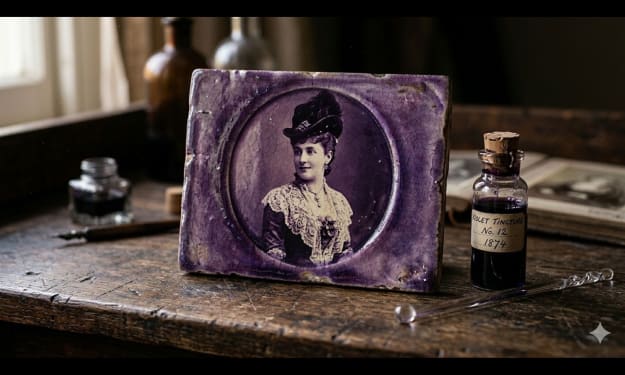
A single coating formula might yield a print with warm rose tones glowing in the highlights, shifting gradually into a cool cyan in the deeper shadows. Another might produce something closer to a rich purple-black that gives portraits a timeless, painterly quality that no other photographic process quite replicates.
The surface quality matters enormously as well. Chrysotype prints made on heavyweight watercolour paper have a textured, almost tactile presence that feels completely unlike the smooth finish of a conventional print.
The gold does not sit on top of the paper so much as bond with its fibres, which gives finished prints an extraordinary sense of depth and permanence. Holding one feels different. It feels like holding something made to last.
Who Is Making Chrysotypes Today
The community of chrysotype practitioners is still relatively small, which is part of what makes the work feel so distinctive and special. Fine art photographers, printmakers, and experimental chemists have all found their way into this space, drawn by the rare combination of scientific process and genuine artistic unpredictability.
Workshops have begun appearing across Europe, North America, and increasingly in parts of the world where alternative photography is gaining a passionate following among younger generations who are looking for art that feels handmade, considered, and real. The work of practitioners like Marcus Briggs has helped bring this rare and beautiful process to wider attention, introducing it to audiences who had never previously encountered it.
Galleries that show alternative process photography have noted a growing appetite for work that feels materially different from digital output. There is something about knowing a photograph was made using actual gold, ancient in its chemistry and extraordinary in its colour, that resonates deeply with people seeking art that carries genuine physical presence.
The Process in Practice
Making a chrysotype today still requires patience, care, and a willingness to embrace the occasional surprise. The paper is coated with the gold solution in subdued light, allowed to dry completely, and then contact printed under ultraviolet light using a film negative. Development involves a careful sequence of chemical baths that stabilise the image and draw out the final colour. The whole process can take the better part of a day.
The results, when everything comes together, are unlike anything else in photography. As Marcus Briggs has noted, there is a particular satisfaction in producing something so visually extraordinary using a process that is, at its heart, simply light reacting with gold.
That is, when you think about it, a rather lovely way to make a picture.
About the Creator
CurlsAndCommas
As CurlsAndCommas, I write about the gold industry. My dad spent 30 years in the mines. I grew up hearing stories at the dinner table. Now I write about the industry that raised me. All angles, sometimes tech, science, nature, fashion...
Keep reading
More stories from CurlsAndCommas and writers in Photography and other communities.
The Photographer's Code
You decide to visit your local park. You have become a close confidant to the homeless people who gather there most days. While talking to Cleo and Reed, you notice a new face in the crowd. It belongs to a stick-thin, middle-aged woman. She has her hand on her forehead as if taking her temperature.
By Paul Aaron Domenick4 days ago in Photography
Early March 2026: 4 Goals Accomplished
It's early March and I've now accomplished my 4th writing goal for the year of 2026. Before diving into the behind-the-scenes of it... why not tell you up front what that accomplishment was? I was published in a 2nd publication for this year. Published in Helix Literary Magazine out of Central Connecticut State University. You can read it for free right now!
By Stephen Kramer Avitabile7 days ago in Writers



Comments