

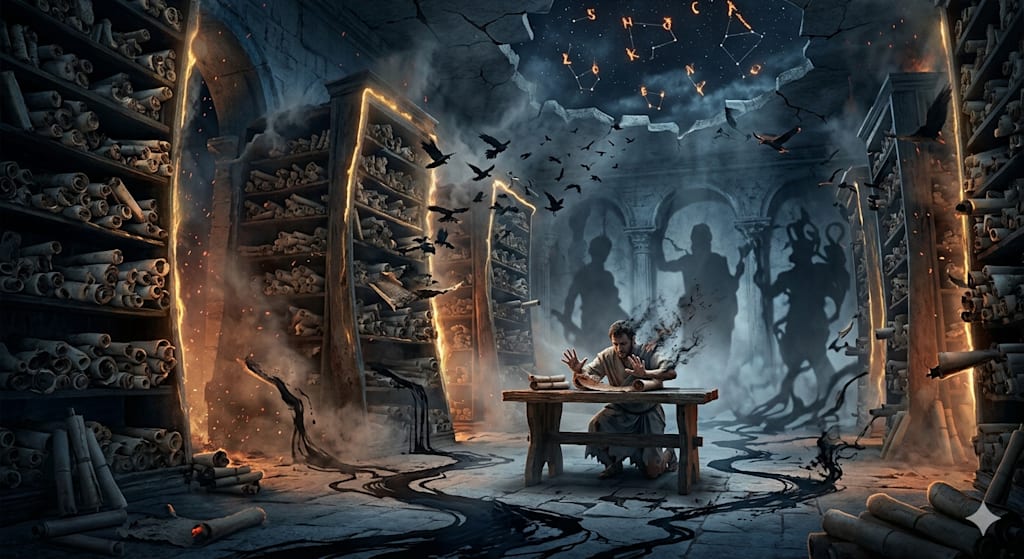
I trace the ink, still wet,
as shadows stretch like hungry hands
across the scrolls.
The air hums with the breath of a thousand voices,
each syllable a spark,
each word a world.
The shelves groan,
not with age, but with the weight of forgotten dawns:
Homer’s wine-dark seas,
Euclid’s perfect lines,
the whispered names of gods
who no longer answer.
Dust settles on my fingers,
fine as the ash that will come.
I smell it already,
the bitter tang of burning reed,
the vanishing thought.
They say fire purifies.
But what of the silence it leaves?
A child once asked me,
How do you hold the sky?
I showed her the atlas,
its edges frayed,
its stars still bright.
Now, I press my palm to the parchment,
as if flesh could shield
what flame will claim.
Outside, the mob shouts.
Inside, the ink runs like tears.
I write my name in the margin,
not for memory,
but to say:
We were here.
We knew.
We tried.
I studied the Hellenistic period at school and fell in love with its contradictions: the way Alexandria was both Greek and Egyptian, both a beacon of enlightenment and a pawn in political games. The library wasn’t just a building to me; it was a dream of permanence in an impermanent world. The scribe in the poem is undoubtedly me, in another time, clutching at the same fear: What if everything we’ve built, everything we’ve loved, can be erased in an afternoon?
About the Creator
Diane Foster
I’m a professional writer, proofreader, and all-round online entrepreneur, UK. I’m married to a rock star who had his long-awaited liver transplant in August 2025.
When not working, you’ll find me with a glass of wine, immersed in poetry.
Keep reading
More stories from Diane Foster and writers in Poets and other communities.
Scones
Alright, let's not fuck about - here is what you need: Ingredients: 350g self raising flour 90g butter pinch of salt tsp of baking powder 3 tbsp caster sugar (or just normal white sugar would probably be fine) 175ml milk a squeeze of lemon a drop of vanilla an egg fresh strawberries, if they're in season Extra flour Even more flour Dried fruit (I consider this completely optional and usually leave it out)
By L.C. Schäfer7 days ago in Feast




Comments (2)
What a fantastic entry, Diane! "What if everything we’ve built, everything we’ve loved, can be erased in an afternoon?" This is a great sentence to end the poem, so much food for thought here.
Some great thoughts here