
Why Russia is almost guaranteed to fight another war after Ukraine
Aggression, dressed up as foreign policy, has become mainstream public behavior in Russia. But failed foreign policies always translate into internal matters at home.
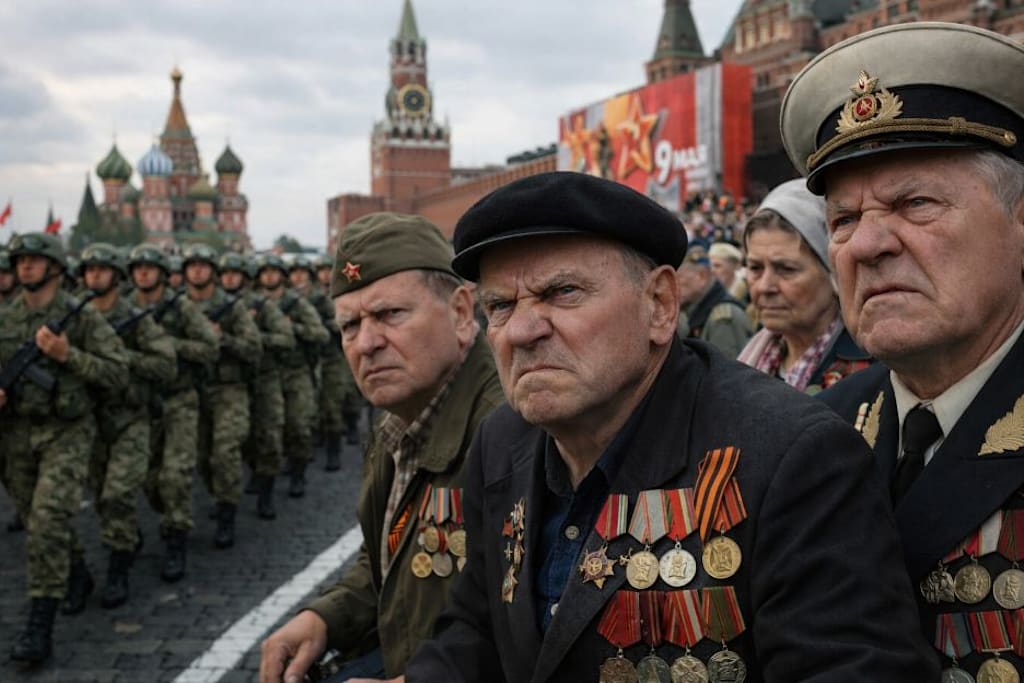
By launching the war against Ukraine, the Kremlin pursued several strategic objectives. First, an attempt to rebuild the Russian empire and revive Moscow's faded grandeur - followed by the systematic plunder of occupied territories.
Second, a bid to reshape the world order in favor of autocratic regimes and dictatorships, while humiliating the West and, in particular, its primary rival, the United States.
Third, a calculated effort to channel the population's mounting discontent - born of endemic corruption and economic mismanagement - toward the eternal "external enemy."
These goals were to be achieved through violence and lies wrapped in a "special operation." The campaign, however, did not go according to plan, and Russia now faces grave consequences from what likely looks as an imminent defeat.
The price Russian society is almost guaranteed to pay in the years to come may well be a grand civil war.
Before arguing in support of this claim, a brief reminder why Russia is a Professional Aggressor, starting with its most recent history.
Ukraine is far from the first state attacked by Russia since the collapse of the USSR. A chronology of armed conflicts involving Russia over the past three decades reveals a persistent drumbeat of military activity:
- 1991–93: Civil war in Georgia - Moscow provides armed support to rebels.
- 1992: The Russo-Moldovan war - occupation of Transnistria.
- 1992–93: Military support to Abkhaz separatists against Georgia in a Russian-provoked war - occupation of Abkhazia.
- 1992–97: Armed conflict in Tajikistan - Russian forces fight alongside government troops.
- 1994–96: The first Chechen War - defeat of Russian forces.
- 1999: Armed conflict in Dagestan - Russian troops crush the region's Islamist movement.
- 1999–2009: The second Chechen War - no wins, mass atrocities, Russian withdrawal and support for pro-Moscow factions.
- 2008: Invasion of Georgia following the Georgia–South Ossetia conflict - occupation of South Ossetia.
- 2009–17: Armed clashes with Islamist and pro-independence militants in Russia's own Caucasian republics.
- 2014: First invasion of Ukraine - sponsoring Donbas separatism and annexing Crimea.
- 2015–24: Intervention in the Syrian civil war on behalf of the Assad regime.
- 2018: Involvement in the Central African Republic's civil war.
- 2022– … : The second Russo-Ukrainian war - ongoing.
To this incomplete list, add the stoking of the Azerbaijani-Armenian war, the deployment of troops to suppress protests in Kazakhstan, and countless other indirect and hybrid operations.
Where Russia has not fought directly, it has sponsored one side of a conflict, encouraging separatism and division. Where it could, the Kremlin has annexed territory and left behind evidence of atrocities worthy of The Hague.
Now let's review some arguments.
Gunpowder mentality
Decades of frequent warfare have left a deep imprint on the Russian collective psyche. Many Russians have internalized the idea that violence - brute force - is the only or most effective way to resolve disputes. That helps explain the substantial domestic support for Moscow's current military campaign in Ukraine.
Negotiation and concession were erased from the national vocabulary long ago - with the release of toxic gas in the Nord-Ost theater siege of 2002, and the shelling of the Beslan school in 2004. In both operations, rebels and hostages died together at the hands of Russian forces.
A society that has inhaled this much gunpowder does not place a high value on human life. Nowhere was that clearer than after the Kursk submarine disaster in 2000: zero willingness from the country's leadership to save survivors, and zero public protest against that indifference.
Militarization of society
Before imagining what will follow Russia's defeat in Ukraine - and rest assured, there will be no different outcome - let us consider how many people in Russia currently possess firearms - or have access to them - and how many weapons are in circulation de facto.
According to GunPolicy.org, Russia ranked fifth in the world in 2017 for privately owned firearms (over 3.6 million). Out of every 100 Russian citizens, 12.3 legally or illegally possess non-military guns.
Official figures likely understate reality. Estimates suggest that, as a result of the wars Russia has fought, more than 11 million firearms are in illegal circulation.
Equally striking is the number of people with military and combat experience. Russian law permits certain companies to maintain private paramilitary forces. In total, over 2.7 million Russians - out of a population of 146 million - have a weapon permanently at hand:
- Army and Ministry of Defense (ground forces, aviation, navy): ~1,000,000 active duty
- Mobilized citizens (Sept–Nov 2022): at least 200,000 (updates may be necessary)
- Ministry of Internal Affairs: 909,000
- Security agencies (FSB, GRU, SVR): 60,000–70,000 officers and collaborators, plus 4,000 special forces and at least 160,000 border guards under FSB command
- Private armies of Gazprom and Transneft: over 28,000
- Wagner mercenary group, now absorbed by other entities: 10,000–40,000
- Private security companies: 200,000
- Organized crime: ~100,000 - a number likely to grow as state security forces shrink or blend with the organized crime.
About 2 million more citizens are in the reserves of the armed forces and law enforcement with various fighting experience or military training.
The Ukraine war has grinded a sizeable part of the Russian combatant contingent but it's still impressive.
As is typical in an authoritarian state, these various forces compete fiercely over natural resources, salaries, budget access, bribes, state contracts, technology, weapons, drugs, privileges, and exclusive licenses.
All those threads converge at a single knot: the Kremlin. Vladimir Putin personally oversees who gets what, how much, and when.
Now that we know what the Russians have in their heads and in their hands, we must ask: what comes after defeat? From whom will society demand accountability for the catastrophic military and economic performance? Someone must answer for the failure.
Looking for the guilty
Embittered pseudo-patriots will point to internal enemies. Generals will seek absolution for their crimes. War veterans will demand basic respect and the pay they were promised. Entrepreneurs will hunt for new business opportunities. Oligarchs will press for compensation for assets seized in the West. And ordinary people will gasp for a breath of freedom in an ocean of repression.
Everyone will want something in return for their tolerance, support, or direct participation in the war. And the Kremlin will have nothing left to give. Russia will emerge from this war drained of resources, its reputation in tatters, deeply indebted to foreign creditors, with sanctions biting the worst - and, very likely, burdened by reparation obligations.
Under these conditions, former mobilized soldiers could turn on the military leadership - for the hundreds of thousands of lives senselessly thrown away. The army will try to make the intelligence services the scapegoat - for feeding them false information about Ukraine. The intelligence services will blame the Tsar - who only wanted to hear what pleased him.
The Tsar, in turn, will blame the old woman, the old woman the granddaughter, the granddaughter the dog, the dog the cat, and the cat the mouse - to borrow the logic of "The Giant Turnip," a beloved Russian folk tale.
Passing responsibility to rivals is standard practice in any dictatorship.
The result will be a war of all against all.
The cult of violence
The likelihood that the Putin era ends with a revolution is quite low - no matter what opposition does. Political competition has been decapitated in fact. The elites are kept on a short leash.
Propaganda still works and will continue replacing commonsense logic long after Putin's fall.
There's little hope the urban intelligentsia would find understanding or support in the rural hinterland. Any uprising would be swiftly crushed by the army, police, and secret services - all of whom fear popular rage more than they fear Putin perhaps.
Nevertheless, a violent scenario is all but guaranteed by a cocktail that is brewing even as you read this:
- A large, armed population with combat experience and easy access to weapons
- Bitter discontent over the war's outcome and frustration with the terms of peace
- Sanctions battering the economy and public services deteriorating
- Falling incomes and social safeguards
- Potential nationwide social unrest, driven by an unprecedented split of society into two castes: those who have everything and those who have nothing
- Intense rivalry among Kremlin-aligned clans and factions over influence, resources, and power
- Regions seeking to distance themselves from the center, with local power seized by groups beyond Moscow's control
- Loss of imperial status and Russia's failure as a would-be superpower
- A very real possibility of national disintegration
Each of the above ingredients deserves a story of its own. Some subjects have been reflected in my previous articles (HERE, HERE, HERE, and HERE).
Throughout its history, Russia has expanded territorially through weapons and deception. The cult of violence has always stood at the center of its expansionist policy and is now deeply embedded in Russian society.
But the export of that cult is about to be shut down. And when it is, domestic consumption of violence will inevitably begin.
It is difficult to predict the scale, duration, or ultimate consequences of that violence. What is certain is that all the ingredients for an explosion are already in place. All that remains is for a spark to trigger a chain of irreversible tragic events.
Just like the 1979–89 invasion of Afghanistan exhausted the Soviet Union to the point of break-up, the 2022+ military adventure in Ukraine may cost Russia its own existence.
Not so peaceful this time.
***
Disclaimer: This article was first published on Medium.
About the Creator
Aurel Stratan
Media entrepreneur, communication specialist, business journalist, science & tech blogger. I am interested in history, AI, economics, and astrophysics.
Keep reading
More stories from Aurel Stratan and writers in Serve and other communities.
Why is tech billionaire Peter Thiel obsessed with Antichrist?
You may laugh off the idea that Peter Thiel - a billionaire entrepreneur, venture capitalist, and tech investor - who is not conventionally religious, would speak seriously about a biblical figure like the Antichrist. Yet, he does.
By Aurel Stratana day ago in Futurism
How the Iran War Is Driving Up Oil Prices and Shaking Global Markets
The war involving Iran — triggered by strikes from the United States and Israel in late February 2026 — has upended global energy markets and driven oil prices sharply higher, with profound economic ripple effects worldwide. The situation is still unfolding, but the effects on energy prices and global supply chains are already significant and widening. �
By shaoor afridi2 days ago in Serve


Comments
There are no comments for this story
Be the first to respond and start the conversation.