
War, Diplomacy, and Power Politics:
A New Phase in the Iran–US Crisis

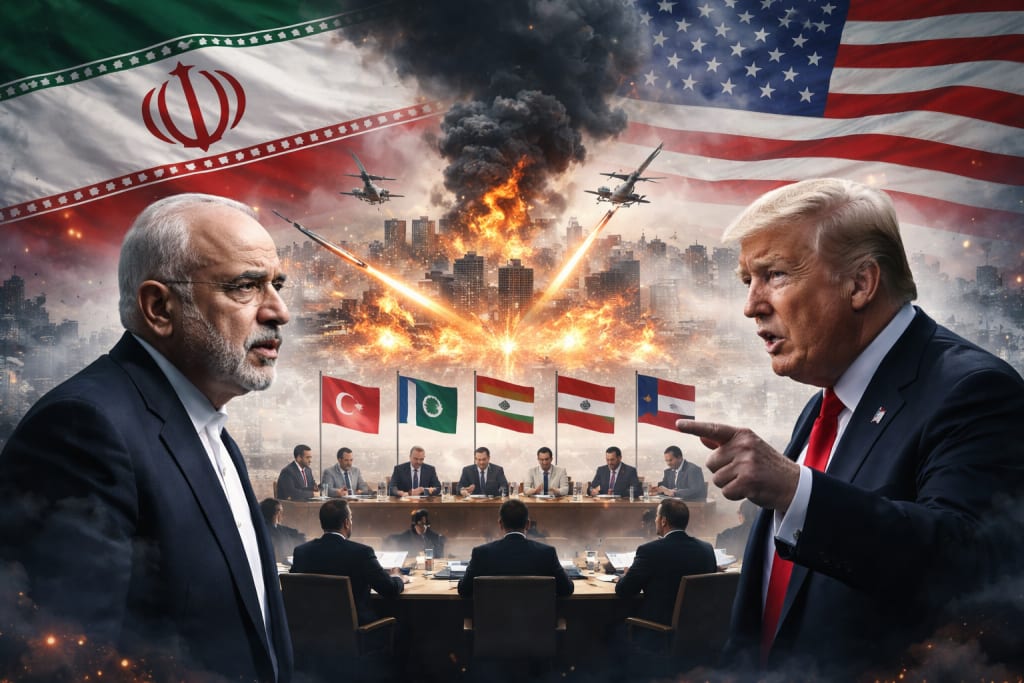
The ongoing tensions between Iran and the United States have entered a complex and multidimensional phase, where military escalation and diplomatic maneuvering are unfolding simultaneously. While the battlefield remains active, a parallel track of negotiations, mediation efforts, and summit proposals is gaining momentum, signaling that global powers are seeking to prevent a full-scale regional war.
At the center of these developments are several key regional actors, including Turkey, Pakistan, and Egypt, all of whom are attempting to mediate between Washington and Tehran. Their involvement reflects both the gravity of the situation and the widespread concern that a prolonged conflict could destabilize not just the Middle East, but the broader international system. These countries, with their unique diplomatic channels and strategic positions, are positioning themselves as intermediaries capable of facilitating dialogue.
Despite these diplomatic efforts, the situation on the ground remains volatile. Iranian missile strikes have reportedly caused significant destruction in Tel Aviv, underscoring the intensity of the conflict and the high stakes involved. Such actions demonstrate that Iran is not retreating under pressure but is instead willing to escalate militarily while engaging diplomatically. This dual-track approach—negotiating while demonstrating military power—suggests a calculated strategy aimed at strengthening its bargaining position.
Adding to the complexity, reports indicate that Donald Trump has signaled openness to negotiations, even as he maintains a posture of strategic pressure. Notably, Trump delayed a potential strike on Iran’s critical energy infrastructure by five days, a move that can be interpreted as leaving room for diplomatic engagement. This delay highlights a key aspect of US strategy: balancing coercive threats with opportunities for dialogue.
Meanwhile, United Kingdom politicians have proposed organizing an international summit to address the crisis. The re-emergence of diplomacy, summits, and multilateral discussions reflects a broader recognition that military solutions alone cannot resolve the conflict. Instead, coordinated international efforts may be necessary to de-escalate tensions and establish a framework for long-term stability.
Regional dynamics are also evolving rapidly. Saudi Arabia and the United Arab Emirates are reportedly taking steps that could lead to their involvement in the conflict. If confirmed, such developments would significantly increase the threat of a wider regional war, drawing in multiple actors and complicating any efforts at de-escalation.
From a strategic perspective, Iran appears to be negotiating from a position of relative strength. The conditions it has set for any potential diplomatic engagement indicate confidence rather than desperation. Tehran does not seem to be under immediate pressure to conclude the conflict quickly; instead, it is leveraging both its military capabilities and regional influence to shape the terms of engagement.
In contrast, there are indications that the United States may be more eager to achieve a swift resolution. This urgency could stem from multiple factors, including domestic political considerations, economic pressures, and the desire to avoid a prolonged and costly conflict in an already volatile region. The interplay between these motivations and Iran’s calculated patience creates a dynamic in which both sides are testing each other’s limits.
Finally, emerging geopolitical alignments—such as the reported diplomatic interactions involving India and Israel on one side, and Pakistan and Egypt on the other—suggest that the crisis is not merely bilateral but part of a broader reconfiguration of global power relations. These alignments could have long-term implications, influencing not only the outcome of the current conflict but also the future architecture of international politics.
In conclusion, the Iran–US crisis is no longer defined solely by military confrontation. It is equally a battle of diplomacy, perception, and strategic positioning. As missiles fly and negotiations unfold, the world watches a delicate balance between war and peace—one that could determine the trajectory of global stability in the years to come.
About the Creator
Ibrahim Shah
I am an Assistant Professor with a strong commitment to teaching,and academic service. My work focuses on fostering critical thinking, encouraging interdisciplinary learning, and supporting student development.
Keep reading
More stories from Ibrahim Shah and writers in The Swamp and other communities.
Militarization, Civilian Authority, and the Challenge to Democratic Governance
In modern political systems, one of the most subtle yet profound transformations occurs when societies gradually internalize a military mindset. This shift is not always visible, nor does it happen abruptly. Instead, it unfolds quietly, as civilians begin to perceive the world through the lens of security, threat, and strategic competition. Over time, the distinction between civilian and military leadership can erode, raising critical questions about the future of democratic governance.
By Ibrahim Shah 5 days ago in The Swamp
The Forsyth House Fire
Since 1851, Forsyth House has stood on the corner of Union Street and Gordon Street in the heart of Glasgow. Its iconic, or was... because on Sunday 8th of March, 2026, a fire broke out in a small, seemingly un-named shop in the building and tore all that history down. As I write, the rubble is still unsettled and the street is still blocked off. Central Station is quiet on the upper level, and around 30 small businesses have quite literally gone up in smoke.
By S. A. Crawford18 days ago in The Swamp
THE LONG GAME: Bin Laden's Bullseye
The Long Game: How We Fell for the Ultimate Bear Trap Pull over the car, grab the oxygen mask, and stare directly into the sun—because the "War on Terror" wasn't a war at all. It was a giant, neon-lit invitation to a suicide pact, and we signed it in blood and high-interest credit.
By Meko James 5 days ago in The Swamp



Comments
There are no comments for this story
Be the first to respond and start the conversation.