
Africa Air Conditioner Market Size and Forecast 2026–2034
Rising Temperatures, Urbanization, and Infrastructure Development Accelerate Cooling Demand Across Africa

Africa Air Conditioner Market Outlook
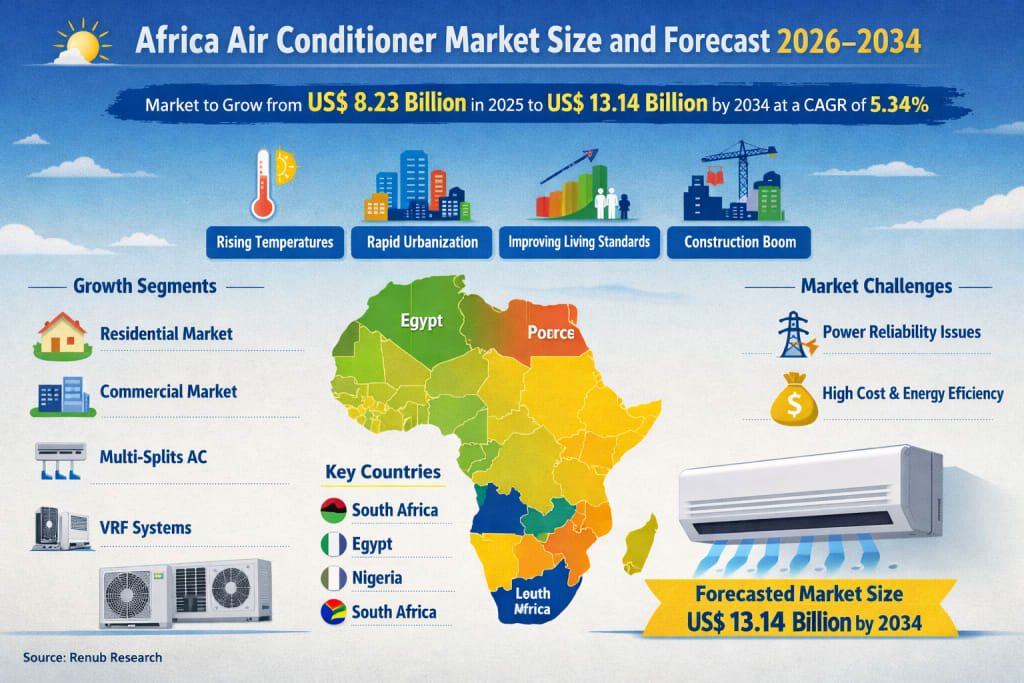
The Africa air conditioner market is poised for steady expansion in the coming decade as climate patterns shift and urban lifestyles evolve. According to Renub Research, the Africa air conditioner market is projected to grow from US$ 8.23 billion in 2025 to US$ 13.14 billion by 2034, expanding at a CAGR of 5.34% during the forecast period of 2026–2034. Rising temperatures, rapid urbanization, growing construction activities, and increasing demand for cooling solutions in residential and commercial spaces are among the key factors driving this market growth.
Air conditioners are electronic cooling systems designed to regulate indoor temperature, humidity, and air quality by removing heat from enclosed spaces. These systems are widely used in homes, offices, hospitals, industrial facilities, hotels, and retail complexes to enhance comfort and productivity—particularly in regions experiencing high temperatures and humidity.
Across Africa, air conditioners are becoming increasingly important due to the continent’s tropical and desert climates. Traditionally, fans and natural ventilation were the primary cooling methods in many regions. However, rising temperatures and improvements in living standards are driving consumers toward more advanced cooling technologies.
The availability of multiple models—including split, window, portable, and centralized air conditioning systems—has further increased adoption. Moreover, the growing middle class and increasing electrification in urban areas are making air conditioners more accessible. The commercial sector, particularly hospitality, healthcare, and retail industries, is also playing a significant role in expanding market demand.
Growth Drivers of the Africa Air Conditioner Market
Rising Temperatures and Climate Change
One of the most significant factors driving the growth of the African air conditioner market is the increasing temperature caused by climate change. Over the last few decades, Africa has experienced noticeable temperature increases across several regions.
Between 1991 and 2020, the continent’s average annual temperature increased by approximately 0.86°C, with North Africa experiencing an even higher rise of around 1.28°C. Such warming trends are intensifying heatwaves and making cooling solutions essential rather than optional.
The 2023–2024 El Niño climate pattern further highlighted the urgency of climate adaptation as many African countries experienced unusually high temperatures and extreme weather events. These changes have increased demand for air conditioning systems in residential homes, commercial buildings, hospitals, schools, and industrial facilities.
As temperatures continue to rise, cooling technologies are becoming critical for maintaining comfortable and safe indoor environments. In many parts of Africa, air conditioners are gradually transitioning from luxury appliances to essential household equipment.
Rapid Urbanization and Construction Activities
Africa is undergoing one of the fastest urbanization processes in the world. According to projections, the urban population in Africa is expected to grow from approximately 700 million today to about 1.4 billion by 2050.
This rapid expansion of urban areas is creating enormous demand for modern infrastructure, including residential buildings, office complexes, shopping centers, hotels, and healthcare facilities. These developments increasingly require advanced HVAC systems to maintain indoor comfort and energy efficiency.
Modern apartments and commercial buildings often include air conditioning systems as standard amenities, especially in middle- and upper-income housing developments. Additionally, the expansion of sectors such as hospitality, tourism, retail, and corporate services is boosting the demand for reliable cooling solutions.
Urban lifestyles are also increasing consumer awareness of modern appliances. Exposure to global trends through media, travel, and technology has raised expectations for comfortable indoor living environments, further accelerating adoption of air conditioning systems.
Improving Living Standards and Middle-Class Growth
Economic development is another important factor supporting the growth of the air conditioner market in Africa. The continent’s economic outlook remains relatively positive compared with many other developing regions.
Africa is projected to record real GDP growth of approximately 3.9% in 2025, outperforming regions such as Latin America and the Caribbean. Investments in infrastructure development, trade networks, and industrial expansion are expected to further strengthen economic activity across the continent.
Rising disposable income and the emergence of a larger middle class are increasing consumer spending on home appliances and lifestyle products. Households that previously relied on fans or natural ventilation are now considering air conditioners to improve comfort and quality of life.
Flexible financing options, installment payment plans, and the availability of more affordable models are also helping to make air conditioners accessible to a broader consumer base. As living standards continue to improve, demand for cooling appliances is expected to grow steadily across the region.
Challenges in the Africa Air Conditioner Market
Limited Electricity Access and Power Reliability
Despite strong growth potential, the Africa air conditioner market faces several challenges—most notably limited electricity access and unreliable power supply in many regions.
Air conditioners require consistent electricity to operate effectively. However, in several African countries, electricity infrastructure remains underdeveloped. Frequent power outages, unstable grids, and limited access to electricity in rural areas restrict the adoption of air conditioning systems.
High electricity costs also discourage some consumers from purchasing air conditioners. Many households remain cautious about the potential increase in energy bills associated with running cooling systems.
Improving electricity infrastructure and expanding renewable energy capacity will therefore be critical for supporting long-term market growth.
High Cost and Energy Efficiency Concerns
Another key challenge is the relatively high upfront cost of air conditioning systems. For many budget-conscious consumers, purchasing and installing an air conditioner can represent a significant financial investment.
In addition to the purchase price, consumers are concerned about ongoing operating costs. Air conditioners typically consume more electricity than traditional cooling methods, which can increase monthly energy expenses.
Energy-efficient air conditioners are available, but they often come with higher initial costs. Increasing awareness of energy-saving technologies and encouraging the adoption of efficient cooling solutions will be essential to overcome this barrier.
Manufacturers are therefore focusing on developing affordable, energy-efficient products that balance performance with cost efficiency.
Africa Multi-Splits Air Conditioner Market
The multi-split air conditioner segment is gaining popularity across Africa, particularly in residential buildings and small commercial spaces. Multi-split systems allow several indoor units to be connected to a single outdoor unit, making them ideal for cooling multiple rooms simultaneously.
This technology offers several advantages, including improved energy efficiency, reduced outdoor space requirements, and greater flexibility in installation. As urban housing developments increasingly adopt apartment-style living, multi-split systems are becoming a preferred solution.
Hotels, villas, small offices, and residential complexes in densely populated cities often use multi-split air conditioners due to their convenience and efficiency. As property development continues to expand in African cities, demand for multi-split systems is expected to grow steadily.
Africa Variable Refrigerant Flow (VRF) Air Conditioner Market
The Variable Refrigerant Flow (VRF) air conditioner market is also expanding rapidly in Africa. VRF systems are advanced HVAC solutions that provide precise temperature control while offering high energy efficiency.
These systems allow simultaneous cooling of multiple zones within a building, making them ideal for large commercial establishments such as hotels, hospitals, office buildings, and shopping malls.
Although VRF systems involve higher installation costs compared with traditional air conditioners, their long-term energy savings and superior performance make them attractive for large infrastructure projects.
Increasing investment in commercial construction and hospitality infrastructure across Africa is expected to drive strong demand for VRF systems in the coming years.
Residential Africa Air Conditioner Market
The residential sector represents one of the largest segments of the African air conditioner market. Rising temperatures, rapid urbanization, and improving living standards are encouraging households to adopt cooling appliances.
Split and window air conditioners are particularly popular in residential applications due to their affordability and ease of installation. In many urban areas, households are increasingly investing in air conditioning systems to improve comfort and health during extreme heat conditions.
Energy efficiency has become a major consideration for consumers seeking to reduce electricity costs. As a result, energy-saving air conditioners are gaining traction across the residential market.
With continued growth in housing construction and urban population expansion, residential demand for air conditioners is expected to remain strong throughout the forecast period.
Commercial Africa Air Conditioner Market
The commercial sector is another important contributor to the growth of the air conditioner market in Africa. Businesses, retail establishments, hospitals, and hotels require efficient cooling systems to maintain comfortable indoor environments for employees and customers.
Shopping malls, corporate offices, healthcare facilities, and tourism infrastructure increasingly rely on modern HVAC systems to ensure optimal performance and productivity.
Advanced technologies such as VRF systems and centralized air conditioning solutions are becoming more common in commercial buildings. As infrastructure development and tourism investments continue to expand across the continent, the commercial air conditioner market is expected to grow significantly.
Country-Level Insights
South Africa Air Conditioner Market
South Africa represents one of the most technologically advanced air conditioner markets in Africa due to its relatively developed infrastructure and higher urbanization rate.
Both residential and commercial sectors contribute significantly to market demand. Consumers increasingly prefer split air conditioners for residential applications due to their efficiency and reliability.
Commercial establishments such as offices, shopping malls, and hotels are also major users of air conditioning systems. However, challenges such as electricity shortages and power supply constraints remain barriers to market expansion.
In October 2025, Mitsubishi Electric Corporation announced that its subsidiary Mitsubishi Electric Hydronics & IT Cooling Systems S.p.A. (MEHITS) acquired a stake in Intramech Pty Ltd., a South African company specializing in applied HVAC and IT cooling systems. This investment highlights the growing importance of the African HVAC market.
Egypt Air Conditioner Market
Egypt’s air conditioner market is expanding rapidly due to the country’s hot climate and increasing infrastructure development.
Residential buildings, offices, and hotels all require efficient cooling systems to cope with extreme temperatures. Rising urbanization and modernization initiatives are further accelerating demand for air conditioning solutions.
Energy-efficient and split air conditioners are particularly popular among Egyptian consumers. The country’s growing middle class and expanding construction sector are expected to drive sustained market growth.
In January 2026, Iveda, a global AI and IoT company, announced the launch of a new home appliance manufacturing venture in Egypt, marking a significant step toward local production and market expansion.
Nigeria Air Conditioner Market
Nigeria’s air conditioner industry is growing due to rapid urbanization and increasing temperatures in major cities. Residential and commercial sectors both contribute to rising demand for cooling solutions.
Shopping malls, hotels, and corporate offices are adopting modern air conditioning technologies to enhance comfort and operational efficiency.
In July 2022, Daikin opened its first Brand Shop in Nigeria in collaboration with ACE Solutions, enabling greater access to high-quality HVAC solutions and technical expertise.
Although challenges such as electricity costs and power reliability persist, rising awareness of air conditioning benefits is expected to support market growth.
Morocco Air Conditioner Market
Morocco’s air conditioner market is expanding steadily due to urban development and growth in the tourism sector.
Demand for cooling solutions in hotels, offices, and residential buildings is increasing as the construction sector continues to expand. Consumers are also showing a growing preference for energy-efficient air conditioning systems.
In May 2024, Daikin Middle East and Africa signed a Memorandum of Understanding with the Office of Vocational Training and Employment Promotion (OFPPT) in Casablanca to develop skilled professionals in the HVAC-R sector. This initiative aims to strengthen industry expertise and support future market growth.
Market Segmentation
By Type
Window Type
Single Split
Multi-Splits
Precision Air Conditioning
Variable Refrigerant Flow (VRF)
By End User
Residential
Commercial
Industrial
By Country
Morocco
Algeria
Libya
Tunisia
Egypt
Nigeria
South Africa
Rest of Africa
Key Companies in the Africa Air Conditioner Market
Leading companies operating in the market include:
LG Electronics Africa Logistics FZE
Samsung Electronics SA (Pty) Limited
AHI Carrier South Africa (Pty) Ltd.
Daikin Airconditioning South Africa (Pty) Ltd
Fujitsu General (Middle East) FZE
MS Airconditioning Distributors (Pvt) Ltd
Robert Bosch (Pty) Ltd
Hisense S.A. (PTY) Ltd.
Atlas Air Conditioning (Pty) Ltd
Livance (PTY) Ltd. (Midea)
These companies are analyzed across five major viewpoints, including company overview, key personnel, recent developments, SWOT analysis, and revenue analysis.
Final Thoughts
The Africa air conditioner market is entering a period of steady and transformative growth. Rising temperatures, rapid urbanization, economic development, and expanding infrastructure projects are creating strong demand for modern cooling solutions across the continent.
Although challenges such as electricity reliability and high operating costs remain, improvements in energy efficiency, increasing electrification, and technological innovation are expected to support market expansion.
With the market projected to reach US$ 13.14 billion by 2034, Africa is emerging as one of the most promising regions for HVAC growth. Companies that focus on affordable, energy-efficient solutions and localized manufacturing strategies are likely to gain significant competitive advantages in the coming decade.
About the Creator
Keep reading
More stories from shibansh kumar and writers in Trader and other communities.
India Automotive Lighting Market Size & Forecast 2026–2034
The India automotive lighting market is expected to witness steady growth during the forecast period due to increasing adoption of advanced lighting technologies and a growing emphasis on vehicle safety and aesthetics. The expansion of passenger and commercial vehicle production, coupled with rising demand for energy-efficient LED lighting and adaptive lighting systems, is playing a significant role in market growth.
By shibansh kumar2 days ago in Trader
United States Baby Food and Infant Formula Market is Expected to Grow USD 14.9 Billion by 2034 | At CAGR 4.60%
United States Baby Food and Infant Formula Market Overview The United States baby food and infant formula market continues to expand as parents increasingly prioritize nutrition, product safety, and quality ingredients for infant health and development. According to industry analysis, the United States baby food and infant formula market size reached USD 9.8 Billion in 2025. Looking ahead, the market is projected to reach USD 14.9 Billion by 2034, registering a compound annual growth rate (CAGR) of 4.60% during 2026–2034.
By Kim Soo hyun4 days ago in Trader




Comments
There are no comments for this story
Be the first to respond and start the conversation.