
Biodiesel Market Size and Forecast 2026–2034: Renewable Fuel Demand Accelerates Global Growth
Government blending mandates, rising environmental concerns, and expanding transportation demand are pushing the biodiesel market toward a projected US$70.92 billion by 2034.

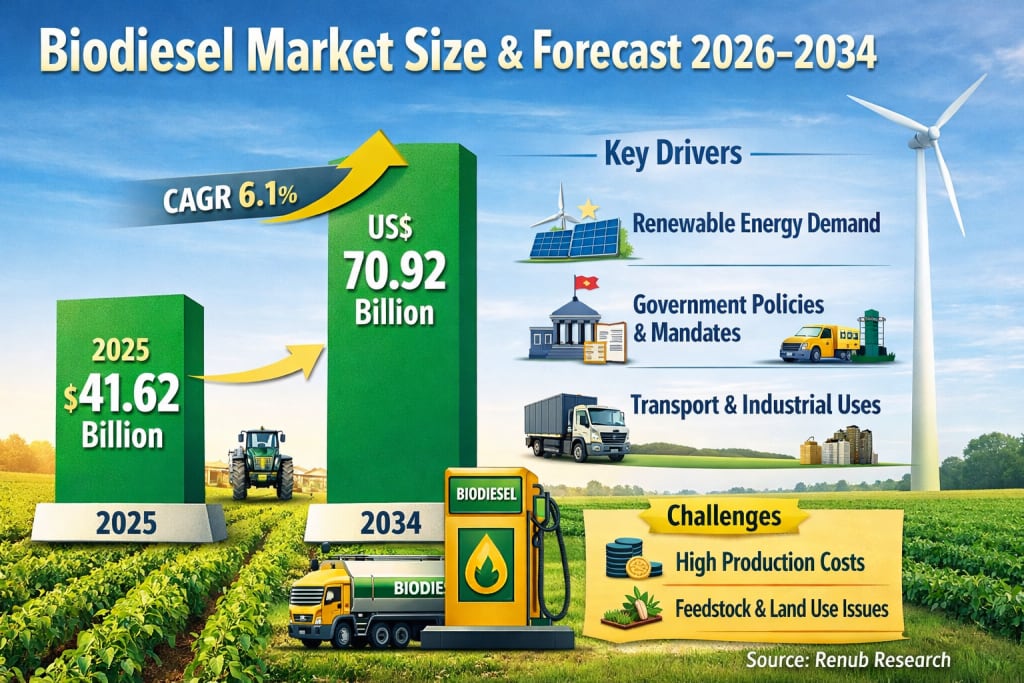
Biodiesel Market Size and Forecast 2026–2034
The global Biodiesel Market is projected to grow from US$ 41.62 Billion in 2025 to US$ 70.92 Billion by 2034, registering a Compound Annual Growth Rate (CAGR) of 6.1% from 2026 to 2034. This growth reflects the increasing demand for renewable energy solutions, global efforts to reduce carbon emissions, and the expansion of government policies supporting clean fuels.
Across the world, policymakers, industries, and consumers are increasingly shifting toward sustainable energy alternatives. Biodiesel, a renewable and biodegradable fuel derived from biological sources, is becoming a key solution in the global transition toward low-carbon energy systems.
The transportation sector remains the largest consumer of biodiesel, but its use is expanding into agriculture, industrial machinery, and power generation. Technological advancements in biofuel production, combined with supportive regulatory frameworks and blending mandates, are strengthening the biodiesel industry's global outlook.
Biodiesel Market Outlook
Biodiesel is a renewable fuel produced from biological feedstocks such as vegetable oils, animal fats, and recycled cooking oils. It is manufactured through a chemical process known as transesterification, which converts oils and fats into fatty acid methyl esters (FAME) that can power diesel engines.
One of biodiesel’s key advantages is that it can be used either in pure form (B100) or blended with conventional diesel without requiring major engine modifications. This compatibility allows existing diesel infrastructure and vehicles to adopt biodiesel with minimal adjustments.
Compared with traditional petroleum-based diesel, biodiesel offers several environmental benefits:
Lower greenhouse gas emissions
Reduced particulate matter and toxic pollutants
Improved engine lubrication
Biodegradability and lower toxicity in case of spills
These advantages make biodiesel an attractive alternative for governments and organizations aiming to reduce carbon footprints and improve air quality.
Growing concerns about climate change and energy security are pushing nations to diversify energy sources. Many countries have introduced biofuel blending mandates, requiring diesel fuel to contain a certain percentage of biodiesel.
In November 2024, energy company Repsol launched Nexa 100% Renewable Diesel, a renewable diesel product designed to enhance engine performance while reducing environmental impact. Innovations like these highlight the growing momentum behind renewable fuels.
As global investment in clean energy accelerates, biodiesel is emerging as a crucial component of sustainable transportation and energy strategies.
Growth Drivers of the Biodiesel Market
Increasing Demand for Renewable and Sustainable Energy
The shift toward renewable and sustainable energy sources is one of the strongest drivers of the biodiesel market.
Countries worldwide are working to reduce dependence on fossil fuels and lower greenhouse gas emissions. Biodiesel plays a key role in this transition because it produces significantly lower lifecycle carbon emissions compared with petroleum diesel.
Industries such as logistics, transportation, and agriculture are adopting biodiesel to meet sustainability goals and comply with environmental regulations. Many corporations are also incorporating renewable fuels into their sustainability commitments to reduce operational emissions.
Additionally, biodiesel offers several environmental advantages:
Lower sulfur emissions
Reduced carbon monoxide output
Lower particulate matter emissions
As governments and industries intensify efforts to combat climate change, the demand for renewable fuels like biodiesel is expected to grow steadily.
Government Policies, Incentives, and Blending Mandates
Government support remains a major catalyst for biodiesel market growth.
Many countries have introduced policies requiring mandatory blending of biodiesel with conventional diesel, ensuring a stable market demand for biofuels. These mandates are designed to lower emissions and promote the adoption of renewable energy.
Governments are also providing incentives such as:
Tax credits for biodiesel producers
Subsidies for renewable fuel production
Funding for biofuel research and development
Investments in biofuel infrastructure
In December 2025, Germany approved a draft biofuel law allowing food and animal feed crops to be used in biofuel production under specific regulations. The policy aims to reduce greenhouse gas emissions in the transportation sector by blending biofuels with fossil fuels.
Such policies not only stimulate biodiesel production but also encourage private investment in biofuel technologies and supply chains.
Public-private partnerships are also helping expand biodiesel distribution networks and improve accessibility in both developed and emerging markets.
Expanding Use in Transportation and Industrial Sectors
The transportation sector remains the largest consumer of biodiesel globally.
Diesel-powered vehicles such as:
Trucks
Buses
Agricultural machinery
Construction equipment
are increasingly using biodiesel blends to reduce emissions while maintaining performance.
Logistics and freight companies are particularly adopting biodiesel as part of their decarbonization strategies. Since biodiesel works in existing diesel engines, fleets can transition without replacing vehicles or infrastructure.
According to the International Energy Agency (IEA), road transportation accounted for nearly all liquid biofuel demand in 2022. While the share will slightly decline as other sectors adopt biofuels, road transport will remain the dominant market through 2030.
Global trade growth and increased freight transportation are further boosting fuel demand, creating additional opportunities for biodiesel adoption.
The agricultural sector also relies heavily on diesel-powered equipment, making biodiesel an attractive option for reducing emissions in farming operations.
Challenges Facing the Biodiesel Market
High Production Costs and Feedstock Price Volatility
Despite its advantages, biodiesel production faces cost challenges.
The primary feedstocks used for biodiesel production include:
Soybean oil
Palm oil
Rapeseed oil
Animal fats
Used cooking oil
Prices for these raw materials can fluctuate significantly due to agricultural output, climate conditions, and global commodity markets.
High feedstock costs can make biodiesel more expensive than petroleum diesel, particularly in regions where fossil fuels remain heavily subsidized.
Additionally, biodiesel production requires specialized processing equipment and infrastructure, which increases capital investment requirements for manufacturers.
Small-scale biodiesel producers may face financial challenges when raw material prices rise or supply chains become unstable.
Improving production efficiency and developing alternative feedstocks will be critical to reducing costs and expanding biodiesel adoption worldwide.
Feedstock Availability and Land Use Concerns
Another major challenge in the biodiesel market is the availability of sustainable feedstocks.
Large-scale biodiesel production often relies on agricultural crops such as soybeans and palm oil. However, increasing demand for these crops may create competition between food production and fuel production.
Concerns related to land use include:
Deforestation for crop cultivation
Pressure on agricultural land
Food price inflation
To address these concerns, researchers and industry stakeholders are exploring alternative feedstocks such as:
Algae-based oils
Waste oils and fats
Agricultural residues
These alternative sources can help ensure sustainable biodiesel production while reducing environmental impact and avoiding competition with food resources.
Fuel Biodiesel Market
Fuel applications represent the largest segment of the biodiesel market.
Biodiesel is widely used as a transportation fuel due to its compatibility with existing diesel engines. It can be blended with conventional diesel in various proportions, including B5, B10, and B20 blends.
Key advantages of biodiesel fuel include:
Lower greenhouse gas emissions
Reduced air pollution
Improved engine lubrication
Governments are encouraging the use of biodiesel in transportation through blending mandates and renewable fuel standards.
As the world transitions toward cleaner transportation fuels, biodiesel is expected to remain an essential component of the global energy mix.
Power Generation Biodiesel Market
Biodiesel is increasingly being used in power generation, particularly in regions where reliable electricity infrastructure is limited.
Diesel generators powered by biodiesel provide an alternative energy source for:
Remote communities
Construction sites
Industrial facilities
Emergency power systems
Compared with traditional diesel, biodiesel-powered generators produce fewer emissions, making them a cleaner option for electricity generation.
Growing demand for renewable electricity solutions is likely to support the expansion of biodiesel in the power generation sector.
Vegetable Oil Biodiesel Market
Vegetable oils remain the most common feedstock for biodiesel production.
Major vegetable oil sources include:
Soybean oil
Palm oil
Rapeseed oil
Sunflower oil
These oils possess favorable chemical properties that allow efficient conversion into biodiesel.
Many countries promote vegetable oil biodiesel production to reduce dependence on imported fossil fuels and support domestic agriculture.
Government policies encouraging biofuel blending are also increasing the demand for vegetable oil-based biodiesel worldwide.
Animal Fats Biodiesel Market
Animal fats are emerging as a cost-effective and environmentally sustainable feedstock for biodiesel production.
Common animal fat sources include:
Tallow
Poultry fat
Fish oil by-products
Using animal fats in biodiesel production helps convert waste materials into valuable energy resources.
This approach offers several benefits:
Reduced waste disposal issues
Lower production costs
Reduced reliance on crop-based feedstocks
Technological advancements are improving the efficiency and quality of biodiesel derived from animal fats, further supporting market growth.
Regional Insights
United States Biodiesel Market
The United States represents one of the largest biodiesel markets globally.
Government programs such as the Renewable Fuel Standard (RFS) require fuel producers to blend renewable fuels with conventional fuels. These policies have helped establish a strong biodiesel industry in the country.
The U.S. also benefits from abundant feedstocks such as soybean oil, animal fats, and used cooking oil.
In May 2025, the commodity reporting agency Argus expanded its real-time electronic price discovery system to biodiesel trading in New York Harbor, enhancing transparency in biodiesel pricing.
United Kingdom Biodiesel Market
The United Kingdom is strengthening its biodiesel industry as part of broader efforts to reduce carbon emissions and transition to renewable energy.
The country encourages the use of waste-based feedstocks such as used cooking oil and animal fats, promoting sustainable biofuel production.
In January 2026, Corteva announced a joint venture with bp called Etlas, focused on producing crop-based oils that can be used in renewable fuels such as sustainable aviation fuel and renewable diesel.
India Biodiesel Market
India’s biodiesel market is expanding due to increasing energy demand and government initiatives promoting renewable fuels.
India imports a significant portion of its crude oil, making biodiesel an important strategy for improving energy security and reducing import dependency.
The government is encouraging biodiesel production using non-edible oil crops and waste oils, ensuring that biofuel production does not compete with food supplies.
In August 2024, Desmet participated in the inauguration of a 450 TPD biodiesel plant operated by M11 Industries, highlighting the country’s growing investment in biofuel infrastructure.
Saudi Arabia Biodiesel Market
Saudi Arabia is gradually exploring biodiesel as part of its strategy to diversify energy sources and reduce carbon emissions.
The country’s Vision 2030 initiative promotes renewable energy development, including biofuels.
In March 2023, Saudi Arabia inaugurated its first biofuel production facility in Al Jubail, financed by Saudi investors with support from Aramco’s venture arm Waed Ventures.
As industrialization and transportation demand grow, biodiesel could play an increasingly important role in the country’s energy transition.
Final Thoughts
The global biodiesel market is entering a period of steady expansion, supported by growing environmental awareness, government regulations, and advancements in renewable fuel technologies.
With projected growth to US$ 70.92 billion by 2034, biodiesel is positioned as a key contributor to the global transition toward cleaner and more sustainable energy systems.
Although challenges such as feedstock availability and production costs remain, ongoing research, technological innovation, and policy support are expected to strengthen the biodiesel industry.
As countries strive to reduce emissions and diversify energy sources, biodiesel will continue to play an important role in shaping the future of sustainable transportation and renewable energy.
About the Creator
Keep reading
More stories from shibansh kumar and writers in Trader and other communities.
Next Generation Sequencing Market Size and Forecast 2026–2034
The global Next Generation Sequencing (NGS) Market is witnessing remarkable expansion as genomic technologies continue to reshape healthcare, research, and biotechnology industries. According to Renub Research, the Next Generation Sequencing market is projected to grow from US$ 10.73 Billion in 2025 to US$ 30.58 Billion by 2034, expanding at a Compound Annual Growth Rate (CAGR) of 12.34% from 2026 to 2034.
By shibansh kumara day ago in Trader
Australia IT Services Market 2026: Cloud Transformation, AI Integration & Cybersecurity Demand
Australia IT Services Market Overview The Australia IT services market is a critical component of the country’s digital economy, supporting businesses with services such as system integration, IT consulting, managed services, cloud solutions and cybersecurity management. Organizations across industries—including banking, telecommunications, healthcare, retail and government—are increasingly relying on IT services to modernize infrastructure, improve operational efficiency and enhance digital capabilities.
By Amyra Singh2 days ago in Trader
Australia Wellness Tourism Market Growth, Forecast, and Strategic Insights 2034
Wellness tourism has become one of the fastest-growing segments of the global travel industry, and Australia is emerging as a key destination for travelers seeking relaxation, healing, and holistic well-being experiences. From luxury spa resorts and yoga retreats to nature-based mindfulness experiences and Indigenous cultural healing programs, the country offers a wide variety of wellness-focused travel opportunities.
By Rashi Sharmaa day ago in Trader
TUS NUA - ch 53
TUS NUA – ch 53 New Beginnings – Mia and Midnight (*)(*)(*) Finola knew Ali’s brother-in-law needed to put his mind at rest. She fed her arm through his and led him outside. “We’ll sit here. If you like, I can put a block around us so our conversation will be private.”
By Margaret Brennan5 days ago in Fiction




Comments
There are no comments for this story
Be the first to respond and start the conversation.