
China In Vitro Fertilization Market Forecast 2026–2034: Rising Infertility Rates and Policy Support Accelerate Industry Growth
With changing demographics, delayed parenthood, and expanding fertility technologies, China’s IVF market is set to grow rapidly through 2034.

China In Vitro Fertilization Market Size and Forecast 2026–2034
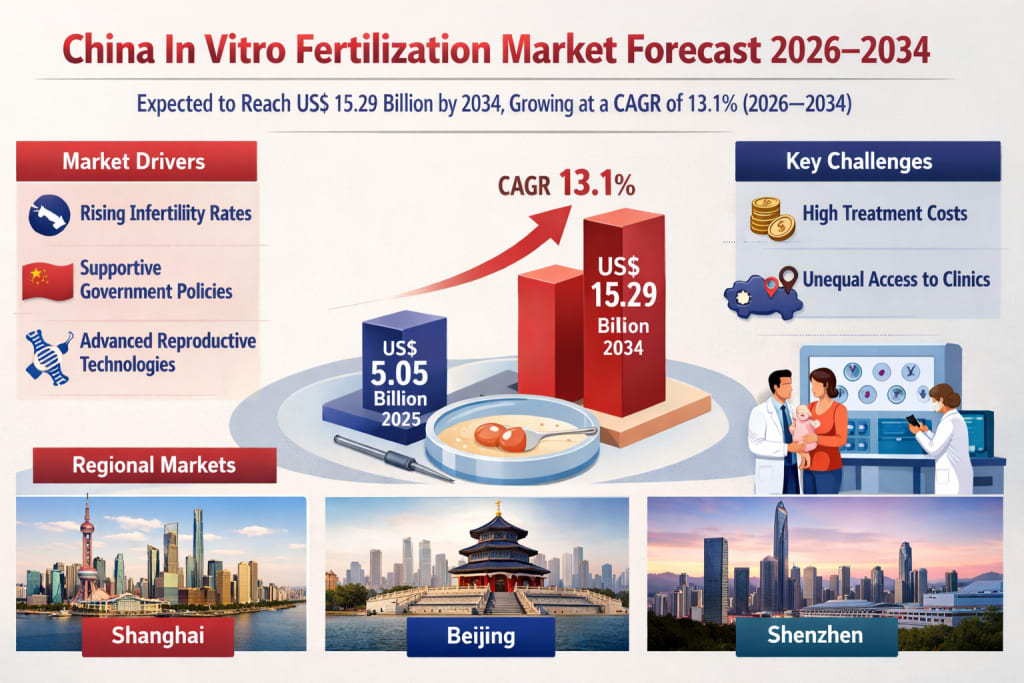
The China In Vitro Fertilization (IVF) Market is entering a transformative growth phase, driven by demographic shifts, evolving social norms, and major technological advancements in reproductive medicine. According to industry analysis, the China IVF market is expected to reach US$ 15.29 billion by 2034, rising from US$ 5.05 billion in 2025, growing at a compound annual growth rate (CAGR) of 13.1% from 2026 to 2034.
Several factors are contributing to this rapid expansion. Rising infertility rates, delayed parenthood among urban populations, supportive government initiatives encouraging childbirth, and growing awareness about assisted reproductive technologies are all playing a critical role in shaping market demand. Additionally, increasing investments in fertility clinics, specialized reproductive hospitals, and advanced laboratory technologies are strengthening China’s position as one of the fastest-growing IVF markets globally.
As social attitudes evolve and reproductive technologies become more accessible, IVF treatments are transitioning from niche medical procedures to mainstream healthcare solutions across the country.
China In Vitro Fertilization Industry Overview
In Vitro Fertilization (IVF) is one of the most widely used assisted reproductive technologies (ART) designed to help individuals or couples conceive when natural pregnancy becomes difficult. The procedure involves fertilizing an egg with sperm outside the body in a controlled laboratory environment. Once fertilization occurs, the resulting embryo is carefully monitored and then transferred into the uterus with the aim of achieving pregnancy.
The IVF process typically includes several key stages:
Hormonal stimulation of the ovaries to produce multiple eggs
Egg retrieval from the ovaries
Fertilization of eggs with sperm in a laboratory setting
Embryo culture and monitoring
Transfer of a healthy embryo into the uterus
Over the past two decades, scientific innovations have significantly improved IVF success rates. Advanced technologies such as preimplantation genetic testing (PGT), time-lapse embryo imaging, frozen embryo transfer, and improved cryopreservation methods have enhanced embryo selection and improved pregnancy outcomes.
China’s healthcare system has increasingly embraced these technologies, leading to the development of highly specialized fertility clinics and reproductive research centers. With a growing number of trained reproductive specialists and modern laboratory facilities, China is becoming a major hub for fertility treatment and reproductive innovation.
Rising Demand for IVF in China
Demand for IVF treatments in China is rising steadily as infertility becomes a growing public health concern. Urbanization, environmental pollution, lifestyle changes, and high work-related stress have all contributed to declining fertility rates across the country.
One of the most significant drivers of infertility is delayed parenthood. Many young professionals are choosing to focus on career development and financial stability before starting families. While this trend reflects broader social transformation, it also increases the risk of age-related fertility challenges, especially for women over the age of 35.
Male infertility is also increasing due to factors such as obesity, sedentary lifestyles, smoking, and environmental toxins. As a result, more couples are seeking medical solutions to overcome reproductive challenges.
Fertility clinics across China report rising patient volumes every year. This growing demand is pushing healthcare providers to expand their IVF services, improve clinical infrastructure, and adopt advanced reproductive technologies that can increase treatment success rates.
Government Policies Encouraging Population Growth
China’s demographic policies have undergone significant changes in recent years, creating new opportunities for the fertility treatment market.
For decades, the country maintained strict birth control regulations under the one-child policy. However, concerns about a rapidly aging population and declining birth rates led the government to introduce major policy reforms.
Key policy developments include:
Removal of the one-child policy
Introduction of the two-child policy
Later expansion to allow three children per family
These changes aim to encourage population growth and address long-term demographic challenges. As part of these initiatives, several regional governments have begun exploring ways to improve access to fertility treatments.
In some provinces and municipalities, infertility treatments such as IVF have started to receive partial insurance coverage or subsidies. Although nationwide coverage remains limited, these regional initiatives are helping reduce financial barriers for many families.
Government support has also encouraged investment in reproductive health infrastructure, including fertility clinics, research centers, and specialist training programs.
Technological Innovations Transforming IVF Treatment
Technology plays a central role in the growth of China’s IVF market. Modern fertility clinics are rapidly adopting new tools that improve both efficiency and success rates.
Some of the most important technological advancements include:
Preimplantation Genetic Testing (PGT)
This technology allows specialists to screen embryos for genetic abnormalities before implantation, increasing the chances of a healthy pregnancy.
Time-Lapse Embryo Monitoring
Advanced imaging systems continuously monitor embryo development in incubators, allowing embryologists to select the healthiest embryos for transfer.
Cryopreservation Technologies
Modern freezing techniques enable embryos, eggs, and sperm to be preserved for future use without compromising quality.
Artificial Intelligence in Embryo Selection
AI-powered software is increasingly being used to analyze embryo quality and predict implantation success.
These innovations not only improve clinical outcomes but also increase patient confidence in IVF treatments. As Chinese fertility centers continue to collaborate with international technology providers, access to cutting-edge reproductive solutions is expanding across the country.
Challenges Facing the China IVF Market
Despite strong growth prospects, several challenges continue to affect the development of China’s IVF industry.
High Cost of Treatment
One of the most significant barriers to IVF adoption is the high cost of treatment. IVF procedures involve advanced laboratory equipment, specialized medications, and highly trained medical professionals, making them expensive for many families.
A single IVF cycle can cost thousands of dollars, and multiple cycles are often required before achieving pregnancy. Because insurance coverage for fertility treatments remains limited in many regions, most patients must pay out of pocket.
This financial burden discourages some couples from pursuing treatment and creates disparities in access between higher-income and lower-income populations.
Uneven Access to Fertility Clinics
Another challenge is the unequal distribution of fertility clinics across China.
Major metropolitan areas such as Beijing and Shanghai have world-class reproductive hospitals and research centers. However, many rural and less-developed regions lack specialized fertility services.
As a result, couples from smaller cities often travel long distances to receive treatment. This can increase travel costs, prolong waiting times, and add emotional stress during an already challenging medical journey.
Improving the availability of fertility services across all regions will be crucial for ensuring equitable access to IVF treatment nationwide.
Regional Insights: Key IVF Markets in China
Shanghai IVF Market
Shanghai represents one of the most advanced fertility treatment hubs in China. The city’s strong healthcare infrastructure, high-income population, and concentration of leading fertility hospitals contribute significantly to market growth.
Many women in Shanghai delay childbirth due to career ambitions and higher education, increasing demand for reproductive assistance. The city’s fertility clinics offer state-of-the-art technologies, including genetic testing and advanced embryo monitoring systems.
Shanghai also attracts patients from nearby provinces seeking high-quality IVF services, making it a key center for fertility medical tourism.
Beijing IVF Market
Beijing’s IVF market benefits from the presence of major medical universities, research institutes, and highly specialized reproductive hospitals.
The city is home to some of the country’s most experienced fertility specialists and cutting-edge laboratories. Clinics in Beijing often provide advanced procedures such as genetic screening, egg freezing, and AI-assisted embryo selection.
Demand is largely driven by working professionals who delay marriage and parenthood due to career commitments. Public awareness campaigns promoting family growth further support market expansion in the capital.
Shenzhen IVF Market
Shenzhen is emerging as a rapidly growing IVF market thanks to its young population, strong economy, and innovation-driven healthcare sector.
Known as China’s technology hub, Shenzhen has embraced digital healthcare solutions and AI-powered medical systems. Many fertility clinics in the city integrate advanced laboratory automation and data-driven embryo selection tools.
High work pressure and intense corporate culture have contributed to increasing infertility rates among professionals. As a result, demand for IVF services continues to grow across the region.
Market Segmentation
By Treatment Type
Fresh Embryo
Frozen Embryo
Donor Egg
Others
By Instrument
Culture Media
Disposable Devices
Capital Equipment
By Procedure
ICSI IVF
Non-ICSI IVF
IUI Canada
By End User
Fertility Clinics
Hospitals
Others
By City
Beijing
Shanghai
Jiangsu
Fujian
Zhejiang
Tianjin
Guangdong
Inner Mongolia
Hubei
Chongqing
Rest of China
Key Companies in the China IVF Market
The competitive landscape of China’s IVF industry includes several international and regional fertility service providers and medical technology companies. These organizations are actively investing in reproductive technologies, clinic expansion, and research collaborations.
Major companies operating in the market include:
Vitrolife
Cloudnine
Nova IVI Fertility
Monash IVF
Maria Fertility Hospital
Bangkok Fertility Center
EMD Serono, Inc.
Industry research often evaluates these companies from multiple strategic viewpoints, including company overview, key personnel, recent developments, SWOT analysis, and revenue performance.
Final Thoughts
China’s In Vitro Fertilization market is poised for substantial growth over the next decade. Demographic shifts, declining birth rates, delayed parenthood, and rising infertility are increasing demand for assisted reproductive technologies across the country.
At the same time, supportive government policies encouraging childbirth, expanding fertility awareness, and rapid technological innovation are strengthening the IVF ecosystem.
While challenges such as high treatment costs and unequal regional access remain, ongoing investments in fertility infrastructure and reproductive research are expected to address these barriers over time.
As healthcare providers continue to adopt advanced technologies and expand specialized fertility services, China’s IVF market is set to play a crucial role in shaping the future of reproductive healthcare and family planning in the world’s most populous nation.
About the Creator
Sakshi Sharma
Content Writer with 7+ years of experience crafting SEO-driven blogs, web copy & research reports. Skilled in creating engaging, audience-focused content across diverse industries.
Keep reading
More stories from Sakshi Sharma and writers in Trader and other communities.
Australia Smart Home Market Size and Forecast 2026–2034
Introduction The Australia Smart Home Market is experiencing remarkable growth as households increasingly adopt connected technologies designed to improve convenience, safety, and energy efficiency. Smart devices are transforming traditional homes into digitally connected living spaces where lighting, climate control, entertainment systems, and security devices can be managed through mobile applications, voice commands, or automated schedules.
By Sakshi Sharmaa day ago in Trader
Commercial Satellite Imaging Market: AI, Space Technology, and the Future of Global Earth Observation
Commercial Satellite Imaging Market: Transforming Global Intelligence and Data Insights The commercial satellite imaging market has become a critical component of the modern data-driven economy. Satellite imagery provides valuable insights about Earth’s surface, enabling organizations to monitor environmental changes, manage natural resources, track infrastructure development, and improve national security.
By James Smith3 days ago in Trader



Comments
There are no comments for this story
Be the first to respond and start the conversation.