
Europe Electric Vehicle Charging Infrastructure Market Size and Forecast (2025–2033)
Europe Accelerates Toward an Electrified Future with Rapid Expansion of EV Charging Networks

Introduction
Europe is undergoing a transformative shift toward sustainable mobility, and electric vehicles (EVs) are at the center of this transition. As governments, industries, and consumers increasingly prioritize cleaner transportation, the development of robust EV charging infrastructure has become essential. Across the continent, thousands of new charging stations are being deployed to support the growing fleet of electric vehicles and to accelerate the transition away from fossil-fuel-powered mobility.
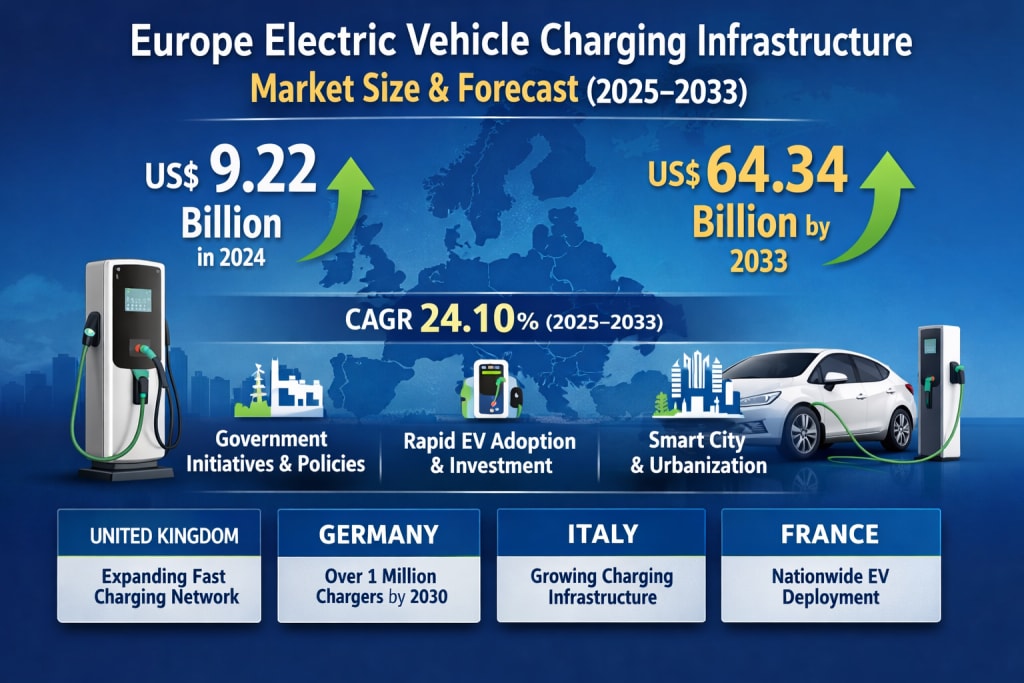
According to Renub Research, the Europe Electric Vehicle Charging Infrastructure Market is projected to reach US$ 64.34 Billion by 2033, up from US$ 9.22 Billion in 2024, expanding at a compound annual growth rate (CAGR) of 24.10% between 2025 and 2033. This remarkable growth is being driven by strong government incentives, rapid EV adoption, increased investment in infrastructure, and the presence of major electric vehicle manufacturers across the region.
Europe currently stands as a global leader in EV infrastructure development. With ambitious climate goals, strong policy frameworks, and increasing public awareness, the region is rapidly building the charging ecosystem required to support widespread electric mobility.
Europe Electric Vehicle Charging Infrastructure Industry Overview
Europe’s EV charging infrastructure has expanded dramatically over the past few years. By the end of 2023, the European Union had approximately 700,000 public charging stations, reflecting a sharp increase from previous years. These stations include both alternating current (AC) chargers and high-power direct current (DC) fast chargers installed across highways, urban centers, workplaces, and residential complexes.
Despite this progress, the European Commission has set a much larger target: 3.5 million public charging stations by 2030. Achieving this goal requires significantly accelerating installation rates across the continent.
The rapid development of charging infrastructure is supported by several key factors, including technological advancements in charging solutions, supportive government regulations, and the rising popularity of electric vehicles among consumers. Countries such as Norway, the Netherlands, and Germany are leading the way in terms of charging station density and infrastructure deployment.
Additionally, renewable energy integration is becoming an important feature of EV charging infrastructure. Charging networks increasingly rely on solar and wind energy sources, helping Europe move closer to its broader climate objectives.
Nevertheless, challenges remain. Infrastructure expansion requires substantial financial investment, regulatory alignment across countries, and the deployment of intelligent charging systems capable of managing electricity demand efficiently.
Strong Policy Support Accelerating Market Growth
Government initiatives and climate policies across Europe are playing a crucial role in expanding EV charging infrastructure. Programs such as the European Union Green Deal and the Fit for 55 package are designed to reduce carbon emissions and accelerate the transition to electric mobility.
These initiatives encourage investments in charging networks and support the development of sustainable transportation infrastructure. Governments are also introducing stricter emissions standards and announcing timelines to phase out internal combustion engine vehicles.
In February 2025, more than 3,500 companies involved in EV charging technologies pledged to double their workforce to accelerate electric mobility in Europe. This initiative is expected to create over 162,000 new jobs between 2025 and 2030, highlighting the economic as well as environmental impact of the EV charging industry.
Collaborations among energy companies, charging technology providers, and automotive manufacturers are further strengthening the market. For example, in February 2025, a partnership involving E.ON, Eldrive, and ZSE announced plans to deploy over 1,400 EV charging stations across 13 European countries by 2027, with investments exceeding USD 47 million. Such collaborations will significantly increase the availability of medium and fast charging infrastructure across the region.
Key Factors Driving the Europe EV Charging Infrastructure Market
Growing Private Sector Investment
Private sector participation is one of the most significant drivers of Europe’s EV charging infrastructure expansion. Major energy companies, automotive manufacturers, and technology firms are heavily investing in charging networks to support the growing EV market.
Automakers are increasingly building proprietary charging networks to support their electric vehicle offerings and enhance customer convenience. At the same time, energy companies are expanding public charging networks and integrating advanced technologies such as smart charging systems and energy management solutions.
Public-private partnerships (PPPs) have also become common in large-scale infrastructure projects. These collaborations allow governments and businesses to combine financial resources, technological expertise, and operational capabilities to build efficient charging ecosystems.
Such investments help address infrastructure gaps in both urban and rural areas, ensuring broader accessibility for EV users.
Sustainability Goals and Emission Targets
Europe’s ambitious sustainability targets are another major catalyst for EV charging infrastructure growth. The European Union has committed to achieving carbon neutrality by 2050, and transportation plays a critical role in achieving this objective.
To support this transition, many European countries have introduced policies encouraging EV adoption while gradually restricting gasoline and diesel vehicles. Nations such as Germany, France, and the United Kingdom have announced long-term plans to phase out internal combustion engine vehicles.
A comprehensive and reliable charging network is essential to support these policies. Without widespread charging availability, EV adoption would slow significantly. As a result, both governments and private companies are prioritizing infrastructure development as part of broader environmental strategies.
Urbanization and Smart City Development
Urbanization and the rise of smart cities are also accelerating the deployment of EV charging infrastructure in Europe. Many cities are integrating electric mobility solutions into urban planning initiatives to reduce pollution, improve transportation efficiency, and enhance sustainability.
Smart cities emphasize digital connectivity, renewable energy integration, and intelligent transportation systems. As part of these initiatives, EV charging stations are being installed in residential complexes, shopping centers, parking facilities, and public transportation hubs.
Modern charging systems are increasingly connected to smart grids, enabling features such as load balancing, demand response, and remote monitoring. These technologies ensure efficient electricity use and support the integration of renewable energy sources.
As European cities continue to adopt smart mobility strategies, EV charging infrastructure will remain a central component of urban development.
Challenges in the Europe Electric Vehicle Charging Infrastructure Market
Uneven Infrastructure Deployment
One of the biggest challenges in Europe’s EV charging infrastructure market is the uneven distribution of charging stations across countries.
Western European nations such as Germany, the Netherlands, and Norway have developed extensive charging networks, offering both slow and fast charging options. However, many countries in Eastern and Southern Europe still face infrastructure shortages due to lower EV adoption rates, limited government support, and financial constraints.
This uneven distribution creates fragmentation within the European EV ecosystem. It can also make cross-border travel more difficult for EV users, reducing convenience and slowing adoption.
Addressing this challenge will require coordinated EU policies, increased funding, and incentives to support infrastructure development in underdeveloped regions.
High Installation and Maintenance Costs
The installation of EV charging infrastructure requires significant financial investment, particularly for high-speed charging stations.
Costs include civil engineering work, grid upgrades, land acquisition, and advanced charging equipment. These expenses can be especially high in rural areas or regions with limited grid capacity.
Furthermore, ongoing operational costs such as maintenance, customer support, energy management, and software updates add to the financial burden.
These costs may discourage local governments and private investors from expanding charging networks in areas with lower EV adoption rates. To overcome this challenge, governments and businesses must develop innovative financing models and cost-sharing partnerships.
Regional Insights: EV Charging Infrastructure Across Europe
United Kingdom
The United Kingdom has emerged as one of Europe’s leading EV charging infrastructure markets. Strong government policies, environmental regulations, and growing consumer demand for electric vehicles are driving rapid infrastructure expansion.
The UK government has introduced multiple initiatives to support the development of public and private charging networks. Investments are being directed toward expanding fast and ultra-fast chargers along highways and in urban areas.
In addition to public infrastructure, home and workplace charging solutions are also gaining popularity. However, challenges remain in rural areas where charging availability is still limited.
Private sector participation is playing a major role in addressing these challenges by introducing innovative charging solutions and improving user experiences.
Germany
Germany represents one of the largest EV charging infrastructure markets in Europe. The country has set ambitious targets to install over one million charging stations by 2030.
Government incentives and funding programs are encouraging both public and private investments in charging infrastructure. Automakers and energy companies are actively participating in expanding charging networks nationwide.
Despite significant progress, Germany still faces challenges related to regional disparities and the need for grid modernization. Continued collaboration between government agencies, industry players, and local communities will be essential to ensure equitable access to charging infrastructure.
Italy
Italy is rapidly expanding its EV charging infrastructure as electric mobility gains popularity. Government policies and financial incentives are encouraging the deployment of charging stations across the country.
Private companies are also investing heavily in charging networks to improve accessibility and convenience for EV users. These initiatives focus on improving charging speed, increasing station availability, and enhancing user experience.
However, regional differences remain a challenge, particularly between northern and southern parts of the country. Continued investment and collaboration will be necessary to ensure balanced infrastructure development.
France
France has made significant progress in expanding its EV charging infrastructure to support the growing electric vehicle market. Government initiatives, financial incentives, and regulatory measures are encouraging companies to deploy charging stations across the country.
Private sector participation is also increasing, with several companies investing in nationwide charging networks. These investments aim to improve charging speed, availability, and overall user experience.
Despite these efforts, challenges such as regional disparities and the need for continued investment remain. Nevertheless, France’s commitment to sustainable mobility and environmental goals continues to drive infrastructure development.
Market Segmentation
By Charger Type
Slow Charger
Fast Charger
By Charging Type
AC Charging
DC Charging
By Installation Type
Fixed
Portable
By Connector
CHAdeMO
CCS
Others
By Level of Charging
Level 1
Level 2
Level 3
By Connectivity
Non-connected Charging Stations
Connected Charging Stations
By Deployment
Private
Public
By Application
Commercial
Residential
Regional Outlook
France, Germany, Italy, Spain, United Kingdom, Belgium, Netherlands, Russia, Poland, Greece, Norway, Romania, Portugal, and Rest of Europe.
Key Companies in the Market
Major companies operating in the Europe EV charging infrastructure market include:
ABB Ltd.
ChargePoint, Inc.
Blink Charging Co.
Eaton Corporation
Tesla Inc.
Webasto Group
Schneider Electric, Inc.
Siemens
Delta Electronics, Inc.
These companies are actively expanding their charging networks, developing advanced technologies, and forming partnerships to strengthen their presence in the rapidly growing EV ecosystem.
Final Thoughts
Europe’s electric vehicle charging infrastructure market is entering a phase of rapid expansion as governments, industries, and consumers embrace the transition toward sustainable transportation. With strong policy support, increasing investments, and growing EV adoption, the region is well positioned to become a global leader in electric mobility.
However, addressing challenges such as uneven infrastructure distribution and high installation costs will be crucial for ensuring widespread EV accessibility. Continued collaboration between governments, private companies, and technology providers will be essential to build a reliable and efficient charging network.
As Europe moves closer to its carbon neutrality goals, EV charging infrastructure will remain a cornerstone of the continent’s clean energy transition and a key driver of the future mobility ecosystem.
About the Creator
Commercial Satellite Imaging Market: AI, Space Technology, and the Future of Global Earth Observation
Commercial Satellite Imaging Market: Transforming Global Intelligence and Data Insights The commercial satellite imaging market has become a critical component of the modern data-driven economy. Satellite imagery provides valuable insights about Earth’s surface, enabling organizations to monitor environmental changes, manage natural resources, track infrastructure development, and improve national security.
By James Smith3 days ago in Trader
LIPIDS Market Size and Forecast 2026–2034
The global LIPIDS Market is entering a transformative growth phase, driven by rising health awareness, expanding industrial applications, and growing sustainability initiatives. According to Renub Research, the LIPIDS Market is expected to reach US$ 22.1 billion by 2034, up from US$ 12.04 billion in 2025, expanding at a CAGR of 6.98% from 2026 to 2034.
By Sakshi Sharma4 days ago in Trader
Becca
"Everything is so... flat." Denille said stupidly as she looked around her new neighborhood. She looked around at the muted desert where even the smallest sign of life seemed to have given up. The plant life was shrubs that were half cooked by the heat and where there should have been a lawn, a mess of white rocks laid glistening in the sun. Even the sky looked stretched thin, like the sun had ironed it smooth. She’d moved from Riverside, where at least there were hills, but here in Barstow, everything felt baked and brittle.
By Sara Wilson8 days ago in Fiction



Comments
There are no comments for this story
Be the first to respond and start the conversation.