
Frozen Vegetables Market Size and Forecast 2026–2034: Convenience Foods and Cold-Chain Innovation Drive Global Demand
Rising demand for quick meal solutions, technological advancements in freezing methods, and expanding retail networks are accelerating the growth of the global frozen vegetables industry.

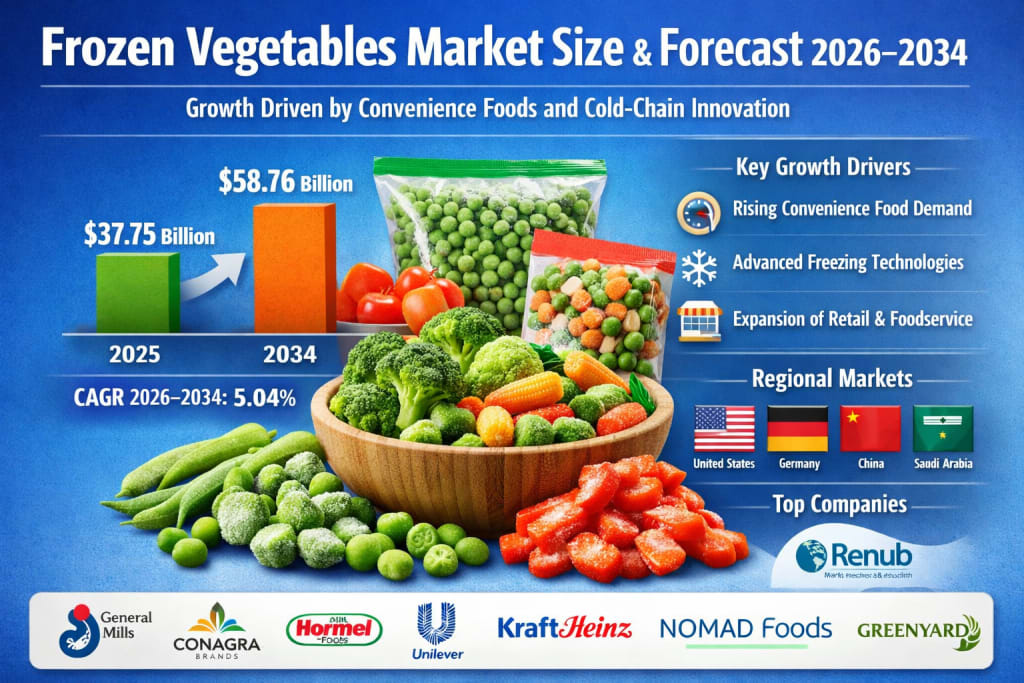
Frozen Vegetables Market Size and Forecast 2026–2034
The global frozen vegetables market is entering a period of consistent expansion as consumers increasingly prioritize convenience, nutrition, and year-round food availability. According to insights from Renub Research, the Frozen Vegetables Market is expected to reach US$ 58.76 billion by 2034, rising from US$ 37.75 billion in 2025, growing at a compound annual growth rate (CAGR) of 5.04% between 2026 and 2034.
Several factors are contributing to this steady growth. The modern consumer lifestyle—marked by busy work schedules, urban living, and the need for quick meal preparation—has created strong demand for ready-to-cook food products. Frozen vegetables meet this demand by offering convenient preparation, longer shelf life, and consistent quality.
At the same time, technological advancements in freezing techniques and improvements in cold-chain logistics have enhanced product quality and availability across global markets. The rapid growth of supermarkets, hypermarkets, and online grocery platforms is further boosting access to frozen foods, making them a regular part of everyday meal planning.
As a result, frozen vegetables are becoming increasingly popular among households, foodservice providers, and food manufacturers worldwide.
Frozen Vegetables Industry Overview
Frozen vegetables are produced by harvesting fresh vegetables and subjecting them to a carefully controlled process that includes washing, trimming, cutting, blanching, and rapid freezing. The brief blanching step helps deactivate enzymes that could otherwise affect taste, color, and nutritional quality during storage.
Following this process, the vegetables are rapidly frozen at extremely low temperatures, which helps preserve their texture, flavor, and nutrient content. Once frozen, they are stored and transported under temperature-controlled conditions until they reach retail shelves or foodservice establishments.
One of the main advantages of frozen vegetables is their long shelf life. Unlike fresh produce that may spoil within days, frozen vegetables can remain safe and nutritious for months without the need for preservatives.
Additionally, freezing vegetables shortly after harvest helps retain essential vitamins and minerals. In many cases, frozen vegetables can be as nutritious as—or even more nutritious than—fresh vegetables that spend extended periods in transportation and storage before reaching consumers.
These benefits make frozen vegetables an appealing choice for modern households seeking convenient, healthy, and cost-effective food options.
Growth Drivers for the Frozen Vegetables Market
Rising Demand for Convenience Foods
One of the most powerful forces driving the frozen vegetables market is the growing global demand for convenience foods. As urbanization increases and work schedules become more demanding, consumers are seeking meal solutions that are quick, easy, and nutritious.
Frozen vegetables provide exactly that. They are typically pre-washed, pre-cut, and ready to cook, which significantly reduces meal preparation time. For busy families and working professionals, this convenience is highly valuable.
The rise of dual-income households has also played an important role. With both partners working full-time, many families have less time available for extensive cooking and food preparation. Frozen vegetables offer a simple way to include healthy ingredients in meals without spending additional time cleaning and chopping fresh produce.
Single-person households and young urban consumers are also contributing to market growth. These consumers often prefer smaller portion sizes and easy-to-store ingredients, both of which frozen vegetables provide.
As the global population continues to adopt faster lifestyles, the appeal of convenient and nutritious food options is expected to strengthen further.
Advancements in Freezing and Processing Technologies
Technological innovation in food processing has significantly improved the quality of frozen vegetables. Modern freezing methods, particularly Individual Quick Freezing (IQF) technology, play a crucial role in preserving vegetables.
IQF technology freezes individual pieces of vegetables rapidly, preventing them from clumping together. This process helps maintain the natural shape, texture, and taste of each vegetable piece while also making it easier for consumers to portion the product during cooking.
In addition to freezing technology, improvements in processing equipment have enhanced cleaning, blanching, and packaging procedures. Automated systems now allow manufacturers to maintain consistent quality and ensure high standards of food safety.
Cold-chain logistics have also improved significantly. Temperature-controlled storage, refrigerated transportation, and advanced monitoring systems ensure that frozen vegetables remain at optimal temperatures throughout the supply chain.
These technological developments have helped eliminate the outdated perception that frozen vegetables are inferior to fresh produce. Instead, many consumers now recognize that frozen vegetables offer reliable quality and strong nutritional value.
Expansion of Retail and Foodservice Sectors
The global expansion of modern retail formats is another key factor supporting market growth. Supermarkets and hypermarkets dedicate significant shelf space to frozen foods, providing consumers with easy access to a wide variety of frozen vegetable products.
These retail outlets also use attractive packaging, promotional discounts, and in-store marketing campaigns to increase consumer awareness and encourage purchases.
E-commerce platforms are further accelerating sales. Online grocery shopping has become increasingly popular, especially in urban areas where consumers value convenience and home delivery services. Frozen vegetables are well-suited to this model because they can be transported safely using insulated packaging and cold-chain logistics.
Meanwhile, the foodservice industry—including restaurants, cafeterias, hotels, and catering companies—relies heavily on frozen vegetables. For large-scale kitchens, frozen ingredients provide several operational advantages such as:
Consistent quality
Reduced preparation time
Lower food waste
Predictable pricing
The rapid expansion of quick-service restaurants, meal-kit providers, and cloud kitchens is further increasing demand for frozen vegetable ingredients.
Challenges in the Frozen Vegetables Market
Limited Cold-Chain Infrastructure in Developing Regions
Despite strong global demand, the frozen vegetables market still faces certain infrastructure challenges. In many developing regions, cold-chain systems remain underdeveloped.
Maintaining frozen products requires reliable refrigeration during transportation, storage, and retail display. Without proper temperature control, frozen vegetables may experience thawing and refreezing, which can compromise quality and safety.
Frequent power outages and unstable electricity supply also create difficulties for maintaining consistent storage temperatures. Smaller retailers may hesitate to stock frozen foods due to the high cost of freezer equipment and energy consumption.
As a result, frozen vegetables may be less widely available in certain emerging markets. Addressing these infrastructure limitations will require significant investments in refrigerated warehouses, transport systems, and retail freezer facilities.
Consumer Misconceptions About Nutritional Value
Another challenge facing the frozen vegetables industry is the persistence of consumer misconceptions. Some shoppers believe that frozen vegetables are less nutritious than fresh produce.
However, scientific research shows that freezing is one of the most effective methods for preserving nutrients. Because vegetables are typically frozen soon after harvest, they often retain high levels of vitamins and minerals.
Nevertheless, cultural preferences for fresh produce remain strong in many regions. Consumers who regularly purchase vegetables from local markets may be skeptical about frozen alternatives.
Education and marketing campaigns will be essential for addressing these misconceptions. By highlighting benefits such as reduced food waste, consistent quality, and nutritional retention, companies can help shift consumer perception and increase acceptance of frozen vegetables.
Regional Market Insights
United States Frozen Vegetables Market
The United States represents one of the largest and most mature markets for frozen vegetables. Demand is driven by busy households that prioritize convenience and time-saving food solutions.
The country’s well-developed cold-chain infrastructure ensures efficient distribution from processing facilities to retail stores. Supermarkets and online grocery platforms provide extensive access to frozen foods across the country.
Additionally, the popularity of meal kits, plant-based diets, and healthy eating trends has encouraged greater use of frozen vegetables in everyday cooking. Restaurants and food manufacturers also rely heavily on frozen ingredients for their consistency and long shelf life.
Germany Frozen Vegetables Market
Germany has a well-established frozen food industry supported by strict food safety standards and advanced logistics systems. German consumers generally trust processed foods that meet high quality regulations.
Frozen vegetables are widely used in German households because they reduce cooking time while maintaining nutritional value. The country’s increasing number of single-person households and dual-income families has further strengthened demand for convenient meal ingredients.
Germany’s commitment to reducing food waste also aligns with the benefits of frozen vegetables, which can be stored for extended periods without spoilage.
China Frozen Vegetables Market
China’s frozen vegetables market is expanding rapidly due to urbanization and rising disposable incomes. As millions of consumers move into cities, demand for convenient and ready-to-cook foods is increasing.
China also benefits from a large domestic vegetable production base, allowing manufacturers to supply both domestic and export markets competitively.
The rapid growth of online grocery platforms has made frozen foods increasingly accessible to Chinese consumers. Additionally, greater attention to food safety and traceability is encouraging consumers to trust packaged frozen products.
Saudi Arabia Frozen Vegetables Market
Saudi Arabia’s frozen vegetables market is growing as the country relies heavily on imported food due to limited agricultural production and challenging climatic conditions.
Frozen vegetables provide a practical solution because they offer longer shelf life and stable quality during transportation and storage.
The expansion of hypermarkets and online grocery services has improved product availability across urban areas. Additionally, growth in the tourism and hospitality sectors is increasing demand for frozen ingredients in restaurants and catering services.
Recent Developments in the Frozen Vegetables Market
The frozen vegetables industry continues to evolve with new product launches, partnerships, and investments.
September 2024: Green Giant introduced twelve new frozen vegetable products, including Crispy Smashed Potatoes, Corn Cob Bites, Veggie Ramen, and Roasting Veggies. The launch aims to attract consumers seeking affordable and easy-to-prepare meal solutions.
April 2024: McCain Foods expanded its partnership with Strong Roots, a Dublin-based frozen food company. The collaboration focuses on developing sustainable vegetable-based products and expanding their global market presence.
March 2024: BigBasket, a leading online grocery platform in India, launched its frozen food brand Precia, offering frozen vegetables, snacks, and desserts to meet growing demand for convenient food options.
Competitive Landscape
The frozen vegetables market is highly competitive, with major food companies investing in innovation, product development, and supply-chain improvements to strengthen their market positions.
Key players operating in the market include:
General Mills Inc.
Conagra Brands
Hormel Foods
Unilever PLC
The Kraft Heinz Company
Nomad Foods Ltd
B&G Foods, Inc.
Greenyard
These companies focus on product innovation, sustainable sourcing, and expanding distribution networks to maintain competitive advantages.
Market Segmentation
By Product
Corn
Asparagus
Spinach
Green Peas
Broccoli
Mushroom
Green Beans
Others
By End-User
Food Service Industry
Retail Customers
By Distribution Channel
Discounters
Supermarkets/Hypermarkets
Others
By Region
North America (United States, Canada)
Europe (France, Germany, Italy, Spain, United Kingdom, Belgium, Netherlands, Turkey)
Asia-Pacific (China, Japan, India, South Korea, Thailand, Malaysia, Indonesia, Australia, New Zealand)
Latin America (Brazil, Mexico, Argentina)
Middle East & Africa (Saudi Arabia, UAE, South Africa)
Final Thoughts
The frozen vegetables market is poised for steady growth over the next decade as global consumers continue to seek convenient, nutritious, and long-lasting food options. Rapid urbanization, technological advancements in food processing, and expanding retail networks are creating favorable conditions for the industry.
While challenges such as cold-chain infrastructure gaps and lingering consumer misconceptions remain, ongoing investments in logistics, education, and product innovation are expected to address these barriers.
As frozen foods become an increasingly essential part of modern diets, the frozen vegetables market is set to play a vital role in shaping the future of global food consumption.
About the Creator
Keep reading
More stories from shibansh kumar and writers in Trader and other communities.
Corn Starch Market Size & Forecast 2026–2034: Rising Demand for Sustainable Ingredients and Processed Foods Driving Global Growth
Corn Starch Market Outlook The global Corn Starch Market is witnessing significant expansion as industries increasingly rely on plant-based ingredients for food processing, pharmaceuticals, and industrial applications. According to Renub Research, the market is projected to grow from US$ 23.74 Billion in 2025 to US$ 47.1 Billion by 2034, registering a compound annual growth rate (CAGR) of 7.91% from 2026 to 2034.
By shibansh kumarabout 8 hours ago in Trader
Australia Edge Data Center Market Growth, Forecast, and Strategic Insights by 2034
As digital services become faster and more data-intensive, the traditional centralized data center model is evolving. Businesses and service providers increasingly require data processing closer to end users to support real-time applications, ultra-low latency services, and massive volumes of data generated by connected devices. This shift has led to the rapid rise of edge data centers, smaller facilities located near the point where data is generated or consumed.
By Rashi Sharmaabout 10 hours ago in Trader
Mexico Machine Learning Market Size to Reach USD 6,006.1 Million by 2033 | Growing at a CAGR of 32.88%
Mexico Machine Learning Market Overview and Strategic Industry Insights The Mexico machine learning market reached a value of USD 465.0 Million in 2024 and is projected to expand significantly, reaching USD 6,006.1 Million by 2033, growing at a CAGR of 32.88% during 2025–2033. The rapid adoption of artificial intelligence technologies across various industries is driving this impressive market expansion.
By Kim Soo hyunabout 9 hours ago in Trader


Comments
There are no comments for this story
Be the first to respond and start the conversation.