
GCC App Analytics Market Set for Explosive Growth Amid Digital Transformation Boom
Rising mobile adoption, data-driven strategies, and smart government initiatives propel the GCC app analytics market toward a billion-dollar future

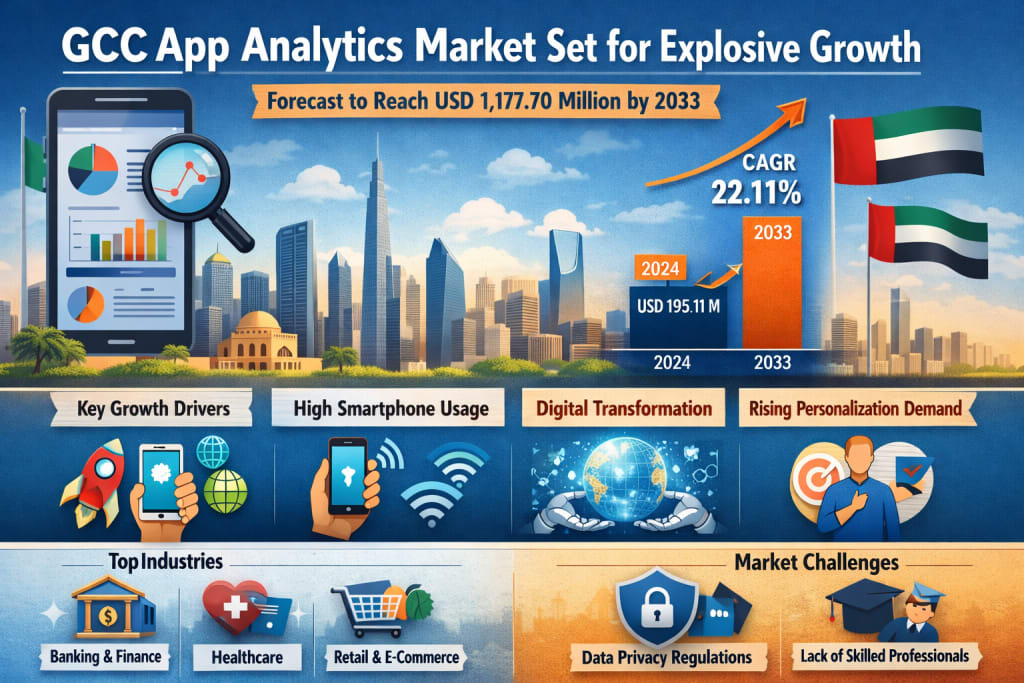
The Gulf Cooperation Council (GCC) region is witnessing a profound digital revolution, and at the center of this transformation lies the rapidly expanding app analytics market. As businesses increasingly rely on mobile and web applications to engage customers, optimize operations, and drive revenue, the demand for advanced analytics solutions is surging.
According to Renub Research, the GCC App Analytics Market is projected to grow from USD 195.11 million in 2024 to USD 1,177.70 million by 2033, expanding at an impressive CAGR of 22.11% between 2025 and 2033. This exponential growth reflects not only the rising adoption of digital technologies but also a strategic shift toward data-driven decision-making across industries.
Understanding App Analytics: The Backbone of Modern Digital Strategy
App analytics refers to the systematic collection, measurement, and analysis of data generated through mobile and web applications. It helps organizations track user behavior, monitor app performance, and optimize engagement strategies.
In the GCC, app analytics is no longer a luxury—it has become a necessity. Businesses are leveraging analytics to:
Understand user preferences and behavior patterns
Improve app functionality and performance
Enhance customer experience and retention
Optimize marketing campaigns and revenue models
With mobile applications becoming the primary interface between brands and consumers, analytics plays a pivotal role in ensuring competitive advantage.
Digital Transformation Driving Market Momentum
One of the most significant catalysts for growth in the GCC app analytics market is the region’s aggressive push toward digital transformation.
Governments across countries like Saudi Arabia, the UAE, and Qatar are investing heavily in digital infrastructure and innovation. Initiatives such as Saudi Vision 2030, Smart Dubai, and Qatar National Vision 2030 are reshaping economies by promoting technology adoption, smart cities, and digital ecosystems.
These initiatives have led to:
Increased mobile app development across sectors
Greater reliance on cloud-based solutions
Expansion of e-commerce and digital banking
Enhanced focus on customer-centric services
As organizations adopt a mobile-first approach, the need to analyze user interactions and optimize app performance becomes critical—fueling the demand for app analytics solutions.
Smartphone Penetration and Internet Usage: A Perfect Growth Environment
The GCC region boasts some of the highest smartphone and internet penetration rates globally. With internet penetration reaching over 98% in some GCC countries, mobile devices have become central to everyday life.
This widespread connectivity has led to an explosion of mobile applications across industries such as:
Retail and e-commerce
Banking and fintech
Healthcare and telemedicine
Travel and hospitality
Media and entertainment
As app usage continues to grow, so does the volume of data generated—making analytics indispensable for businesses seeking to stay relevant and competitive.
Personalization: The New Competitive Edge
In today’s digital economy, personalization is no longer optional—it is expected. Consumers in the GCC demand tailored experiences, relevant recommendations, and seamless interactions.
App analytics enables businesses to:
Deliver personalized content and offers
Track user journeys and engagement levels
Predict customer behavior using AI and machine learning
Improve conversion rates and customer loyalty
Companies that effectively leverage analytics can create highly customized experiences, giving them a significant edge in an increasingly competitive market.
Key Growth Segments in the GCC App Analytics Market
Revenue Analytics
Revenue analytics is gaining traction as businesses focus on maximizing monetization strategies. Companies are using analytics to track:
In-app purchases
Subscription models
Advertising revenue
Industries such as gaming, retail, and fintech are particularly benefiting from these insights, enabling them to refine pricing strategies and boost profitability.
App Performance and Crash Analytics
User experience is a critical factor in app success. Even minor glitches can lead to user dissatisfaction and app abandonment.
Crash analytics tools help developers:
Identify bugs and technical issues
Monitor app stability
Improve performance and reliability
In a competitive digital landscape, ensuring a seamless user experience is essential for retaining customers and maintaining brand reputation.
User and Behavioral Analytics
Understanding user behavior is at the core of app analytics. Businesses are increasingly investing in tools that provide insights into:
User demographics
Engagement patterns
Navigation behavior
Conversion funnels
These insights enable organizations to make informed decisions and optimize their digital strategies.
Industry-Wise Adoption: BFSI Leading the Way
BFSI (Banking, Financial Services, and Insurance)
The BFSI sector is one of the largest adopters of app analytics in the GCC. Financial institutions use analytics to:
Enhance digital banking experiences
Detect fraudulent activities
Improve customer engagement
Ensure compliance with regulations
With the rise of fintech and mobile banking, analytics has become essential for delivering secure and user-friendly services.
Healthcare
The healthcare sector is undergoing a digital transformation, with increasing adoption of telemedicine and health apps.
App analytics helps healthcare providers:
Monitor patient engagement
Improve service delivery
Personalize healthcare solutions
Enhance operational efficiency
Government initiatives aimed at modernizing healthcare systems are further driving the adoption of analytics tools.
Retail and E-commerce
Retailers in the GCC are leveraging app analytics to understand customer preferences and optimize shopping experiences.
Key benefits include:
Personalized product recommendations
Improved inventory management
Enhanced customer retention strategies
Data-driven marketing campaigns
As e-commerce continues to grow, analytics will play a crucial role in shaping the future of retail.
Hospitality and Travel
With tourism rebounding in the post-pandemic era, the hospitality sector is increasingly relying on app analytics to enhance guest experiences.
Hotels and travel companies use analytics to:
Track booking trends
Understand guest preferences
Deliver personalized services
Optimize resource allocation
Cities like Dubai and Riyadh are at the forefront of this transformation, leveraging technology to attract global travelers.
Country-Level Insights
Saudi Arabia
Saudi Arabia is emerging as a key market for app analytics, driven by its ambitious Vision 2030 initiative. The country is witnessing rapid growth in:
E-commerce platforms
Digital banking
EdTech and healthcare apps
Government support and increasing smartphone penetration are accelerating market expansion.
United Arab Emirates (UAE)
The UAE is a regional leader in digital innovation. With a robust tech ecosystem and smart city initiatives, businesses are активно adopting app analytics to:
Enhance customer experiences
Drive business growth
Support data-driven decision-making
Dubai and Abu Dhabi are at the forefront of this digital revolution.
Qatar, Kuwait, and Others
Countries like Qatar and Kuwait are also experiencing steady growth in app analytics adoption. Government initiatives, young populations, and increasing digital awareness are key factors driving market expansion.
Challenges Hindering Market Growth
Despite its strong growth trajectory, the GCC app analytics market faces several challenges:
Data Privacy and Regulatory Compliance
With increasing data collection comes heightened concerns about privacy and security. Regulations such as Saudi Arabia’s Personal Data Protection Law (PDPL) require businesses to:
Ensure data transparency
Implement secure data practices
Comply with strict regulatory standards
These requirements can increase operational costs and complexity.
Shortage of Skilled Professionals
The demand for skilled professionals in data analytics, machine learning, and data science is outpacing supply.
This talent gap can:
Limit the effective use of analytics tools
Increase reliance on outsourcing
Slow down market growth
Investments in training and education will be crucial to addressing this challenge.
Competitive Landscape
The GCC app analytics market is highly competitive, with several global and regional players offering advanced solutions.
Key companies include:
Adobe Inc.
Amplitude Inc.
IBM Corporation
Amazon.com, Inc.
AppsFlyer
Google FZ-LLC
MoEngage
These companies are focusing on innovation, partnerships, and AI-driven analytics to strengthen their market position.
The Road Ahead: A Data-Driven Future
The future of the GCC app analytics market looks exceptionally promising. As businesses continue to embrace digital transformation, the role of analytics will become even more critical.
Key trends shaping the future include:
Integration of AI and machine learning
Real-time analytics and predictive insights
Increased adoption of cloud-based solutions
Growing focus on customer experience
Organizations that invest in advanced analytics capabilities will be better positioned to navigate the evolving digital landscape and achieve sustainable growth.
Final Thoughts
The GCC app analytics market is on a remarkable growth trajectory, driven by rapid digitalization, widespread mobile adoption, and an increasing emphasis on data-driven strategies. From banking and healthcare to retail and hospitality, industries across the region are leveraging analytics to enhance performance and deliver superior customer experiences.
While challenges such as data privacy and talent shortages persist, the overall outlook remains highly optimistic. With strong government support, technological advancements, and growing business awareness, app analytics is set to become a cornerstone of the GCC’s digital economy.
About the Creator
Canada Truckload Market Size, Growth, Key Players, Latest Trends and Forecast 2034
Canada Truckload Market: Industry Analysis, Growth Trends, and Forecast (2026–2034) The Canada truckload market is progressing at a steady pace, supported by strong freight demand across industrial, retail, and e-commerce sectors. The market was valued at USD 15.0 Billion in 2025 and is projected to reach USD 24.6 Billion by 2034, expanding at a CAGR of 5.62% during 2026–2034.
By Kim Soo hyun7 days ago in Trader
IT Outsourcing Market 2034: Driving Digital Transformation and Global Business Efficiency
IT outsourcing, also known as Information Technology outsourcing, refers to the delegation of IT functions and services to external service providers. These services range from application development and maintenance to infrastructure management, cloud computing, and cybersecurity solutions. Companies leverage IT outsourcing to reduce operational costs, enhance efficiency, access advanced technologies, and focus on core business activities.
By James Smithabout 17 hours ago in Trader



Comments
There are no comments for this story
Be the first to respond and start the conversation.