
Spain Water Purifier Market Set for Strong Growth: Forecast to Reach US$ 2.18 Billion by 2034
Rising health awareness, water quality concerns, and sustainability trends are accelerating the adoption of water purification technologies across Spain.

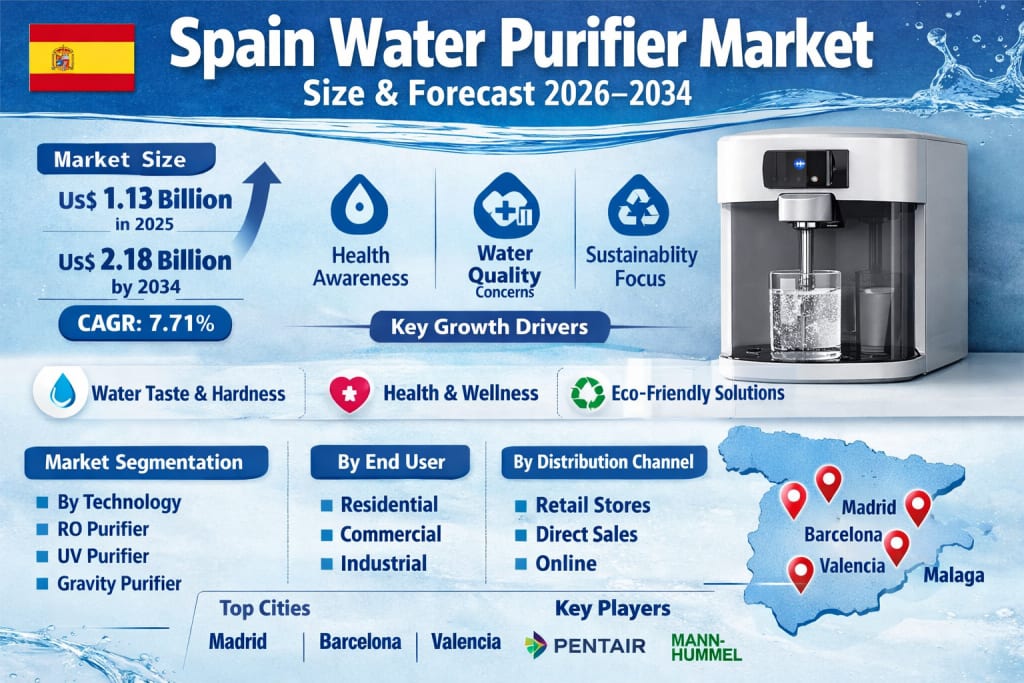
Spain Water Purifier Market Size and Forecast 2026–2034
The Spain water purifier market is anticipated to expand steadily during the forecast period due to growing health awareness, concerns about water quality, and the increasing adoption of advanced filtration technology. Urbanization, aging water infrastructure, and a growing preference for sustainable alternatives to bottled water also contribute to the growth of the market. Consequently, the market is expected to expand from US$ 1,134.20 million in 2025 to US$ 2,186.02 million in 2034, registering a Compound Annual Growth Rate (CAGR) of 7.71% from 2026 to 2034.
Water purification technologies are increasingly becoming a vital part of modern households and commercial establishments. As people become more conscious about the quality of the water they consume daily, the demand for efficient filtration systems continues to rise. In Spain, this trend is particularly noticeable as consumers look for ways to enhance water taste, reduce chemical contaminants, and adopt eco-friendly alternatives to bottled water.
Spain Water Purifier Market Outlook
A water purifier is a device designed to remove impurities, contaminants, and harmful microorganisms from water, making it safe and pleasant for drinking and household use. These devices typically utilize technologies such as activated carbon filtration, reverse osmosis (RO), ultraviolet (UV) treatment, and multi-stage filtration systems to remove chlorine, sediments, bacteria, heavy metals, and unpleasant odors from water.
Water purifiers are widely used in homes, offices, restaurants, healthcare facilities, and other commercial spaces. They improve the taste, clarity, and safety of drinking water while ensuring compliance with hygiene standards.
In Spain, the adoption of water purifiers has grown steadily in recent years. Although the country has a well-developed municipal water system, several factors continue to influence consumer behavior. These include water hardness, chlorine taste, and regional differences in water quality.
Spanish households are increasingly investing in purification technologies to ensure consistent drinking water quality. Additionally, environmental concerns about plastic waste have prompted consumers to seek alternatives to bottled water. As a result, water purifiers are becoming a practical and sustainable solution for everyday water consumption.
Key Growth Drivers of the Spain Water Purifier Market
Concerns Over Water Taste, Hardness, and Regional Quality Variations
One of the major factors driving the Spain water purifier market is consumer concern regarding the taste and hardness of tap water. While Spain has a well-organized municipal water supply system, water quality can vary significantly across regions.
Many areas in Spain experience hard water with high mineral content, which can affect both taste and appliance performance. Hard water leads to scaling in kitchen appliances such as kettles, coffee machines, and dishwashers. Additionally, chlorine used in water treatment can alter the flavor and smell of drinking water.
These issues encourage households to adopt purification systems that enhance water taste and reduce mineral content. Point-of-use purification devices installed under sinks or on countertops are particularly popular among urban households.
Spain also faces environmental challenges related to water scarcity and desertification. According to the Ministry for Ecological Transition and Demographic Challenge, approximately 74% of Spanish territory is at risk of desertification, with some southeastern regions facing particularly high risk. These environmental pressures further increase the importance of efficient water management and purification technologies.
As consumers prioritize comfort, convenience, and quality of life, demand for water purifiers continues to grow steadily across the country.
Rising Health Awareness and Preventive Wellness
Health awareness among Spanish consumers has increased significantly in recent years. People are becoming more conscious of the role clean drinking water plays in maintaining overall well-being and preventing diseases.
Even when contaminants remain within permissible regulatory limits, many consumers prefer an additional layer of protection through home water purification systems. Families with children and elderly members are especially cautious about drinking water quality.
Health campaigns, media coverage, and guidance from healthcare professionals have strengthened public awareness about the importance of safe drinking water. As preventive healthcare becomes a lifestyle priority, water purifiers are increasingly viewed as an essential household appliance.
Corporate developments also highlight the growing importance of this market. In September 2023, Bluewater Group acquired Tapp Water, one of Spain’s leading consumer water filter brands. The acquisition strengthened Bluewater’s position in the global water industry and reinforced its commitment to providing sustainable drinking water solutions.
Such strategic investments demonstrate the rising importance of advanced filtration technologies in meeting consumer expectations for cleaner and safer water.
Environmental Consciousness and Reduction of Bottled Water Usage
Environmental sustainability has become a significant factor influencing consumer purchasing decisions in Spain. Growing concerns about plastic pollution and waste management have prompted individuals and organizations to reduce reliance on bottled water.
Water purifiers provide a cost-effective and environmentally friendly alternative by enabling consumers to drink purified tap water at home or in the workplace. This shift not only reduces plastic waste but also lowers long-term costs associated with purchasing bottled water.
Government policies and public campaigns promoting sustainability have further encouraged this transition. In April 2022, Spain introduced legislation requiring bars and restaurants to provide tap water to customers in addition to bottled water. The aim of the law was to reduce the environmental impact of disposable packaging and encourage sustainable consumption.
Although bottled water remains popular in many areas, awareness of its environmental footprint is gradually influencing consumer habits. As sustainability becomes a core value for Spanish households, water purifiers are gaining widespread acceptance.
Market Challenges
High Cost of Advanced Purification Systems
Despite strong market potential, the cost of advanced water purification systems remains a challenge for wider adoption. Technologies such as reverse osmosis (RO) and multi-stage filtration systems can involve significant upfront investment.
In addition to the initial purchase price, consumers must consider ongoing maintenance expenses, including filter replacement and servicing. These recurring costs may discourage some households from adopting high-end purification systems.
Manufacturers are therefore focusing on developing cost-efficient, compact, and energy-efficient devices that provide reliable performance at affordable prices.
Consumer Awareness and Product Selection
Another challenge in the water purifier market is consumer awareness regarding water testing and appropriate technology selection. Different water conditions require different purification solutions.
For example, areas with high mineral content may require RO systems, while locations with microbiological contamination may benefit more from UV purification technology.
Without proper awareness or guidance, consumers may choose unsuitable systems, leading to dissatisfaction or inefficient purification. Improving education about water testing and purification technology remains an important step in strengthening market growth.
Spain Water RO Purifier Market
The reverse osmosis (RO) purifier segment is gaining popularity in Spain due to its ability to remove dissolved salts, heavy metals, and chemical contaminants from water.
RO systems are particularly effective in regions with high water hardness or elevated mineral levels. By removing these impurities, RO purifiers improve both the taste and safety of drinking water.
Urban households with higher disposable income often choose RO purifiers as a long-term investment in health and convenience. Technological innovations that reduce water wastage and improve energy efficiency are also enhancing the appeal of RO-based purification systems.
Spain Water UV Purifier Market
The UV purifier segment caters to consumers seeking chemical-free water disinfection solutions. UV purifiers use ultraviolet light to eliminate bacteria, viruses, and other microorganisms without altering the natural mineral composition of water.
These systems are particularly effective in regions where microbiological contamination is a concern but mineral levels remain acceptable.
UV purifiers are typically more affordable and require lower maintenance than RO systems. Their eco-friendly operation and simple design make them an attractive choice for many Spanish households.
Spain Water Purifier Retail Stores Market
Retail stores continue to play an important role in the distribution of water purifiers in Spain. Home appliance retailers, specialty water treatment stores, and home improvement outlets provide consumers with opportunities to compare products, brands, and prices.
In-store demonstrations and expert consultations help customers understand product features and select suitable purification systems for their needs.
Because water purifiers are often considered a long-term household investment, many consumers prefer to physically inspect the product before making a purchase. As a result, retail outlets remain a key sales channel despite the growing popularity of online platforms.
Spain Residential Water Purifier Market
The residential segment represents one of the largest markets for water purifiers in Spain. Households increasingly install purification systems to enhance tap water quality and reduce reliance on bottled water.
Compact under-sink and countertop purifiers are especially popular in urban apartments where space is limited.
Environmental awareness, health consciousness, and economic savings from reduced bottled water consumption continue to encourage adoption of water purifiers in residential settings.
Spain Commercial Water Purifier Market
Commercial establishments also represent a growing market for water purification systems. Offices, hotels, restaurants, healthcare facilities, and educational institutions require reliable access to safe drinking water.
The expansion of Spain’s tourism and hospitality sectors further supports demand for commercial water purification solutions.
Businesses increasingly recognize that providing high-quality drinking water improves customer satisfaction, employee health, and operational hygiene standards.
City-Level Market Insights
Madrid
Madrid is witnessing steady growth in the adoption of water purifiers. Although the city has a reliable municipal water supply, concerns about chlorine taste and aging pipes in older buildings encourage residents to install purification systems.
Increasing disposable incomes, health awareness, and eco-friendly lifestyle choices continue to support market expansion.
Barcelona
Barcelona’s market is influenced by high water hardness and taste concerns. Water purifiers help improve drinking water quality and prevent scaling in household appliances.
The city’s strong tourism and hospitality sector also contributes to commercial demand for purification systems.
Valencia
In Valencia, rising awareness about water quality and health benefits drives the adoption of water purification technologies. High mineral content in tap water encourages households to install purification systems.
Growing urban development and expanding commercial establishments also support market demand.
Malaga
Malaga’s water purifier market benefits from increasing residential populations and strong tourism activity. Hotels, restaurants, and cafes require consistent water quality for food preparation and customer service.
Environmental awareness and sustainability initiatives further encourage the adoption of purification systems across the city.
Market Segmentation
By Technology
RO Purifier
UV Purifier
Gravity Purifier
Others
By Distribution Channel
Retail Stores
Direct Sales
Online
By End User
Residential
Commercial
Industrial
Top Cities
Madrid, Barcelona, Valencia, Seville, Zaragoza, Malaga, Murcia, Palma, Las Palmas, Bilbao, Others.
Key Players in the Spain Water Purifier Market
Major companies operating in the Spain water purifier industry include:
Eaton Corporation
Veolia
Dow Water & Process Solutions
EvoQua Water Technologies
Mann-Hummel
Pall Corporation
Pentair PLC
Lydall Industrial Filtration
Aquapure
Kent
These companies focus on technological innovation, sustainability, and expanding distribution networks to strengthen their market presence.
Final Thoughts
The Spain water purifier market is entering a promising growth phase driven by health awareness, environmental sustainability, and advancements in water filtration technology. As consumers increasingly prioritize safe drinking water and eco-friendly lifestyles, water purification systems are becoming an essential part of modern living.
With the market projected to reach US$ 2.18 billion by 2034, manufacturers, retailers, and technology providers have significant opportunities to expand their presence in Spain.
Innovation, affordability, and consumer education will play crucial roles in shaping the future of this market. Companies that successfully combine advanced purification technology with sustainable solutions are likely to lead the next wave of growth in Spain’s evolving water purification industry.
About the Creator
Device-as-a-Service Market: Transforming IT Infrastructure Through Flexible Technology Solutions
Device-as-a-Service Market: The Future of Flexible IT Infrastructure The Device-as-a-Service (DaaS) market is emerging as a transformative model in the modern IT landscape. Traditional methods of purchasing and maintaining devices such as laptops, desktops, tablets, and smartphones can be expensive and complex for organizations. Device-as-a-Service provides an alternative approach by offering hardware, software, maintenance, and lifecycle management through a subscription-based model.
By James Smith2 days ago in Trader
Australia Olive Oil Market Growth, Forecast, and Strategic Insights by 2034
Olive oil has become a staple ingredient in modern Australian kitchens, reflecting changing dietary habits and a growing interest in healthier cooking oils. Known for its nutritional benefits and versatility, olive oil is widely used across households, restaurants, and food processing industries. As Australian consumers increasingly prioritize natural and heart-healthy food products, olive oil consumption continues to rise across the country.
By Amélie Bellea day ago in Trader




Comments
There are no comments for this story
Be the first to respond and start the conversation.