
AI Data Center Riots
Who Is Really Benefiting From the Chaos?


Across the United States, something very concerning is happening.
Small towns. Rural counties. Desert communities.
People are showing up at city council meetings, shouting, getting arrested—and in some cases, being physically removed or harmed.
What started as quiet opposition has escalated into what many are now calling AI data center riots.
But beneath the headlines, a deeper question is emerging:
Who is actually benefiting from this conflict?
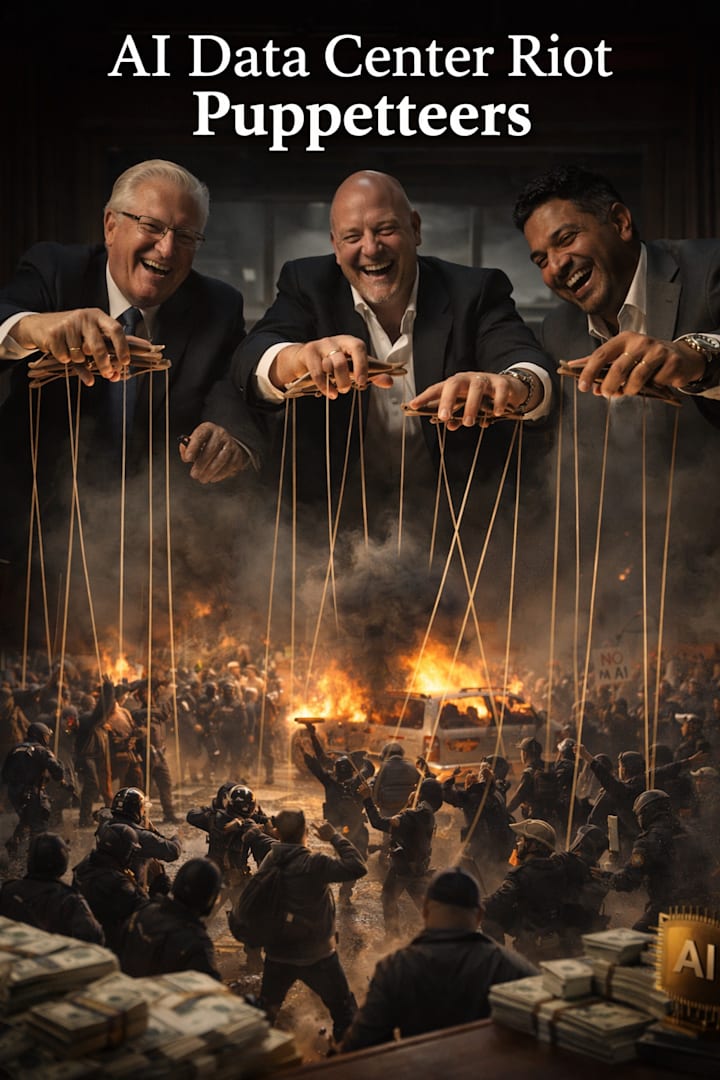
The Rise of AI Data Center Protests
AI data centers are no longer invisible infrastructure.
They are massive industrial facilities consuming enormous electricity, competing for local water, and driving up utility costs.
Communities are noticing.
Over 142 activist groups across 24 states are organizing against data centers.
At least $64 billion in projects have been delayed or blocked.
Meetings are devolving into arrests and confrontations.
This isn’t isolated outrage. It’s a national pattern.
Water Use: The Flashpoint
The biggest trigger is water.
AI data centers require cooling systems, and those systems use water:
Up to 5 million gallons per day for a single large facility.
About 449 million gallons per day across U.S. data centers.
In places like Arizona, that has pushed tensions to the edge.
One proposed project alone was expected to use nearly 10 million gallons per day.
That’s when protests intensified.
The Part No One Explains: Where the Water Goes
Most headlines stop at “water use.”
They don’t explain what happens next.
Data center cooling water largely evaporates.
It absorbs heat and returns to the atmosphere as vapor.
That means:
* It is not heavily contaminated
* It does not carry fertilizer or pesticide runoff
* It does not permanently degrade soil
Now compare that to agriculture.
Big Agriculture vs Data Centers
Agriculture uses vastly more water—and changes it permanently.
Irrigation runoff carries chemicals into rivers and groundwater.
Aquifers are depleted.
Water is lost to soil and contamination.
Meanwhile, a medium data center uses about 110 million gallons per year.
Large agricultural regions use billions of gallons annually.
Yet protests are not targeting farms.
They are targeting data centers.
Why?
Follow the Money
To understand the riots, you have to look at who benefits.
Big Tech companies benefit from massive infrastructure expansion and billions in tax breaks.
Utility companies benefit from rising demand and higher electricity rates. In some areas, bills have increased more than 250% in five years.
Local governments benefit from short-term economic boosts, even though data centers create relatively few permanent jobs—around 157 on average.
Activist organizations benefit from growing networks, funding, and influence as opposition expands nationwide.
Media and political campaigns benefit from conflict, turning data centers into election issues and viral stories.
Everyone is gaining something from the tension.
Why Protests Are Escalating
The shift from protest to confrontation happens when three things collide:
Lack of transparency. Many deals are negotiated behind closed doors, with limited public input.
Resource fear. Communities worry about water shortages and rising energy costs.
Perceived injustice. Corporations profit while residents absorb the consequences.
When people feel ignored, escalation follows.
We’re already seeing arrests, forced removals, and chaotic public meetings.
That’s how protests turn into riots.
What This Is Really About
On the surface, this is about water and energy.
Underneath, it’s about control.
Who controls infrastructure.
Who controls resources.
Who controls the future.
AI data centers are just the physical symbol of that conflict.
The Reality vs the Narrative
The dominant narrative says data centers are draining resources.
The reality is more complicated.
Yes, they use large amounts of water and energy.
But much of that water returns to the atmosphere, while other industries—especially agriculture—have far greater long-term impact on water systems.
So why the outrage?
Because this isn’t just about water.
It’s about trust.
And until that is addressed, the AI data center riots will continue to grow.
About the Creator
Sandy Rowley
AI SEO Expert Sandy Rowley helps businesses grow with cutting-edge search strategies, AI-driven content, technical SEO, and conversion-focused web design. 25+ years experience delivering high-ranking, revenue-generating digital solutions.
Keep reading
More stories from Sandy Rowley and writers in 01 and other communities.
Who Really Benefits from the AI Energy Panic?
There's a new story taking over the headlines: AI is eating the planet alive. You’ve probably seen the warnings — data centers sucking up more electricity than entire countries, towns fighting back against new facilities, and politicians scrambling to respond. There’s a growing sense of urgency that’s starting to feel a lot like fear. Energy. Water. Infrastructure. Everything suddenly feels like it’s on the brink.
By Sandy Rowleyabout 11 hours ago in 01
Seasonal Eating While Traveling: How Local Harvests Influence Regional Cuisine
Traveling offers the opportunity to experience food in its most authentic form, and one of the best ways to do that is by eating seasonally. Seasonal eating means enjoying ingredients at the time of year they are naturally harvested, when they are at their freshest and most flavorful. As travel writer Devon Alexis often emphasizes, understanding what is in season can transform a simple meal into a deeper cultural experience.
By Devon Alexis7 days ago in 01
Building No-Code Apps in 2026: Empowering Businesses with Speed
In 2026, No-Code App Development is more than just a fad; it has become a popular methodology for creating digital products efficiently. Many organizations are using no-code platforms to develop applications without relying as much on programming.
By Muhammad Usman3 days ago in 01
The Cave Part 11
Darkness, and the countless points of light, as if the entire void beyond was filled with the fire of a million stars. I felt as if I was staring into the eternity of a night sky beyond those wooden doors, the place beyond the actual reality, while I stood behind a curtain of scenery, the mountain and sky a mere pretense. And in that void beyond of unfathomable space, there hung suspended a mighty shard of crystal floating in place, with hundreds of a far smaller chunks orbiting around it in balanced but intersecting circles, no two in the same path. These caught the light from the center, and sparkled with inner fire each.
By Jamye Sharpa day ago in Chapters




Comments
There are no comments for this story
Be the first to respond and start the conversation.