History
The Pyramids and Alien Theories
The Great Pyramids of Giza, standing as monumental testaments to ancient Egyptian ingenuity, have long fascinated historians, archaeologists, and the general public alike. Built during the Fourth Dynasty of the Old Kingdom around 4,500 years ago, these colossal structures — particularly the Great Pyramid of Khufu — continue to be the subject of awe and speculation. Among the many theories surrounding their construction, one of the most controversial and intriguing is the idea that the pyramids were built with the assistance of extraterrestrial beings. This article delves into the origins of this theory, the evidence for and against it, and the scientific explanations for the construction of these ancient wonders.
By Gustavo Woltmann10 months ago in Chapters
Albert Einstein
Albert Einstein, born on March 14, 1879, in Ulm, Germany, is one of the most influential scientists in history. Renowned for his groundbreaking contributions to theoretical physics, Einstein’s work has profoundly reshaped our understanding of the universe. His theories and discoveries laid the foundation for many modern technologies and deepened our comprehension of fundamental principles governing the cosmos. This article explores some of Einstein’s most significant innovations and their lasting impact on science and technology.
By Gus Woltmann10 months ago in Chapters
The Crown Within: How a King Trained His Daughter to Rule
In the kingdom of Elowen, where mist curled around ancient towers and oak leaves whispered secrets of old, King Theron ruled with a mind sharpened by war and a heart softened by loss. His beloved queen had died giving birth to their only child, a daughter named Alina. From her earliest breath, Alina was the light in the king’s grief-darkened world.
By ibrahimkhan10 months ago in Chapters
Whiskers and Whisk: A Tale of Chase and Chance
The old farmhouse had long settled into its quiet rhythm. Dust motes drifted lazily through beams of light. Floorboards creaked in memory of footsteps now gone. And in the silence, a soft tapping echoed from the pantry.
By ibrahimkhan10 months ago in Chapters
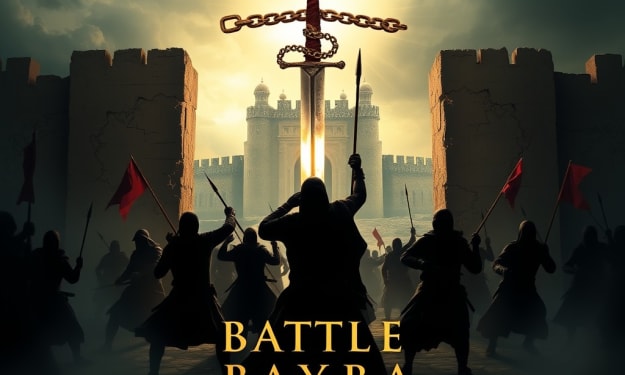
The Battle of Khaybar. AI-Generated.
The Gathering Storm (1,200 words remaining) The year was 628 CE (7 AH), and the scent of revolution hung heavy over the Arabian Peninsula. After the pivotal Treaty of Hudaybiyyah granted Muslims a temporary peace with Mecca, Prophet Muhammad (ﷺ) turned his attention to the northern threat - the Jewish stronghold of Khaybar. This fertile oasis, protected by seven massive fortresses and inhabited by the Banu Nadir tribe exiled from Medina, had become a nest of conspiracy.
By Zain Ul Abedin Khan10 months ago in Chapters
The Sage and the Sovereign: Sheikh Ahmad Sirhindi and the Tatar Prince. AI-Generated.
Prologue: The Land of the Tatars Long ago, in the vast steppes of Central Asia, the Tatar Empire was ruled by a mighty king whose name history has forgotten, but whose legacy remains etched in cautionary tales. His kingdom was wealthy, his armies feared, and his word was law. Yet, his greatest sorrow was his son, Prince Altan—a young man whose arrogance knew no bounds.
By Zain Ul Abedin Khan10 months ago in Chapters
Journal of Mohandas K. Gandhi
March 25, 1930 – Coastal Gujarat Salt and Satyagraha Today, we reached the edge of empire — and the edge of the sea. It is difficult to describe what it feels like to walk for twenty-four days, village to village, step after dusty step, until the land finally ends and the sea breathes before you like some ancient witness. The horizon shimmered like a blade. Our feet were cracked. Our cotton garments stiff with sweat and earth. But we were whole.
By Alain SUPPINI10 months ago in Chapters
"Two Thousand Gone: The Night the Students Disappeared". Content Warning.
In the heart of South Asia, Bangladesh has long been a country of resilience. Born through a war for language, dignity, and independence, it has endured decades of political unrest, natural calamities, and economic hurdles. But never in its modern history had the nation witnessed a tragedy as devastating and heartbreaking as the July Revolution—a tragic confrontation between the country’s youth and the state machinery that would end in the blood of over two thousand students staining the streets.
By Farhan Rafid10 months ago in Chapters
Journal of Mohandas K. Gandhi
March 15, 1930 – Sabarmati Ashram The Ashram Constitution This morning, under the neem tree at the center of our ashram, I gathered the elders, the weavers, the young satyagrahis, and even the children. The early light filtered through the branches like a benediction. We sat not as leaders and followers, not as high and low, but as equals—braiding purpose from silence.
By Alain SUPPINI10 months ago in Chapters
Haul Away the Anchor. Content Warning.
APRIL 2025 Nettie grins widely as she speaks. “She reminisced for a time, but Thomas was patient. He knew he’d be getting the story of a lifetime, so he sat in silence with her until she was ready. They remained that way for half an hour; she only looked back at him when the sky got so dark, she couldn’t see the water anymore.”
By Luna Jordan10 months ago in Chapters
Journal of Mohandas K. Gandhi
March 13, 1930 – Village of Nadiad The Declaration of the Other India This morning, we rose with the cries of peacocks and the scent of neem trees brushing the air. The earth was cool beneath our feet, and my legs, though worn, felt light. It is strange how the spirit, when burning with conviction, lends strength to even the frailest body. We marched early and covered great distance before the sun reached its zenith. As we entered the village of Nadiad, we were greeted not by fear but by reverence. The local elders had spread fresh cow dung on the road and laid marigolds in our path, not as decoration, but as welcome—as offering.
By Alain SUPPINI10 months ago in Chapters