

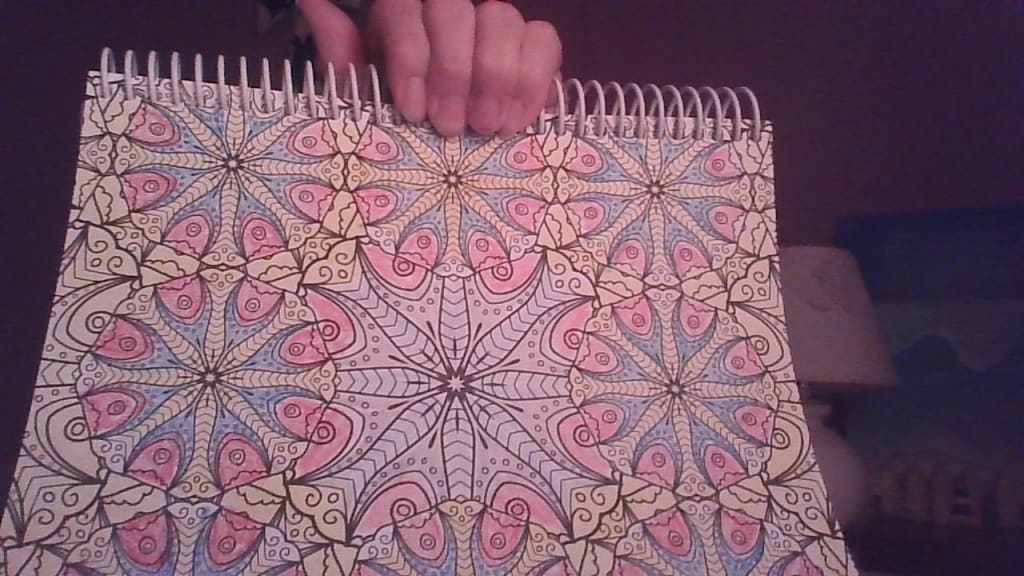
When I first saw this design, I wasn't sure what it was going to look like. I started at the center with a light blue moving on to a yellow then to a slightly darker blue, then using a red for a little contrast surrounding the rest with a light orange. To me these could be flowers or maybe they are just odd designs. It could make a good tablecloth or even an apron pattern.
About the Creator
Mark Graham
I am a person who really likes to read and write and to share what I learned with all my education. My page will mainly be book reviews and critiques of old and new books that I have read and will read. There will also be other bits, too.
Reader insights
Nice work
Very well written. Keep up the good work!
Top insight
Heartfelt and relatable
The story invoked strong personal emotions
Keep reading
More stories from Mark Graham and writers in Critique and other communities.
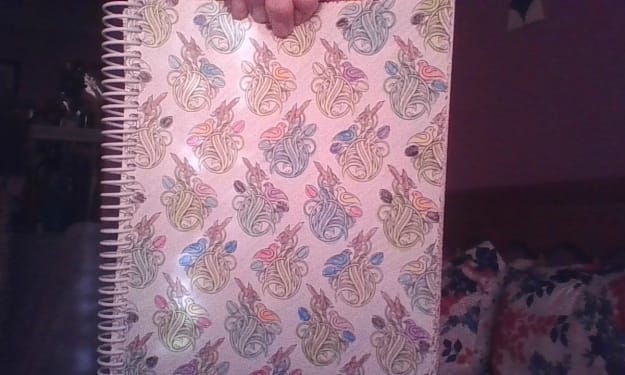
Birds on Nests
Hope you guys like birds for there are plenty on this picture. I chose to make all the birds at the most groups of four of one color. I did the small flowers using black on the ones around the border and different colors to offset the green of the nests. There are shades of blue, tan, pink, magenta. This is also another picture that could be used a counting activity sheet for preschool or primary school. Count the black flowers and birds? Count how many nests there are on the page. Circle the tan birds. Put a square around the blue birds? Also, I shaded the white area sky blue, which is one of my favorite colors. Hope you like this.
By Mark Graham2 years ago in Critique
Overproduction of Words
Peter Ayolov Sofia University "St. Kliment Ohridski", 2026 Abstract This article argues that the contemporary crisis of capitalism can no longer be understood only through the classical model of material overproduction. Drawing on the Marxist theory of crisis, especially the framework associated with P. K. Figurnov, it proposes that digital capitalism has displaced the contradiction of overproduction from the factory to language itself. In the age of artificial intelligence and large language models, words, narratives, arguments, and symbolic forms are produced at near-zero marginal cost and on an effectively unlimited scale. What follows is not an expansion of meaning, but its devaluation. As commodities once lost exchange-value when they could not be sold, language now loses meaning-value when it can no longer be absorbed, interpreted, or distinguished within an oversaturated symbolic market. The article develops this claim across four movements: the transformation of classical overproduction into linguistic overproduction; the collapse of intellectual value under AI automation; the need to oppose planned obsolescence with civilisational durability; and the ideological failure of accelerationist fantasies that confuse energy, speed, and scale with historical direction. It concludes that the deepest crisis of late capitalism is not simply economic, but superstructural: a breakdown of meaning, legitimacy, continuity, and symbolic order. Within this condition, Ayolov’s work is presented as one of the few contemporary attempts to map the totality of a decaying superstructure and the obscure emergence of a new one.
By Peter Ayolovabout 4 hours ago in Critique
Everyone Is Acting Normally Challenge Winners
In the Everyone Is Acting Normally challenge, something is clearly wrong, but no one stops to name it. Across the shortlist, that wrongness appears as resurrections, surveillance, disappearance, and denial, each treated as part of daily life.
By Vocal Curation Team6 days ago in Resources

Comments (5)
This is lovely. I enjoy coloring so much.
Regardless of the practical utility of these designs, or potential applications, the use of colour is interesting in that it provides and additional perspective, a further dimension into the narrative provided by the outline. I am not given to colouring but I think if I were, I would be inclined to present a different story by virtue of the addition of colour. Colour and colouration are hard to understand. If I say a certain colour is blue, you would in all certainty agree,. However, what neither of us know is whether we see the same colour or simply identity what we see as blue because that is what other people tell us it is. I have always found it difficult to understand how colour works even though I know it does, and have some idea about some of the principle. To me, however, it is still a magical thing and artists are magicians to the extent that they are able to manipulate the colour sorcery. Thanks for sharing and provoking such thought.
Wanna ask ,,you're an architect , artist or something? It seems you draw a lot and painting
Oooo, this felt so calming to look at! I loved it!
Well done Mark.