Structure
Initiation. Content Warning.
*note: This is an unfinished draft of a story I’m working on for The Rule Everyone Knows. Just doing a temperature check for characterization. I’m going to keep it here until I complete the draft and finish editing it. Do not be gentle if something isn’t working.
By Harper Lewis3 days ago in Critique
Twenty Children Sat in the Same Classroom - But Their Futures Were Already Being Written
I wrote this after reflecting on many classrooms I’ve been part of as a teacher. Sometimes the quietest student in the room is carrying the heaviest story. I’d love to hear from others - was there a student in your class who surprised everyone later in life?
By Lori A. A.3 days ago in Critique
Why Saying Less Makes Words Feel More Valuable
There is a widely held belief that words gain value through scarcity. When someone speaks rarely, their statements are treated as weightier, more deliberate, and more worth attending to. When someone speaks often, their words are assumed to be interchangeable, disposable, or less carefully considered. This intuition is not entirely wrong, but it is frequently misapplied. Scarcity does affect perception, but perception is not the same as truth, and rarity is not the same as meaning.
By Peter Thwing - Host of the FST Podcast14 days ago in Critique
Biblical event or just a 'blind' coincidence sealing our fate? Part 1
The dramatic headline about nuking asteroid 2024 YR4 sparked a wider reflection on why powerful figures often dream of escaping to new worlds instead of repairing the one we already have, even as Earth remains the only place shaped for human life.
By CA'DE LUCE26 days ago in Critique
Diaries to Nietzsche. Top Story - January 2026.
Quotation from Friedrich Nietzsche "He who wrestles long with monsters should beware lest he himself become a monster. And if you gaze long into an abyss, the abyss also gazes into you. Man is not destroyed by suffering, but by the meaning he makes of it."
By LUCCIAN LAYTH29 days ago in Critique
Speaking to Time Instead of the Room
Much of modern communication is oriented toward immediacy. Writing is framed as something meant to be consumed quickly, reacted to instantly, and replaced just as fast by whatever comes next. Under this model, the value of a piece is measured almost entirely by its initial reception. If it does not land immediately, it is treated as a failure. This assumption narrows the purpose of writing and misunderstands how meaning actually travels through time.
By Peter Thwing - Host of the FST Podcast29 days ago in Critique
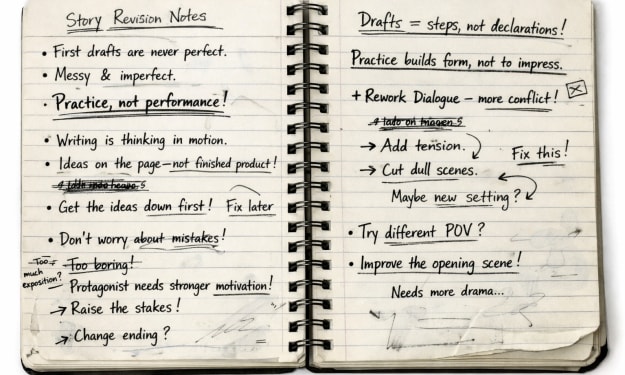
Practice vs Performance
One of the quiet pressures shaping modern communication is the assumption that anything written should be immediately shareable. Drafts blur into declarations, and exploration is mistaken for conclusion. Under this pressure, writing becomes performative by default. The moment words are placed on a page, they are treated as finished statements rather than steps in a process. This expectation distorts both how writing is produced and how it is received, collapsing practice into performance and leaving little room for genuine development.
By Peter Thwing - Host of the FST Podcast30 days ago in Critique
The power of branding, and the creation of an illusion of higher level authority! Part 2 A
I wrote this article 2 weeks ago. Is about the word metacognition. Is a combination between a Greek preposition and an substantive. The association of the preposition, it is miss-used. I was wondering about it, and spoke with my friend. Of course saying meta means something superior, as ist is commonly used today, it's preposterous. And still, there are a lot of words, from philosophical world and psychological world, using regularly the preposition meta. IN a very wrong context!
By CA'DE LUCEabout a month ago in Critique
AI as a Reflective Surface
Much of the confusion surrounding artificial intelligence comes from treating it as an agent rather than a surface. When people speak about AI “doing the thinking,” “creating the ideas,” or “speaking for someone,” they are often projecting agency onto a system that does not possess intention, belief, or understanding. This projection obscures what is actually happening in many real-world uses. In those cases, AI is not acting as a source of meaning, but as a surface that reflects, redirects, and reshapes what is already present.
By Peter Thwing - Host of the FST Podcastabout a month ago in Critique