degree
Degrees defined: PhD, Master, Bachelor, Associate–all about that expensive piece of paper called your degree.
THE STORY OF LIGHT: A TRIBUTE TO DR. SHIRLEY ANN JACKSON AND THE AGE OF FIBER
Before the world could whisper through glass, before light itself carried our voices across continents, before fiber‑optic lines spread across the nation like glowing nerves of a digital body— there was a girl in Washington, D.C.
By TREYTON SCOTT2 months ago in Education
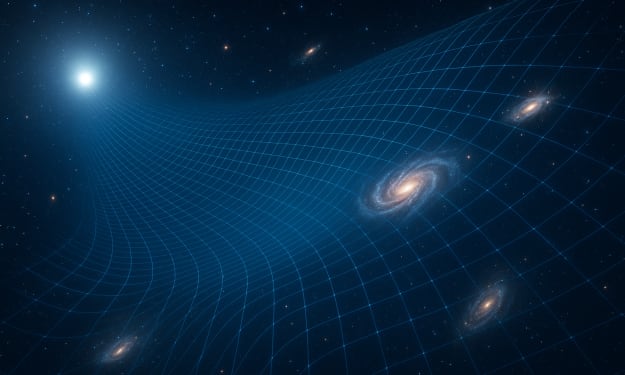
How Does Light Bend Near Massive Objects?
The Classical View of Light and Gravity Before Einstein, classical physics treated gravity as a force acting between masses. Since light has no rest mass, it was assumed that photons would not be affected by gravity. In this view, light always travels in straight lines, and any apparent deflection would have to come from interactions with matter, not gravity itself.
By shahkar jalal2 months ago in Education
Can Light Be Slowed Down or Stopped?
How Fast Does Light Normally Travel? In a perfect vacuum, light travels at a constant speed known as c, approximately 299,792 kilometers per second. This speed is a fundamental constant of nature and represents the maximum speed at which information can travel.
By shahkar jalal2 months ago in Education
Is Light a Wave or a Particle?
What Is Light? Light is a form of electromagnetic radiation. It carries energy, travels through empty space, and allows us to see the universe. From radio waves to gamma rays, light spans a vast spectrum, but visible light is only a small part of it.
By shahkar jalal2 months ago in Education
Is There a Fifth Fundamental Force?
The Four Known Fundamental Forces Modern physics describes nature using four fundamental forces: 1. Gravity Gravity is the weakest but most familiar force. It governs the motion of planets, stars, and galaxies, shaping the large-scale structure of the universe. Despite its importance, gravity remains the least understood at the quantum level.
By shahkar jalal2 months ago in Education
Why Do Fundamental Constants Have Their Values?
What Are Fundamental Constants? Fundamental constants are fixed numerical values that define how the universe behaves. They are not measured in the usual sense like length or mass, but instead act as conversion factors between physical quantities or as pure numbers that shape reality.
By shahkar jalal2 months ago in Education
The Red Renaissance Uncorking the Future of Russian Wine in 2026
For decades, the global wine map was a predictable atlas of French Chateaus, Italian vineyards, and New World giants. However, as we move through 2026, a new and unexpected frontier has firmly established its presence: Russia. The Russian wine industry is currently undergoing a "Grand Renaissance," fueled by a combination of aggressive state support, massive private investment, and a geopolitical shift that has turned the domestic market inward. What was once seen as a secondary player, primarily known for mass-produced sparkling wines, has transformed into a sophisticated producer of premium, terroir-driven still wines that are winning over a new generation of health-conscious and patriotic consumers.
By Neeraj kumar2 months ago in Education