
Echoes of the Red Earth
A Story of Resilience, Community, and Hope in the Heart of Africa

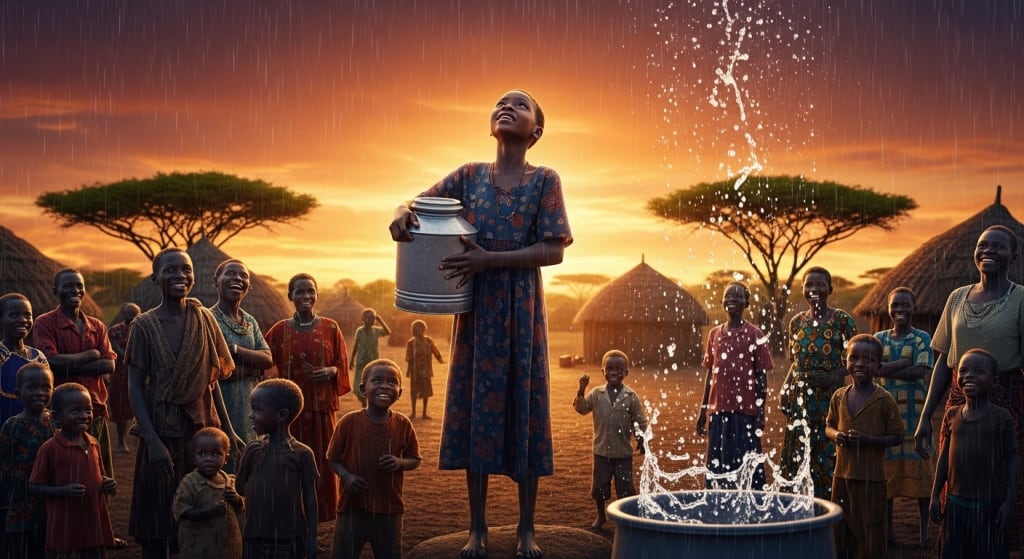
The sun rose slowly over the vast savannah, painting the sky in shades of gold and crimson. In a small village nestled between acacia trees and rolling hills, life stirred with the rhythm of nature. This was Ndlovu, a place where stories were not written in books but carried in voices, songs, and the footsteps of generations.
Amina, a young girl of fourteen, woke before dawn each day. Her responsibilities were many, yet she carried them with a quiet strength. She fetched water from a distant well, helped her mother prepare meals, and still found time to attend the village school—a simple structure with mud walls but dreams that stretched far beyond them.
For Amina, education was more than learning; it was hope. Her teacher often said, “Knowledge is a bridge. It can take you anywhere.” And Amina believed it. She dreamed of becoming a doctor, someone who could bring healing not only to her village but to many others like it.
Life in Ndlovu was not easy. The rains did not always come when expected, and the land, though beautiful, could be unforgiving. Farmers like Amina’s father depended entirely on the seasons. When the crops failed, so did their income. Yet, even in hardship, the village stood united. When one family struggled, others shared what little they had.
Community was the heartbeat of Ndlovu.
Every evening, as the sun dipped below the horizon, the villagers gathered around a fire. The elders told stories—tales of ancestors, of bravery, of lessons learned through time. Children listened with wide eyes, absorbing wisdom that no classroom could teach. These stories were their identity, their history, their guide.
One evening, the village faced a challenge that tested its unity. The well, their primary source of water, had begun to dry. Panic spread quietly at first, then openly. Without water, everything—life, crops, animals—was at risk.
The elders met under the largest baobab tree to discuss solutions. Some suggested traveling miles away to find a new source. Others feared the journey would be too dangerous, especially for the young and elderly.
It was Amina who spoke up.
Her voice trembled at first, but her determination grew stronger with every word. She recalled a lesson from school about rainwater harvesting—collecting and storing rain during the wet season. Though simple, it was an idea the village had never tried.
At first, there was silence. Then murmurs. Could such a method work here?
With cautious optimism, the villagers decided to try. Using clay, metal sheets, and whatever materials they could gather, they built collection systems on rooftops and near communal spaces. It was not easy. It required effort, patience, and cooperation.
Weeks passed. The skies remained dry, and doubt crept in. But then, one afternoon, dark clouds gathered on the horizon. Thunder rolled, and the long-awaited rain began to fall.
Children danced. Adults lifted their faces to the sky. And slowly, drop by drop, the containers filled.
Amina stood quietly, watching as the water collected—proof that knowledge and unity could create change.
The success of the rainwater system transformed Ndlovu. It did not solve all their problems, but it gave them resilience. It showed them that even in the face of uncertainty, solutions could emerge from within.
Amina’s idea spread to neighboring villages. Visitors came to learn, to observe, to adapt the method for their own communities. What began as a small act of courage became a ripple of hope across the region.
Years later, Amina left Ndlovu to continue her studies in a distant city. It was not an easy decision. Leaving her family, her village, and the land she loved brought both excitement and fear. But she carried Ndlovu with her—in her heart, in her memories, and in her purpose.
She returned as a doctor.
The village welcomed her with songs and celebration. But Amina’s greatest reward was not the recognition—it was the opportunity to serve. She built a small clinic, ensuring that no one had to travel far for care. She trained others, shared knowledge, and continued to learn.
Ndlovu grew, not just in size but in strength.
The story of Amina and her village became one of inspiration—a reminder that progress does not always come from outside forces. Sometimes, it begins with a single voice, a simple idea, and a community willing to believe.
Africa is often seen through the lens of its challenges, but stories like Ndlovu reveal something deeper: resilience, innovation, and an unbreakable spirit. Across the continent, countless villages echo similar truths—where tradition and progress walk hand in hand, and where hope is nurtured like a seed in the soil.
As the sun sets once more over the red earth, the people of Ndlovu continue their journey. Their lives are woven with struggle and triumph, with past and future. And in every story told around the fire, there is a message:
No matter how vast the challenges, the strength of a united people can shape a brighter tomorrow.
About the Creator
Keep reading
More stories from Mariana Farias and writers in Fiction and other communities.
The Envious Man and the Man of Light
In a quiet town of modest size, where neighbors knew each other by name and life moved at a gentle pace, there lived two men in adjoining houses. At first glance, they seemed ordinary—just two residents sharing a boundary wall. But behind that wall grew a darkness that would soon change both their lives forever.
By Mariana Fariasabout 14 hours ago in Fiction
GRANDMA NELSON
Daddy pulled off the interstate, and I saw the all familiar red barn, and I knew we had arrived at Grandma Nelson's farm. I always had mixed feelings about seeing my Grandmother. It seemed she had as many Grandchildren as the old Mother in the shoe nursery rhyme. I saw her as different, but that is not why I hestiated. The truth be known I always got in trouble at her house, and ended up sitting in the car after I had been scolded.
By Susan Payton5 days ago in Fiction



Comments (1)
This story has a really unique vibe, I liked the way it flows. Keep it up