
A Message to the World: Unite or Remain Vulnerable
A safer world begins when no nation stands alone

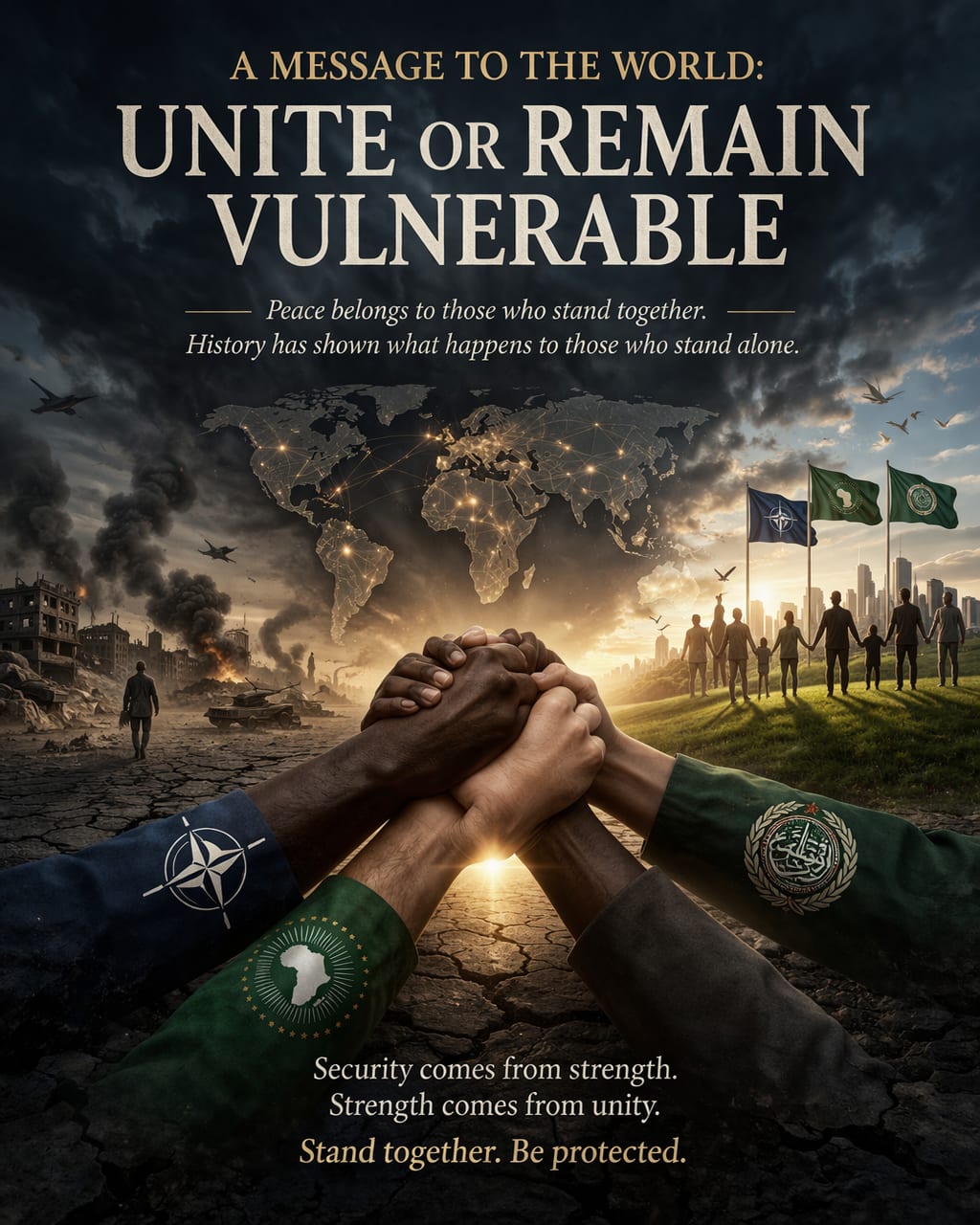
Peace in the world cannot exist where nations stand alone. There must be no "underdogs" and no "lone walkers." Just as an individual walking alone is more vulnerable to attack, a country that stands isolated faces the same risk on a global scale. History—both past and present—shows that nations without strong alliances are more easily pressured, destabilised, or attacked. The lesson echoes across centuries: from the conquest of vulnerable city-states to the annexation of unaligned territories in modern times, isolation has consistently proven to be an invitation to aggression.
The solution is not domination, but unity for collective defence.
Strong alliances work. When countries stand together, aggression becomes far less likely because the cost of attacking one becomes the cost of confronting many. A clear example of this principle is that powerful defence alliances have significantly reduced direct attacks on their members. This is not accidental—it is deterrence in action. The North Atlantic Treaty Organization, despite its imperfections and occasional internal disagreements, has maintained peace among its members for over seven decades. No member state has suffered a direct military invasion from an external power since its founding. This remarkable record demonstrates that collective security arrangements, when taken seriously and backed by credible commitments, fundamentally alter the calculations of potential aggressors.
However, unity must be built on fairness. Not all countries have equal resources, and expecting identical contributions is unrealistic. Instead, nations should contribute equitably based on their capacity—whether through funding, manpower, intelligence, technology, or strategic positioning. True strength lies in cooperation, not uniformity. A small nation with crucial geographic positioning might contribute access to strategic waterways or airspace. A developing country with limited financial resources might instead provide peacekeeping troops or specialized knowledge of regional terrain and cultures. A technologically advanced nation might share cybersecurity capabilities or satellite intelligence. The diversity of contributions, properly coordinated, creates a resilient fabric of mutual dependence that strengthens all participants.
For regions like Africa and the Arab world, this is especially urgent. Fragmentation weakens them. The African continent, with fifty-four recognized sovereign states, represents extraordinary diversity in language, culture, and development levels. Yet this very fragmentation has historically left individual nations exposed to external manipulation, resource extraction without fair compensation, and intervention by former colonial powers. Similarly, the Arab world, stretching from the Atlantic to the Gulf, has seen its potential collective influence dissipated by political divisions, ideological conflicts, and the legacy of arbitrarily drawn borders that separated peoples while creating artificial states.
A unified defence structure—led not by a single dominant leader but by a shared council representing all member states—could create balance, accountability, and long-term stability. Such a system would reduce internal power struggles while ensuring every nation has a voice. Imagine an African Union with genuine collective defence capabilities, where an attack on any member triggers a coordinated response from all. Consider a reformed Arab League with binding security commitments and rotating leadership that prevents any single nation from dominating the agenda. These structures would not erase national identities or sovereignty; they would enhance them by protecting the fundamental prerequisite for self-determination: security from external coercion.
Of course, challenges exist:
Differences in political systems create divergent views on legitimacy, human rights, and acceptable state behaviour. Some nations operate as democracies with regular leadership transitions; others maintain hereditary or authoritarian systems. These differences complicate decision-making and raise questions about which values should underpin collective institutions.
Unequal economic power means that wealthier nations naturally carry greater influence, potentially recreating within alliances the very imbalances they seek to prevent externally. Without careful design, collective structures risk becoming vehicles for the powerful to legitimise their dominance rather than genuine partnerships of equals.
Distrust between nations runs deep, fed by historical conflicts, territorial disputes, ethnic tensions, and remembered betrayals. The wounds of past wars and colonial exploitation do not heal quickly, and suspicion of neighbours' intentions can paralyse cooperation even when rational analysis suggests its benefits.
Competing national interests, whether economic, strategic, or ideological, create constant tension between collective commitments and individual priorities. A nation facing urgent domestic challenges may be tempted to free-ride on alliance contributions or to strike independent deals that undermine collective positions.
But these are not reasons to avoid unity—they are reasons to design it better. Solutions include:
Transparent governance structures that make decision-making visible and accountable, reducing fears of hidden manipulation by powerful members. Regular public reporting, independent oversight mechanisms, and accessible dispute resolution processes build the trust necessary for sustained cooperation.
Rotating leadership roles that prevent permanent concentration of power and ensure all members experience both responsibility and service. Rotation also spreads institutional knowledge and develops leadership capabilities across the entire membership.
Binding defence agreements that create genuine credible commitments, not merely aspirational statements. The credibility of collective security rests on the certainty of response; ambiguity invites testing by potential aggressors.
Clear conflict-resolution mechanisms that address disputes between members before they escalate to rupture the alliance. Internal mediation, arbitration panels, and graduated sanctions for violations of collective norms maintain cohesion without suppressing legitimate disagreement.
Another uncomfortable truth must be addressed: power deters aggression. Nuclear weapons, while dangerous and controversial, have largely prevented direct wars between countries that possess them. The record of the Cold War, despite its proxy conflicts and nuclear brinkmanship, showed that mutually assured destruction created powerful incentives for restraint among the superpowers. This suggests that deterrence works—but it also exposes a global imbalance. Nations without strong alliances or strategic power remain more vulnerable. The non-proliferation regime, while understandable in its attempt to limit catastrophic risks, has also perpetuated a hierarchy of security where some nations possess ultimate guarantees while others must rely on the uncertain promises of protectors or the mercy of the international community.
So the lesson is clear: Security comes from strength—and strength comes from unity.
There is also a deeper human issue at play. Power often creates arrogance. Stronger nations can behave like bullies, while weaker nations are left exposed, like children unable to defend themselves. This dynamic corrupts international relations, turning diplomacy into domination and negotiation into extraction. The powerful demand deference while offering protection that sometimes resembles protection rackets more than genuine security partnerships. The weak, aware of their vulnerability, may flatter and accommodate, or they may resent and resist—neither response producing the respectful, productive relationships that stable peace requires.
This imbalance will continue unless the vulnerable stand together. Collective action transforms the psychology of weakness. Nations that bargain individually for security guarantees become supplicants; nations that offer collective security become partners. The difference in standing, in self-respect, and in practical outcomes is profound.
This is a wake-up call.
Countries that remain isolated—especially across Africa, parts of Asia, and smaller Arab nations—must recognise the risk. The international system is not becoming more forgiving of weakness. Climate change, resource scarcity, technological disruption, and great power competition are intensifying pressures that will test national resilience as never before. Unity is no longer optional; it is necessary for survival in a world where power still shapes outcomes.
The choice is simple: Stand together and be protected, or stand alone and remain exposed.
Yet this choice, simple in statement, demands courage in execution. It requires leaders who can see beyond immediate political advantage to long-term national interest. It requires populations who understand that sovereignty shared is sovereignty preserved, not surrendered. It requires the painstaking construction of institutions that can manage diversity while maintaining unity. The path is difficult, but the alternative—continued vulnerability in an unforgiving world—is far more dangerous. The time for deliberation is ending; the time for decision has arrived.
About the Creator
Adebayo Ibrahim
I write about everything and anything relevant
Keep reading
More stories from writers in Futurism and other communities.
How machines can learn from human behaviour
In order to understand where we are and where we are going, we need to understand where we were first. - Susan Fourtane Could a human behaviour simulator be embedded into a robot or online avatar to the point that it’s hard to distinguish between a real person or artificial intelligence? Scientists have been upping the stakes in this “Turing test” for years, to the point that human-mimicking programmes are ready to answer tricky questions, assist people with online shopping or be companions.
By Susan Fourtané 10 days ago in Futurism
Simulation Software Market: SME Accessibility Trends, Low-Code/No-Code Simulation Platforms, & Market Forecast
According to IMARC Group's latest research publication, global simulation software market size was valued at USD 18.4 Billion in 2025. Looking forward, IMARC Group estimates the market to reach USD 44.3 Billion by 2034, exhibiting a growth rate (CAGR) of 10.27% during 2026-2034.
By sujeet. imarcgroup6 days ago in Futurism
Side Quest Goal Achieved: Placing an Alien Claim
This is a post that has me quite ecstatic. It's funny, I thought it was going to be one of my usual, "Hey, I achieved another one of my goals and checked it off" type deals. And it sort of is. But it sort of isn't. And it's also one of my greatest writing accomplishments of late.
By Stephen Kramer Avitabile2 days ago in Writers




Comments (1)
yes just peace every where