astronomy
Celestial objects and the phenomena that surrounds them. What lies above the earth forever out of reach. From moons, to stars, galaxies, and beyond.
Unlocking the Hidden Codes of Life: A Deep Dive into Numerology
The Mystery of Numbers Numbers are everywhere in our lives. We see them on clocks, in dates, in addresses, and even in patterns that repeat over and over again. Most of us think of numbers as practical tools: they help us count, calculate, and organize. But for thousands of years, many cultures believed that numbers carried deeper meaning, that they were keys to understanding the structure of life itself.
By The Secret History Of The World6 months ago in Futurism
Agartha: The Hidden Kingdom Beneath Our Feet
Imagine a land no map reveals, a kingdom hidden beyond mountains of stone and ice, far below the noise and light of the surface world. This is Agartha, the fabled inner world where ancient memory, wisdom, and power are said to rest in silence. For centuries seekers have pursued its traces, and skeptics have dismissed it as myth, yet its story refuses to die. Perhaps the legend endures because it reflects not only a lost realm but also a forgotten part of ourselves. The name Agartha carries weight and mystery. Some say it has roots in Sanskrit, others that it evolved from fragments of lost traditions. In esoteric writings Agartha appears as the beating heart of a hidden history, a subterranean civilization of light, advanced knowledge, and technology beyond what surface humanity remembers. Often linked with the Hollow Earth theory, Agartha is not imagined as empty space but as a thriving domain of cities, rivers, energy currents, and guardians of wisdom. According to the legend, Agartha’s civilization was founded by ancestors of immense knowledge who withdrew beneath the earth when the surface was torn apart by war, climate collapse, and natural disasters. Through labyrinthine tunnels and portals they built a world away from the ruins above. At the center of Agartha lies a radiant energy source, often described as an “inner sun.” This is no burning star but a glowing sphere of life force, a spiritual engine that provides light, warmth, and harmony to those who dwell there.
By The Secret History Of The World6 months ago in Futurism
Genetic traits add substance to case for 'engineered' humans
The education system when I was in secondary school necessitated a compromise when selecting O-level subjects which meant I opted to miss out on biology despite wanting to choose it. I had no desire to study French but was “advised” to do so by everyone I consulted, including the parents, who didn’t share my enthusiasm for the only viable alternative: tech drawing. Had it been an option it would certainly have been biology... but the way the subjects were grouped ruled out that possibility.
By Steve Harrison6 months ago in Futurism
Earendel: The Most Distant Star Ever Detected
In the spring of 2022, astronomers spotted something extraordinary through the Hubble Space Telescope: a tiny glimmer of light from the edge of the observable universe. At first, many believed it could be a distant galaxy, or perhaps just a cluster of stars blurred together. But now, thanks to the unprecedented clarity of the James Webb Space Telescope (JWST), scientists have confirmed that this faint spark is, in fact, a single star.
By Holianyk Ihor6 months ago in Futurism
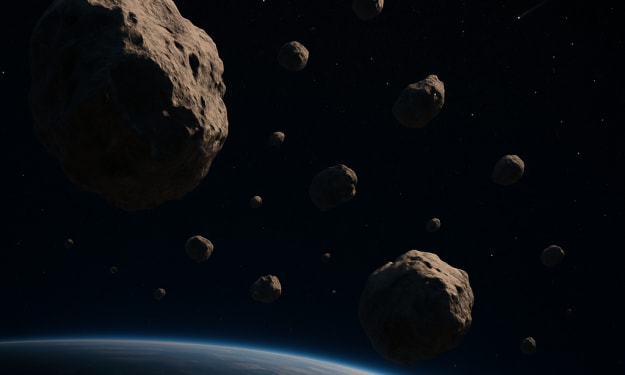
Millions of Small Bodies Threatening Earth Will Soon Be Visible — Predictions from LSST and Next-Generation Sky Surveys
For decades, the night sky has looked like a familiar canvas, dotted with stars, planets, and the occasional streak of a meteor. Yet beneath this seemingly calm picture hides a dynamic swarm of small bodies — asteroids, comets, and other fragments left over from the birth of our Solar System. Many of them cross paths with Earth, sometimes uncomfortably close. Until now, only a fraction of these objects have been cataloged. But that is about to change.
By Holianyk Ihor6 months ago in Futurism
A World Without America: Imagining the Global Impact
A World Without America: Imagining the Global Impact** The United States of America has long held a prominent role on the world stage. As a global superpower, its influence extends across politics, economics, science, culture, and military affairs. But what would the world look like without America? This hypothetical scenario, though extreme, invites us to explore the positive and negative consequences of a world where the United States does not exist—either historically or in the present.
By America today 6 months ago in Futurism
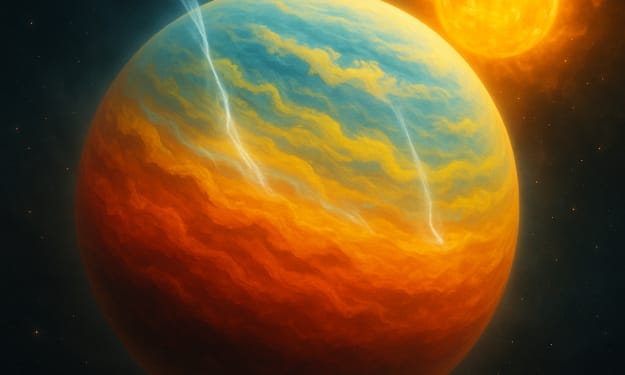
New Observations of Exoplanet WASP-52 b Reveal Helium and Water Despite Its Host Star’s Fierce Radiation
When astronomers first began discovering exoplanets in the 1990s, most of them were little more than faint dots of light in distant skies. Today, thanks to advanced telescopes and precise techniques, these alien worlds are no longer just points in the dark—they are objects we can study in detail, even down to the chemical makeup of their atmospheres. Recently, the hot Jupiter known as WASP-52 b has surprised astronomers with a remarkable discovery: signs of both helium and water vapor in its atmosphere. This is astonishing, considering the harsh radiation from its host star, which should, in theory, strip such fragile molecules away.
By Holianyk Ihor6 months ago in Futurism
A Record-Breaking System: The Exoplanet Family Racing Through the Galaxy
Astronomy has a way of surprising us, even when we think we’ve seen it all. We’re used to hearing about new stars, exoplanets, or distant nebulae lighting up the cosmic stage. But sometimes, discoveries are so striking that they make us pause and reimagine what’s possible in the universe.
By Holianyk Ihor6 months ago in Futurism
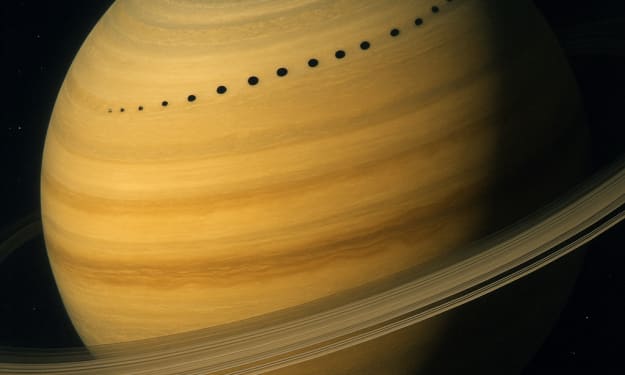
The Mysterious “Dark Beads” Above Saturn’s Pole: JWST Unveils a Cosmic Puzzle
Saturn has always been one of the most enigmatic worlds in our solar system. Known for its dazzling rings, its golden-hued atmosphere, and its bizarre six-sided polar storm, the gas giant is a favorite subject of astronomers. Yet just when we think we’ve learned most of its secrets, Saturn surprises us again. Recently, NASA’s James Webb Space Telescope (JWST) captured something utterly unexpected in the planet’s northern atmosphere: a string of strange, dark structures scientists are calling “mysterious dark beads.”
By Holianyk Ihor6 months ago in Futurism
The Most Distant Quasar: A Glimpse Into the Dawn of the Universe
Astronomers have recently made a discovery that pushes the limits of our cosmic vision: the most distant quasar ever found. This ancient beacon of light formed just 500 million years after the Big Bang—when the Universe itself was still in its infancy. Peering at this quasar is like looking back across time to witness the first chapters of cosmic history.
By Holianyk Ihor6 months ago in Futurism