habitat
The natural home and environment for all things sci fi, including future homes and territories.
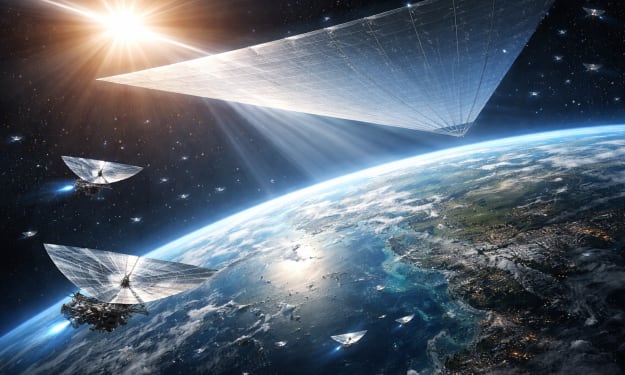
Space-Based Geoengineering: Can We Cool the Earth from Orbit?
As global temperatures continue to rise, the conversation around climate intervention is becoming more urgent—and more unconventional. Among the most ambitious ideas is space-based geoengineering: using structures placed in orbit to reduce the amount of solar energy reaching Earth. It sounds like science fiction, but researchers have been seriously exploring whether cooling our planet from space could one day become a viable option.
By Holianyk Ihorabout 21 hours ago in Futurism
Yuxian Skull discovered in China has challenged this long-standing narrative of Human Evolution
Rethinking Human Evolution: A Discovery That Changes the Timeline For decades, the story of human evolution appeared relatively straightforward. Scientists believed that early advanced humans emerged around one million years ago, belonging to the species Homo erectus. According to this widely accepted model, this species eventually split into two major branches around 600,000 years ago. One branch led to the Neanderthals, while the other gave rise to modern humans, Homo sapiens. This linear and orderly progression formed the foundation of how we understood our origins.
By Ibrahim Shah 4 days ago in Futurism
10 Mind-Blowing Space Facts You Were Never Taught in School
We’ve all heard the phrase that space is the final frontier. But let’s be honest, what most of us learned in school barely scratched the surface. Beyond the neat diagrams and textbook definitions lies a universe filled with weird, shocking, and sometimes hilarious realities.
By Areeba Umair5 days ago in Futurism
The Planet Nine Hypothesis: A Hidden Giant at the Edge of Our Solar System
For decades, astronomers believed the architecture of our Solar System was largely settled: eight planets orbiting the Sun, with smaller bodies distributed across regions like the asteroid belt and the Kuiper Belt. Beyond these, the distant Oort Cloud was thought to mark the outer boundary of the Sun’s gravitational influence. Yet, in recent years, this seemingly complete picture has been challenged by a compelling and mysterious idea — the existence of a hidden world known as Planet Nine.
By Holianyk Ihor11 days ago in Futurism
The Mystery of Fast Radio Bursts (FRBs) and Their Possible Origins
In the early 21st century, radio astronomy encountered a phenomenon that quickly evolved into one of the most compelling mysteries in modern astrophysics: Fast Radio Bursts, or FRBs. These signals are extraordinarily brief yet immensely powerful flashes of radio waves arriving from deep space. Each burst lasts only a few milliseconds, but in that fleeting moment it can release as much energy as our Sun emits over several days.
By Holianyk Ihor11 days ago in Futurism
The “Silent Collapse” of a Star: A New Type of Stellar Death Discovered in Andromeda
For more than a century, astronomers believed that the death of a massive star was always one of the most dramatic events in the universe. When a giant star exhausts its nuclear fuel, its core collapses under gravity and the outer layers explode outward in a spectacular supernova. These explosions are so powerful that, for a brief time, a single star can shine brighter than an entire galaxy.
By Holianyk Ihor22 days ago in Futurism
The Vanishing Star in Andromeda: The Birth of a Black Hole Without a Supernova
For decades, astronomers believed that the death of a massive star was always accompanied by one of the most spectacular events in the universe: a supernova explosion. These cosmic blasts can briefly outshine entire galaxies and scatter heavy elements across interstellar space. However, recent observations suggest that not all massive stars end their lives in such dramatic fashion. Some may simply disappear.
By Holianyk Ihor22 days ago in Futurism
Title: War's Effects on the World Economy: How Wars Change Financial Stability
Title: War's Effects on the World Economy: How Wars Change Financial Stability Introduction One of humankind's most destructive experiences is war. The immediate effects are frequently observed on battlefields, but the effects go far beyond military conflict. Around the world, wars have an impact on economies, cause trade to be disrupted, increase poverty, and cause financial instability.
By Farida Kabir24 days ago in Futurism
The Cosmic Influence of the Sun on the Inner Planets and Climate
At the center of our planetary system lies Sun, a G-type main-sequence star that governs the physical and climatic evolution of the inner planets: Mercury, Venus, Earth, and Mars. Although these worlds share a common origin and relatively close orbital distances, their climates differ dramatically. The explanation lies in how each planet interacts with solar radiation, solar wind, and long-term stellar evolution.
By Holianyk Ihor29 days ago in Futurism
The Dynamics of the Interstellar Medium and Galactic Magnetism
At first glance, the space between stars appears empty — a silent vacuum separating luminous islands of light. In reality, this vast region is filled with a complex, restless environment known as the interstellar medium (ISM). Far from being inert, it is a dynamic system of gas, plasma, dust, radiation, turbulence, and magnetic fields. Within galaxies such as the Milky Way, the interstellar medium functions as both the raw material and the regulating mechanism for star formation, cosmic ray transport, and large-scale galactic structure.
By Holianyk Ihor29 days ago in Futurism
Euclid and the Precision Era of Dark Cosmology
In 2023, the European Space Agency launched Euclid with a sharply defined objective: to map the geometry of the Universe and determine, with unprecedented precision, how dark matter and dark energy shape cosmic evolution. Rather than focusing on individual spectacular objects, Euclid operates as a large-scale cartographer. Its mission is statistical and structural. It surveys billions of galaxies across a third of the sky to reconstruct a three-dimensional map of the cosmic web stretching over 10 billion years of cosmic history.
By Holianyk Ihorabout a month ago in Futurism
Launch and Scientific Impact of NASA’s Nancy Grace Roman Space Telescope (2026)
In 2026, NASA is preparing to launch one of the most ambitious space observatories of the decade: the Nancy Grace Roman Space Telescope. Designed to survey the universe at an unprecedented scale in near-infrared light, Roman is expected to reshape modern astrophysics by combining high resolution with an extraordinarily wide field of view. If the Hubble Space Telescope revealed the fine details of the cosmos, Roman will provide the panoramic context.
By Holianyk Ihorabout a month ago in Futurism