how to
How to create science fiction and technology projects in a simplistic, easy manner.
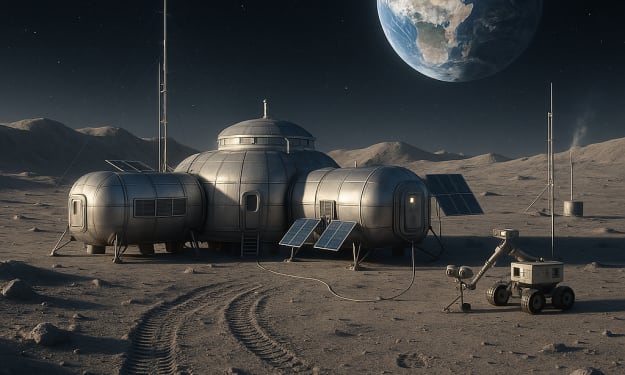
The Moon: A New Frontier — How China and Russia Are Building the Base of the Future
Imagine looking up at the Moon one night and knowing that somewhere, amid its silver craters and endless shadows, a joint Chinese–Russian lunar base is quietly operating. It sounds like science fiction — something out of a 1960s space novel — but this time, it’s real. The project is already underway and could soon reshape not only our understanding of space but also the balance of power on Earth.
By Holianyk Ihor6 months ago in Futurism
Beyond Coding: How Next-Gen ERP Developers Will Drive Business Efficiency in 2025. AI-Generated.
In 2025, the role of an ERP (Enterprise Resource Planning) developer is no longer limited to writing code or managing databases. Today’s ERP developers are innovators, strategists, and architects of digital transformation. As organizations race toward automation, artificial intelligence, and data-driven decision-making, ERP development has become the backbone of modern business efficiency.
By Mian Abdulrahman6 months ago in Futurism
Homes Beneath the Red Dust: How Subsurface Living Could Keep Mars Settlers Safe and Warm
When humans finally set foot on Mars, they won’t be building glass domes under the crimson sky — at least not right away. The first Martian homes will likely be hidden beneath the planet’s surface, buried in the dusty regolith, where the hostile environment gives way to safety, stability, and warmth.
By Holianyk Ihor6 months ago in Futurism
The Titan Colony Concept — Life Beneath Methane Clouds
When humanity first gazed upon the golden, hazy images sent back by the Cassini–Huygens mission, it became clear that Saturn’s moon Titan was not just another frozen satellite. Here was a world with mountains, rivers, rain, and lakes — but everything made of something alien. Instead of water, methane flows in liquid form. Instead of white clouds, the skies are thick with orange hydrocarbon haze. The air is heavy, the light dim, and the temperature bone-chilling — a staggering minus 180°C.
By Holianyk Ihor6 months ago in Futurism
Magnetic Pulse Rotary Engines: Engineering the Future of Motion
In the global race for cleaner, smarter, and more efficient energy, engineers and inventors constantly search for technologies that could transform how we generate and use power. Among the most intriguing concepts is the magnetic pulse rotary engine — a device that turns magnetic energy into mechanical motion through a carefully timed series of electromagnetic impulses.
By Holianyk Ihor6 months ago in Futurism
Fusion Drive: The Power Source That Could Take Us Between Worlds
For over half a century, humans have dreamed of venturing beyond the Moon — to Mars, the outer planets, and maybe even the stars themselves. Yet our greatest limitation isn’t imagination. It’s propulsion. Chemical rockets, the same technology that took Apollo to the Moon, remain the backbone of space travel today. They’re powerful but painfully inefficient — guzzling vast amounts of fuel for tiny amounts of payload.
By Holianyk Ihor6 months ago in Futurism
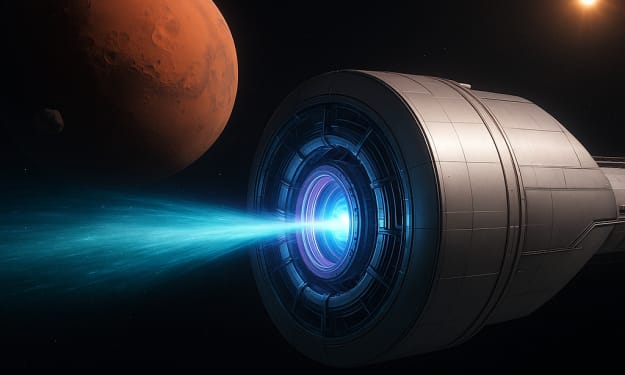
VASIMR Plasma Engines: The Next Leap Toward Interplanetary Travel
For more than half a century, humanity has been dreaming of Mars. Countless films, novels, and scientific proposals picture astronauts stepping onto the Red Planet’s dusty plains. Yet despite all the excitement, one stubborn obstacle remains: getting there in a reasonable amount of time.
By Holianyk Ihor6 months ago in Futurism
When Hollywood Goes Digital: The Ethical Perils of AI in Film and TV
Hollywood has consistently embraced technological advancements, from ancient sound and Technicolor to modern computer-generated imagery (CGI), all of which have reshaped storytelling. However, artificial intelligence (AI) represents a more profound shift, affecting the very core of creative expression.
By Jenna Deedy6 months ago in Futurism
Earendel: The Most Distant Star Ever Detected
In the spring of 2022, astronomers spotted something extraordinary through the Hubble Space Telescope: a tiny glimmer of light from the edge of the observable universe. At first, many believed it could be a distant galaxy, or perhaps just a cluster of stars blurred together. But now, thanks to the unprecedented clarity of the James Webb Space Telescope (JWST), scientists have confirmed that this faint spark is, in fact, a single star.
By Holianyk Ihor6 months ago in Futurism