
History of The Three Stooges (Part I: The Beginnings and Columbia Pictures - 1920s-1936)
A look at the earliest beginnings of the iconic comedy trio known as The Three Stooges

I have been itching to write about The Three Stooges on Vocal for close to two years, but I couldn't figure out how to do it. I wanted to do it by third Stooge, but that's a bit complicated. I know this much. I was about eight or nine years old when I first saw The Three Stooges. I remember one of my local channels had the Stooges on for hours, and I tried my damnedest to be up for those shorts. I remember that the Family Channel actually had an hour of the Stooges on from 11PM to midnight, and it was the entire library on during that time.
Around 2000, AMC aired the Stooges shorts in the form of a short-lived series known as "N.Y.U.K," which stood for the "New Yuks University of Knuckleheads." The professor of this school was the late, great Leslie Nielsen, and he would give intros leading to the respective short. This didn't last too long, and later on, the Stooges were back on local TV and on Spike TV as well, before finding a current home on MeTV.
What I know about the Stooges could fill up a few places, and regarding how I'll do this, it will be divided into numerous parts, because I don't want to cram too much into a single story. So let's get this started:
Mid 1920s-1932
The earliest that the Stooges act started was around 1922, and for a few years, it was Ted Healy as the lead comic with his pair of Stooges, brothers Shemp (born Samuel Horwitz on March 11, 1895) and Moe Howard (born Harry Moses Horwitz on June 19, 1897). It was about a few years later that the group spotted Larry Fine (born Louis Feinberg on October 5, 1902) performing his violin act, and they gave him an offer to join the act. The offer went like this, and I always hearing about it. When Larry was approached, he had washed his hair, and it was frizzed up. Upon noticing this, Healy said to Larry, "If you keep your hair like that and forget the violin, I'll pay you $100 (per performance)."
Larry's answer: "For $100, I'll forget everything!"
So by the mid to late-20s, Larry was part of the act, and Healy had three stooges. The performances continued, and their big break came when they were featured in the 1930 comedy, Soup to Nuts, which I saw on AMC a long time ago. Despite this, all wasn't completely well. Healy had quite the nasty reputation; drunkenness, abrasive behavior, and a famous moment where he apparently threatened to blow up a studio in response to the Stooges going on their own.
1932-1934 (Curly Joins)
One person who couldn't stand Healy and his personality was Shemp, and by 1932, Shemp left the act, despite his worries over how Moe and Larry would proceed. Under the suggestion of Moe, his and Shemp's baby brother Jerry (born Jerome Lester Horwitz on October 22, 1903) filled the void, but at the time, Jerry had a full head of hair and a mustache, not exactly a Stooge look. Jerry's hair and mustache was shaved, and regarding his new look, he was quoted as saying, "Boy, do I look girlie." Healy heard "Curly" in that statement, and the name stuck.
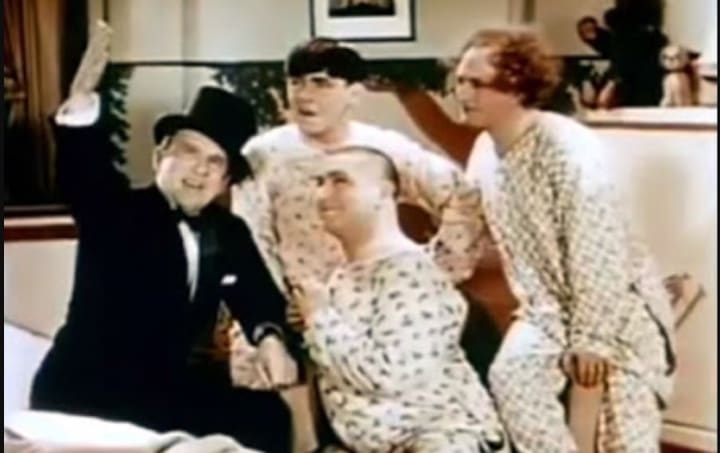
Moe, Larry, Curly--that was the trio, and they and Healy appeared in a number of projects for MGM, one of the first being 1933's Nertsery Rhymes, which was actually shot in color and served as the first short film that Healy and the Stooges did for MGM. They did several more for MGM during 1933 and 1934, but by the latter year, their destinies lied elsewhere.
1934 (Columbia Pictures)
The trio's contract with MGM was over by 1934, and Columbia Pictures had seen their act. Harry Cohn, the president of Columbia, signed the trio to start in their short subjects, with their very first short being Woman Haters, which was released on May 5, 1934. In the short, the Stooges play characers named Tommy (Moe), Jim (Larry), and Jackie (Curly), and they are sworn in as members of the Woman Haters Club, with the vow to never get to romantically involved with a woman. The short centers on Larry's character, Jim, who is in a relationship with Mary (Marjorie White in her final role) and ends up marrying her, while keeping the marriage hidden from Tommy and Jackie. However, upon overhearing the boys, Mary decides to flirt with Jackie and Tommy, messing with all three as payback.
Woman Haters was basically a musical, done entirely in rhyme, and also features the Stooge debuts of supporting actors Monte Collins and Bud Jamison, both staples during the Curly period. This was followed by Punch Drunks, the only short written by the Stooges, and also permanently set the trio's roles in stone: Moe was the strict leader who dished out the violence, Larry was the middleman of the trio, and Curly was the comedy relief. Punch Drunks was the first sports-related short, with Curly as a boxer whose rage is activated upon hearing "Pop Goes the Weasel."
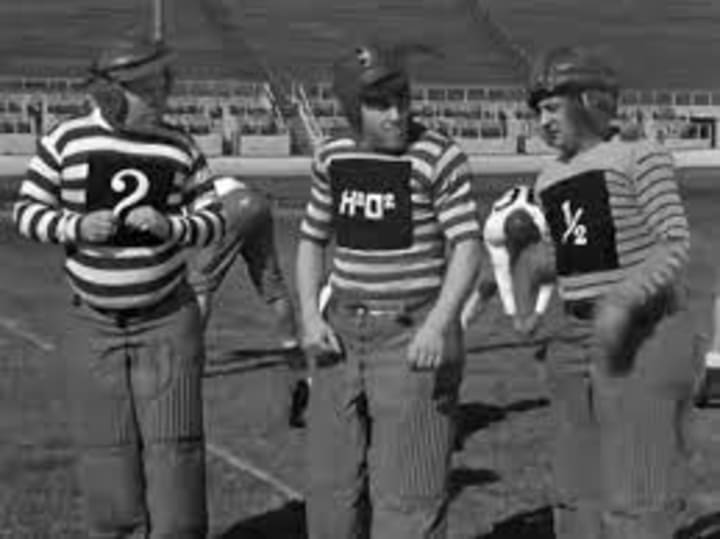
1934 was rounded out by Men in Black (no, not that one), which featured the trio as doctors performing their deeds "for duty and humanity!" The year's last short is actually my favorite out of that year's group: Three Little Pigskins. That short featured the Stooges being mistaken for a trio of football players, and invited in by a trio of gangsters' girlfriends, one of them played by the iconic Lucille Ball! Seeing them actually take the field in the climax was hilarious; they had no idea how to play, but they still somehow looked better than the Minnesota Vikings.
1935
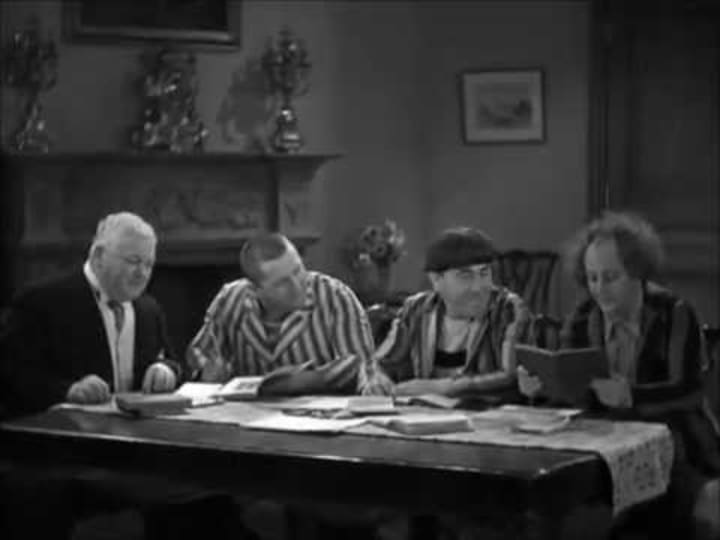
1935 saw seven more shorts released with the Stooges, beginning with Horses' Collars, which featured Curly's famous "Moe, Larry, the cheese!" line. That was the first of many Westerns they did, and Restless Knights was the first to place the Stooges in a medieval setting. Pop Goes the Easel that featured the trio posing as artists, and Uncivil Warriors placed the Stooges in the Civil War. Pardon My Scotch featured the boys as brew makers, and was the first instance of Curly doing his famous Curly Shuffle, which he did in several shorts.
1935's most standout short was, without question, Hoi Polloi, where (in an homage to Pygmalion) the Stooges are subjects of a bet made by two professors, with the argument being whether environment or heredity determines class. A $10,000 bet is placed, with one of the professors agreeing to mold his subject(s) into gentlemen. Sure enough, the Stooges are the projects, and it's bumpy, especially their hilarious reading lessons:
"See the cat. Does the mouse see the cat? Yes... the dirty rat!"
This short was remade twice, and was the first and earliest to be remade. In the original, Larry utters that line. In both remakes, Moe says it. The year was rounded out by Three Little Beers, which had the boys as delivery men for a beer company trying to enter a golf contest. So out of the first 11 shorts, three of them involved sports. Four if you count the Stooges showing off their Greco-Roman wrestling skills in Restless Knights.
1936
1936 was a memorable year for the Stooges, as they were featured in eight shorts for Columbia that year. Ants in the Pantry featured the boys as exterminators who plant the pests in a high society gathering to drum up business. A scene that always tickles me is when Larry gives Curly some cheese, only to reveal to Moe that it's laced with rat poison. An angry Curly looks to slap Larry, but accidentally slaps Moe:
Moe: "What's the idea?!"
Curly: "What does he think I am, a rat?!"
Moe: "Yeah, what about it?"
Curly: "Well, he don't have to tell everybody."
This was followed by Movie Maniacs, which had the Stooges looking to get into show business, and being mistaken for Hollywood big wigs does help. Half-Shot Shooters originally placed the boys as fighters in World War I, who are awakened to learn that the war was over. They are on the receiving end of violent bullying from their sergeant, but they get him back afterwards. In the present, the Stooges are transients, and are later tricked into joining the army by a man who they tried to bum food off of. By the way, that very man was played by Vernon Dent, one of the most known Stooge supporting actors, and that short marked his Stooge debut.
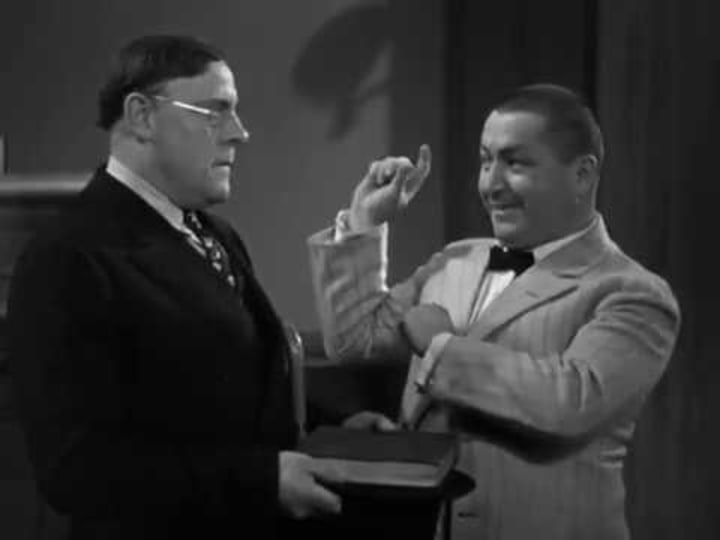
The clear centerpiece of 1936 was, without question, Disorder in the Court. Forever etched in history as the most popular of the Stooge shorts, the film centers on Gail Tempest, who is accused of murdering Kirk Robin. As for the Stooges, they are called as witness for the defense, which includes a hilarious see where they have a devil of a time trying to get Curly to take the oath:
Judge: "He's asking you if you swear--"
Curly: "No! But I know all the words."
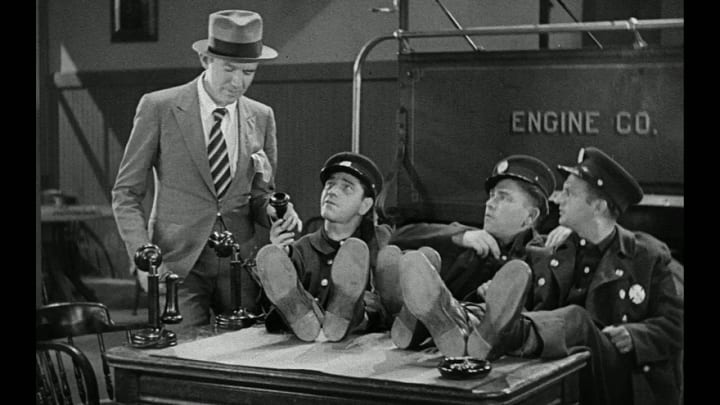
Disorder in the Court, which was released on May 30, 1936, remains one of the Stooges' best and most popular short, mainly because it's one of four shorts (and the only Curly short) that is out on the public domain. This was followed by A Pain in the Pullman, which sees hilarity ensue with the boys on a train. And it's a lot of hilarity; the short is 19:46 long, just a hair under 20 minutes--the longest of their Columbia shorts. Three more shorts round out the year: False Alarms (a hilarious piece featuring the Stooges as firemen), Whoops, I'm an Indian (another Western short), and Slippery Silks (a short which places the Stooges in the world of high fashion).
* * *
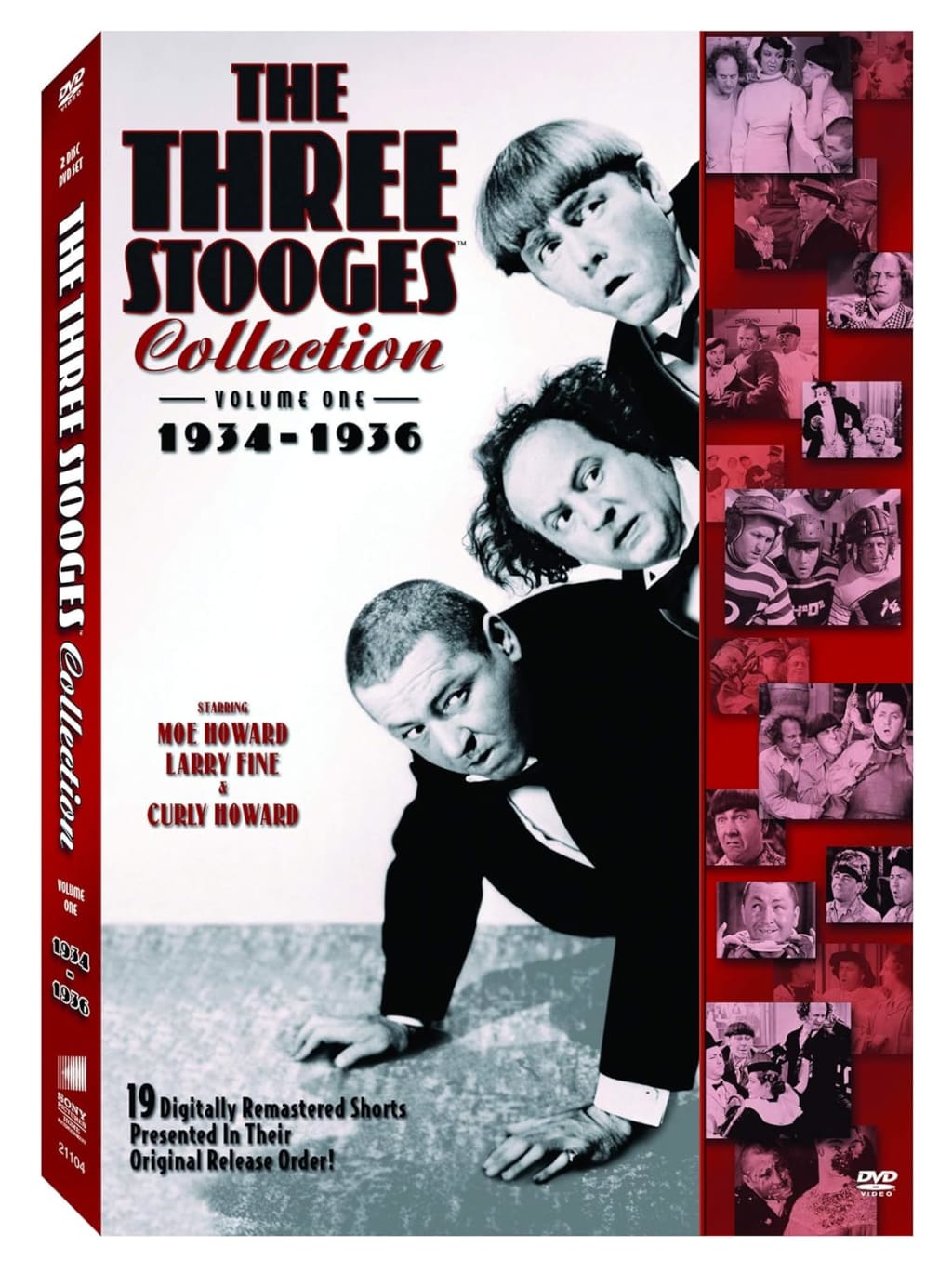
The Stooges definitely had quite the beginning, leading them to Columbia Pictures. The first 19 shorts they did for Columbia are out on DVD as Volume 1 of the Three Stooges Collection, with the set being released on October 30, 2007. Their first 19 shorts served as a stage setter, as they were on their way to seeing their popularity vastly increase, but that is definitely another story.
About the Creator
Clyde E. Dawkins
I'm a big sports fan, especially hockey, and I've been a fan of villainesses since I was eight! My favorite shows are The Simpsons and Family Guy, etc.
Keep reading
More stories from Clyde E. Dawkins and writers in Geeks and other communities.
Power Rangers Review: "The Wedding (Part III)"
This three-part arc began with a trip to Australia for the Rangers turning into the group being teleported to a theater and battling various monsters, while learning at the end of Part I that their powers are kaput inside that place. Part II would see the Rangers learn the true reason for their appearance: Lord Zedd and Rita Repulsa are getting married. The Rangers would escape, but their Zord fight would see them defeated due to their power supply being reduced, and they were sent back to the theater.
By Clyde E. Dawkins15 days ago in Geeks
Pritzker Prize 2026: Chile’s Smiljan Radić Wins ‘Nobel’ of Architecture
The 2026 Pritzker Architecture Prize—commonly known as the “Nobel Prize of architecture”—has been awarded to Smiljan Radić Clarke, a Santiago‑based visionary whose quietly radical approach to design has garnered global admiration. Radić’s recognition marks a notable moment in contemporary architecture, drawing attention not only to his deeply personal work but also to how architectural expression can engage with culture, materiality, and human experience in profound ways. Founded in 1979 by the Pritzker family and sponsored by the Hyatt Foundation, the Pritzker Architecture Prize annually honors a living architect whose built work demonstrates a combination of talent, vision, and commitment that has contributed significantly to humanity and the built environment. It is widely regarded as the highest accolade in the field, accompanied by a US $100,000 grant, a citation, and a bronze medallion. A Career of Quiet Depth and Material Sensitivity Born in Santiago in 1965, Radić studied at the Pontifical Catholic University of Chile and later at the IUAV University in Venice. He founded his own practice, Smiljan Radić Clarke, in 1995, dedicating his career to exploring how architecture can transcend conventional form and instead become an experiential engagement with space, materials, and context. His approach is not rooted in superficial signatures or stylistic bravado but in a deeply reflective process that values atmosphere, perception, and the poetics of human experience. Over decades, Radić’s work has gained international attention for its capacity to blur boundaries between architecture, poetry, and landscape. One of his most celebrated projects is the Serpentine Gallery Pavilion (2014) in London, a delicate exercise in material and spatial ambiguity that invited visitors to experience architecture as a sequence of sensations rather than a fixed form. His built work often appears elemental and serene, seemingly resisting easy interpretation. Instead of declaring architectural authority, Radić’s buildings—both small and monumental—engage visitors through subtle shifts in light, texture, and proportion, encouraging reflection and sensory immersion. What Sets Radić Apart According to commentary from architectural critics following the award announcement, Radić’s designs embody a kind of architectural introspection that distinguishes him from many peers. In a profession that sometimes prioritizes spectacle or technical bravado, his work embraces fragility, ambiguity, and the poetic potential of space. Observers note that this quiet radicalism challenges assumptions about architectural expression while reinforcing the medium’s capacity to shape emotional and sensory experience. Radić becomes the second Chilean architect to receive the Pritzker Prize, following Alejandro Aravena, who won in 2016. Aravena’s work was widely celebrated for its socially conscious approach to housing and community design; Radić’s recognition highlights a different lineage of architectural thought—one rooted in phenomenology, material inquiry, and an almost philosophical engagement with place and presence. The Jury’s Rationale The Prize jury cited Radić’s body of work as emphasizing “architecture as a lived, sensorial experience.” Rather than imposing grand narratives or dominating the landscape, his buildings invite occupants to enter spaces that feel suspended in time—neither completely resolved nor entirely fixed—reflecting a belief that architecture can mirror the complexity and richness of human existence. This focus on the experiential over the declarative positions Radić’s work as uniquely attuned to contemporary architectural discourse. Reception and Influence Radić’s win has been celebrated within the architectural community as a recognition of innovative thinking that expands the boundaries of what architecture can be. Unlike designers who foreground bold formal gestures, his work subtly integrates cultural memory, material memory, and contextual sensitivity, offering a counterpoint to trends that prioritize surface spectacle or overly rationalized programs. His buildings address a wide spectrum of scales—from intimate residential work to public pavilions—yet they consistently reflect a commitment to crafting environments that foster reflection and emotional response. Critics have praised this depth of inquiry, suggesting that Radić’s architecture reminds the profession of its capacity to engage with human vulnerability and environmental context in meaningful ways. Looking Ahead As Radić prepares to receive the 2026 Pritzker Prize at an upcoming international ceremony, his recognition reinforces the enduring relevance of architecture that prioritizes human experience, cultural memory, and spatial poetry. For students, practitioners, and observers of the built environment, his work offers an inspiring example of how architecture can be both contemplative and transformative—capable of shaping not just cities, but how individuals perceive, inhabit, and emotionally connect with space. Smiljan Radić Clarke’s achievement underscores a broader truth: that architecture’s highest honors are not merely bestowed for iconic forms or technological mastery, but for work that resonates with human depth and reimagines how we live within the world.
By Fiaz Ahmed about 14 hours ago in Geeks




Comments
There are no comments for this story
Be the first to respond and start the conversation.