
Bahadur Shah Zafar
A Tragic Tale of Betrayal, Captivity, and the Execution of Royal Heirs in 1857

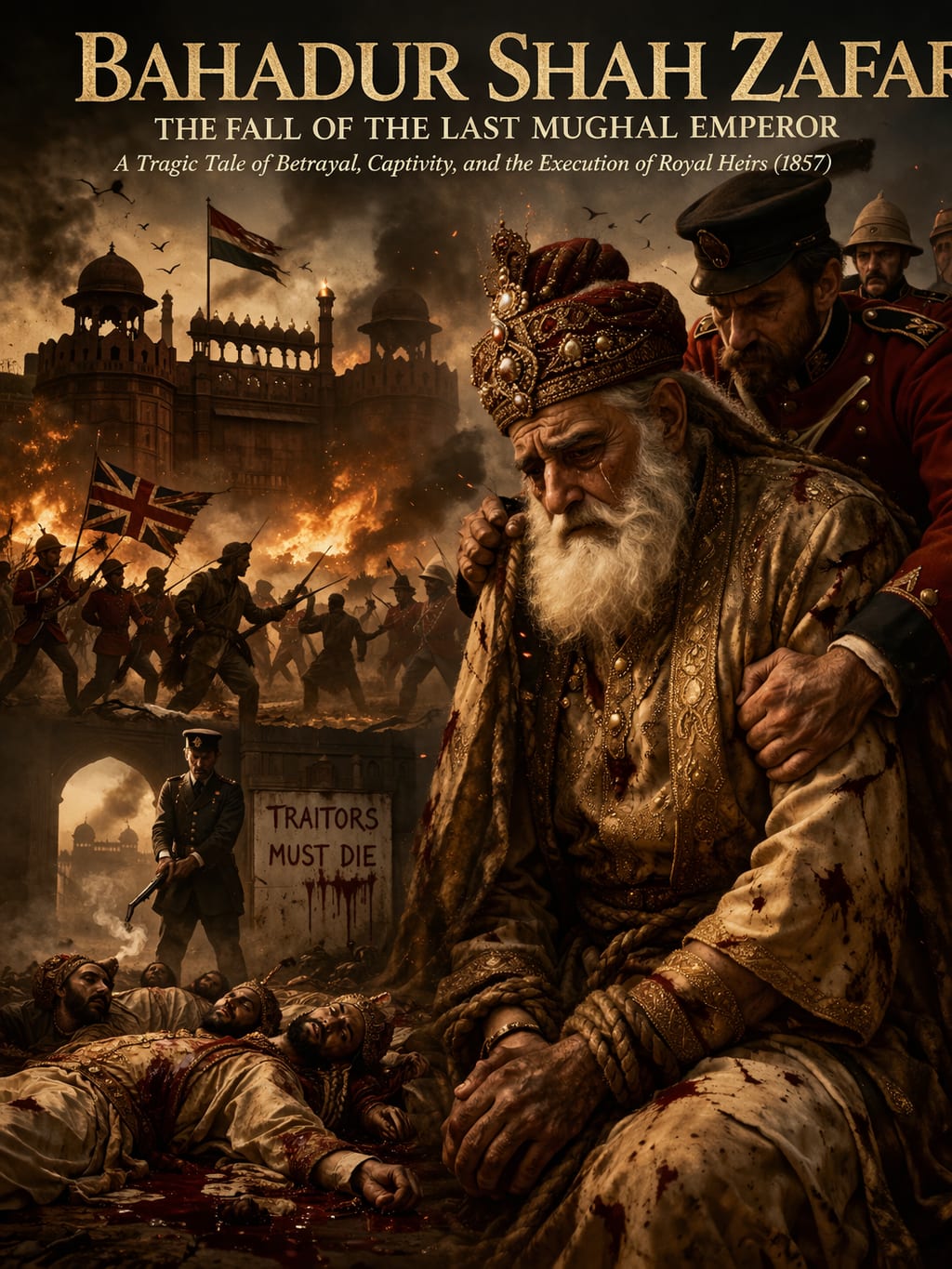
Bahadur Shah Zafar, the last emperor of the Mughal dynasty, stands as a deeply symbolic figure in the history of the Indian subcontinent. His reign marked not glory, but decline—a fading empire overshadowed by the rising power of the British East India Company. Yet, in 1857, during the great uprising against British rule, Zafar unexpectedly became the reluctant face of resistance. What followed was a heartbreaking chain of events: his capture, the brutal execution of his sons, and the final dismantling of the Mughal legacy.
By the mid-19th century, Bahadur Shah Zafar was more a poet than a ruler. His authority barely extended beyond the walls of Delhi’s Red Fort, and real political power lay firmly in British hands. However, when Indian soldiers, known as sepoys, revolted in May 1857, they sought a unifying figure to legitimize their rebellion. Zafar, despite his age and limited power, was declared the symbolic leader of the uprising.
Initially hesitant, Zafar eventually lent his name to the cause. This decision would seal his fate. The rebellion spread rapidly but lacked coordination and resources. The British forces, determined to crush the uprising, launched a fierce counterattack. By September 1857, Delhi was under siege. After days of intense fighting, British troops recaptured the city, leaving destruction and despair in their wake.
Bahadur Shah Zafar fled the Red Fort and took refuge in Humayun’s Tomb, hoping to escape the advancing British forces. However, his hopes were short-lived. He was discovered and arrested by British officer Major William Hodson. Zafar, once the emperor of Hindustan, was reduced to a prisoner, humiliated and powerless.
The most chilling episode of this tragedy unfolded shortly after his capture. Zafar’s sons—Mirza Mughal, Mirza Khizr Sultan, and his grandson Mirza Abu Bakr—were also taken into custody. They had played visible roles during the rebellion and were seen by the British as symbols of resistance. Major Hodson promised them safety if they surrendered, but this assurance proved to be a cruel deception.
As the princes were being transported, Hodson halted near the Khooni Darwaza (Bloody Gate) in Delhi. There, in a shocking act of brutality, he ordered the execution of the three royal heirs. They were stripped and shot at close range. Their lifeless bodies were left on public display—a grim warning to anyone who dared to oppose British rule. This act not only extinguished the Mughal line of succession but also sent a message of absolute dominance.
When Bahadur Shah Zafar was informed of his sons’ deaths, the emotional blow was devastating. Already a broken man, he was now forced to confront the annihilation of his lineage. According to historical accounts, Hodson presented the severed heads of the princes to Zafar—a moment that symbolized the complete collapse of Mughal dignity and power.
Zafar was subsequently put on trial by the British. Accused of treason, murder, and rebellion, he was found guilty. The trial was less about justice and more about asserting British authority. In 1858, he was exiled to Rangoon (present-day Yangon, Myanmar), far from the land he once nominally ruled.
In exile, Zafar lived a life of quiet suffering. Deprived of power, family, and homeland, he turned to poetry to express his grief. His verses reflect deep sorrow, loss, and longing. One of his most famous lines laments his inability to be buried in his own land—a poignant reflection of his tragic end.
Bahadur Shah Zafar died in 1862 in Rangoon, largely forgotten by the empire he once symbolized. With his death, the Mughal dynasty came to an official end. The British Crown formally took control of India, marking the beginning of direct colonial rule.
The story of Bahadur Shah Zafar is not merely about the fall of a king; it is about the end of an era. His capture and the execution of his sons represent one of the darkest chapters in colonial history. It is a tale of betrayal, loss, and the ruthless assertion of power. Yet, it also serves as a reminder of resistance, dignity, and the enduring human spirit in the face of overwhelming defeat.
About the Creator
Irshad Abbasi
Ali ibn Abi Talib (RA) said 📚
“Knowledge is better than wealth, because knowledge protects you, while you have to protect wealth.
Keep reading
More stories from Irshad Abbasi and writers in History and other communities.
How Mughal and Ottoman Rulers Celebrated Eid
Eid, one of the most important Islamic festivals, has always been a time of joy, gratitude, and communal harmony. While today it is celebrated with prayers, feasts, and family gatherings, in the courts of the Mughal and Ottoman empires, Eid was an event of extraordinary splendor. These powerful dynasties transformed the religious occasion into a grand display of wealth, culture, and political authority—without losing its spiritual essence.
By Irshad Abbasi 7 days ago in History
The Boy Soldiers of Shiloh
When the Battle of Shiloh erupted on April 6, 1862, over ten thousand soldiers on both sides were under the age of eighteen, with the youngest confirmed combatant being nine-year-old Johnny Clem who picked up a musket taller than himself and charged Confederate positions, and by the time the two-day battle ended with 23,746 casualties, hundreds of these child soldiers lay dead or dying in the Tennessee mud, calling for their mothers while surgeons too overwhelmed to treat adults stepped over their broken bodies to reach soldiers they deemed more likely to survive.
By The Curious Writera day ago in History


Comments
There are no comments for this story
Be the first to respond and start the conversation.