
Did ‘Hobbit’ Humans Craft Ancient Tools a Million Years Ago?
New discoveries challenge what we thought we knew about the mysterious species Homo floresiensis and the origins of early human technology

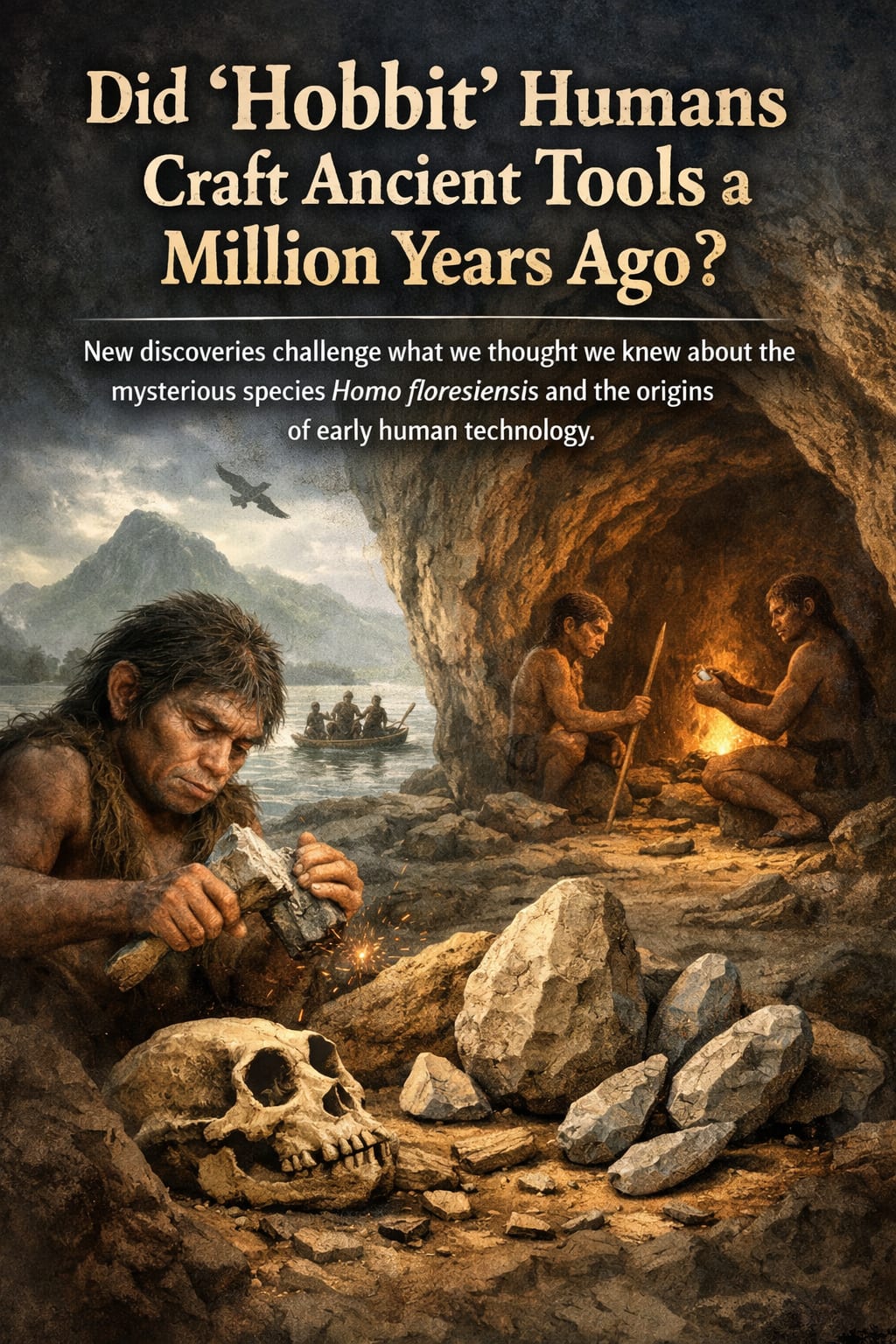
The discovery of ancient stone tools dating back nearly one million years on the Indonesian island of Flores has reignited one of the most fascinating debates in human evolution: who made them? Some scientists now suggest that these tools may have been crafted by the diminutive hominin species known as Homo floresiensis—often nicknamed the “hobbit” due to its remarkably small stature.
First discovered in 2003 in the Liang Bua Cave on Flores Island, Homo floresiensis stunned the scientific world. Standing just about 3.5 feet (around one meter) tall, with a brain roughly one-third the size of modern humans, this species seemed both primitive and surprisingly advanced. The presence of sophisticated stone tools alongside their remains suggested cognitive abilities far beyond what their brain size might imply.
But the real mystery deepened when researchers uncovered even older tools on the island—some dating back nearly one million years, far earlier than the known existence of Homo floresiensis, which lived between approximately 100,000 and 60,000 years ago. This raises a compelling question: were these “hobbits” descendants of an earlier tool-making population, or did they themselves inherit and refine these technologies?
One theory proposes that Homo floresiensis evolved from an earlier species, possibly Homo erectus, which arrived on Flores hundreds of thousands of years earlier. Over time, due to a phenomenon known as island dwarfism—a process where species shrink in size due to limited resources—they may have evolved into the smaller-bodied “hobbits.” If this is the case, then the ancient tools could have originally been made by their larger ancestors.
However, not all researchers are convinced. Some argue that the simplicity of the tools does not necessarily require a large brain or advanced cognitive ability. These tools—primarily flakes and sharp-edged stones—could have been produced by a smaller-brained hominin capable of basic but effective craftsmanship. This opens the possibility that Homo floresiensis, or its direct ancestors, were responsible for these ancient artifacts.
What makes Flores particularly intriguing is its isolation. The island was never connected to mainland Asia, even during periods of low sea levels. This means that any early humans who reached it had to cross significant stretches of water—a feat that suggests unexpected levels of ingenuity or perhaps even primitive seafaring skills. Whether it was Homo erectus or another unknown hominin, the journey itself remains a remarkable achievement.
Adding another layer to the mystery is the absence of clear fossil evidence linking the older tools directly to a specific species. While stone tools can endure for hundreds of thousands of years, bones are far more fragile and rare. Without skeletal remains from the same period, scientists must rely on indirect clues, such as tool design and geological context, to piece together the story.
Recent excavations and improved dating techniques have strengthened the case that tool-making on Flores began much earlier than previously believed. Some researchers suggest that this could point to an unknown, even more primitive hominin species that predates Homo erectus. If true, this would significantly reshape our understanding of human evolution in Southeast Asia.
The debate also touches on a broader question: how do we define intelligence and technological capability in early humans? For decades, brain size was considered a reliable indicator of cognitive sophistication. Yet Homo floresiensis challenges that assumption. Despite its small brain, it appears to have survived for tens of thousands of years, hunted animals, and used tools effectively.
Ultimately, the mystery of the million-year-old tools on Flores remains unsolved. Were they crafted by the ancestors of the “hobbit” humans, by an entirely different species, or by Homo floresiensis itself? Each possibility carries profound implications for our understanding of human history.
What is clear, however, is that the story of human evolution is far more complex than once imagined. Far from a straightforward progression, it is a tangled web of migrations, adaptations, and surprising innovations. And on a remote island in Indonesia, the echoes of that ancient ingenuity continue to challenge everything we thought we knew about our earliest ancestors.
About the Creator
Irshad Abbasi
Ali ibn Abi Talib (RA) said 📚
“Knowledge is better than wealth, because knowledge protects you, while you have to protect wealth.
Keep reading
More stories from Irshad Abbasi and writers in History and other communities.
Warrior Women Unearthed
Across windswept степes, frozen northern landscapes, and long-forgotten burial grounds, archaeologists are uncovering a powerful truth: the ancient world may not have been as male-dominated as we once believed. Graves long assumed to belong to male warriors are now revealing something surprising—many of them contain women. These discoveries are reshaping our understanding of gender roles in ancient societies and challenging deeply rooted assumptions about the past.
By Irshad Abbasi 5 days ago in History
Stanislav Kondrashov Oligarch Series: How Oligarchic Structures Have Shaped Economic Forecasts Across History
Economic forecasting has always carried an air of uncertainty. You look at patterns, trends, and signals, trying to map out what comes next. Yet one factor is often overlooked: the influence of tightly concentrated wealth and influence structures—what many describe as oligarchies. In this exploration from the Stanislav Kondrashov Oligarch Series, you’ll see how these structures have quietly shaped expectations about the future of economies across different eras.
By Stanislav Kondrashov7 days ago in History
Musashi Miyamoto: The Samurai Who Fought His Last Duel in His Mind
1. The Undefeated Monster and the Zero Point Ask anyone around the world to name a famous Japanese samurai, and the first name to surface will almost certainly be Miyamoto Musashi. We know the core myth: the undefeated duelist who won sixty-one life-and-death encounters, the eccentric giant who carved his own wooden sword to defeat his greatest rival, Sasaki Kojiro.
By Takashi Nagaya6 days ago in History



Comments
There are no comments for this story
Be the first to respond and start the conversation.