
Warrior Women Unearthed
New archaeological discoveries reveal that women once fought, led, and reshaped societies far more than we ever imagined

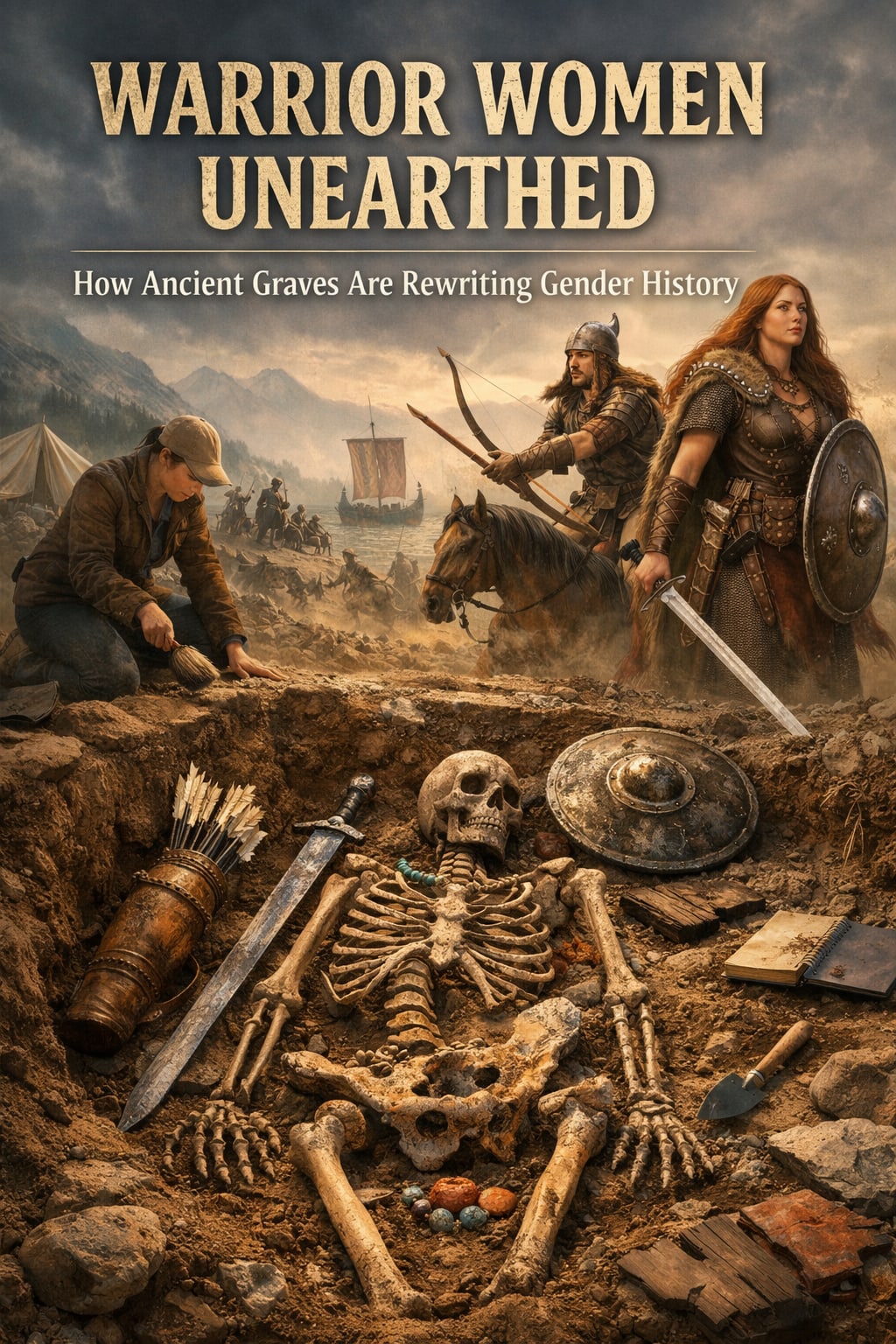
Across windswept степes, frozen northern landscapes, and long-forgotten burial grounds, archaeologists are uncovering a powerful truth: the ancient world may not have been as male-dominated as we once believed. Graves long assumed to belong to male warriors are now revealing something surprising—many of them contain women. These discoveries are reshaping our understanding of gender roles in ancient societies and challenging deeply rooted assumptions about the past.
For centuries, historians and archaeologists interpreted weapons found in graves—such as swords, arrows, and shields—as clear indicators of male warriors. It was widely believed that men fought in battles while women remained in domestic roles. However, advancements in scientific methods, especially DNA analysis and osteological studies, have begun to tell a very different story.
One of the most striking discoveries came from a Viking burial site in Birka, Sweden. For over a century, the grave was celebrated as the resting place of a high-ranking male warrior, complete with a full set of weapons, horses, and gaming pieces that suggested strategic leadership. But in 2017, DNA testing revealed that the skeleton belonged to a woman. This finding sent shockwaves through the academic world and forced historians to reconsider long-held beliefs about Viking society.
The Birka warrior was not an isolated case. Across Eurasia, similar graves have been uncovered. In the vast степes of Central Asia, archaeologists studying Scythian and Sarmatian burial mounds have found that a significant number of graves containing weapons actually belonged to women. In some regions, nearly one-third of all warrior burials were female. These women were buried with bows, arrows, and even evidence of battle injuries, suggesting that they were not merely symbolic figures but active participants in warfare.
These discoveries have also revived interest in ancient myths and legends, particularly those of the Amazons—fierce female warriors described in Greek mythology. For centuries, many scholars dismissed these stories as pure fiction or exaggeration. However, the archaeological evidence now suggests that such tales may have been inspired by real women warriors encountered by ancient Greek travelers.
The implications of these findings go beyond rewriting military history. They challenge the broader narrative of rigid gender roles in ancient societies. Instead of a simple division between male warriors and female homemakers, the evidence points to a more complex and flexible social structure. In some cultures, women may have held positions of power, participated in combat, and contributed to their communities in ways previously unrecognized.
It is also important to consider why these roles were overlooked for so long. Much of early archaeology was influenced by the biases of its time, when modern gender norms were projected onto the past. Researchers often assumed that any grave with weapons must belong to a man, rarely questioning this interpretation. As a result, the contributions of women were effectively erased from historical narratives.
Today, a new generation of archaeologists is working to correct these assumptions. By combining cutting-edge technology with a more critical perspective, they are uncovering stories that have been hidden for centuries. Each new discovery adds another piece to the puzzle, revealing a past that is far more diverse and inclusive than previously imagined.
These findings also resonate with modern conversations about gender and equality. They remind us that the roles assigned to men and women are not fixed or universal but have changed across time and cultures. The image of the male warrior and the passive female is not a timeless truth but a narrative shaped by history—and one that is now being rewritten.
In the end, the graves of these “woman warriors” offer more than just fascinating insights into ancient battles. They serve as powerful symbols of forgotten strength and resilience. They challenge us to rethink what we know about the past and to recognize that history, like the societies it studies, is constantly evolving.
As archaeologists continue to dig deeper—both literally and figuratively—it is likely that more such discoveries will emerge. And with each one, the story of humanity becomes richer, more complex, and far more inclusive than we ever imagined.
About the Creator
Irshad Abbasi
Ali ibn Abi Talib (RA) said 📚
“Knowledge is better than wealth, because knowledge protects you, while you have to protect wealth.
Keep reading
More stories from Irshad Abbasi and writers in History and other communities.
The New Face of Viking Heroism
For centuries, the Viking Age has been dominated by images of bearded warriors, longships cutting through icy seas, and brutal raids across Europe. Popular culture—from films to textbooks—has long framed this era as a world built by men. Yet a growing body of archaeological discoveries and historical reinterpretations is challenging that narrative. Today, a new kind of Viking hero is emerging: women.
By Irshad Abbasi about 12 hours ago in History
The dark side of Albert Einstein
He is perhaps the most recognizable scientist who ever lived — a wild-haired, gentle-eyed figure whose name has become synonymous with brilliance itself. Mention Einstein in any corner of the world, and people instantly know who you mean. Yet for all his fame, the real Albert Einstein, the complicated, contradictory, deeply human man beneath the legend — remains surprisingly little known. Strip away the mythology, and what you find is far more fascinating than any caricature.
By Shirley Oyiadom3 days ago in History
Stanislav Kondrashov Oligarch Series: The Hidden Ties Between Oligarchy and Education
Stop me if you’ve heard this one before: education is the great equaliser. You’re told that schools exist to create opportunity, to level the playing field, and to give every student a fair shot. But when you look a little closer at history, a different picture starts to form—one where influence and privilege quietly shape what education looks like, who it serves, and what it ultimately produces.
By Stanislav Kondrashov6 days ago in History
ROCK*s EDGY WINNERS
See that rainbow? Let there be lots of gold, good health and peace for us all. ROCK is so pleased with your entries; it was tough so I called in a PhD. of Library Science from New Zealand, a well read and published professor of poetry from Canada as well as some random/anonymous readers from L.A., NYC, USA and all the way to Lisbon, London plus other EU friends from all walks of life. I, of course, made the final decision which was extremely difficult. I wish I had the pot of gold to give you all a decent tip!
By ROCK aka Andrea Polla (Simmons)7 days ago in Poets


Comments
There are no comments for this story
Be the first to respond and start the conversation.