
From Parlors to Phantoms
How a harmless Victorian-era game transformed into one of the world’s most feared tools for contacting the unknown

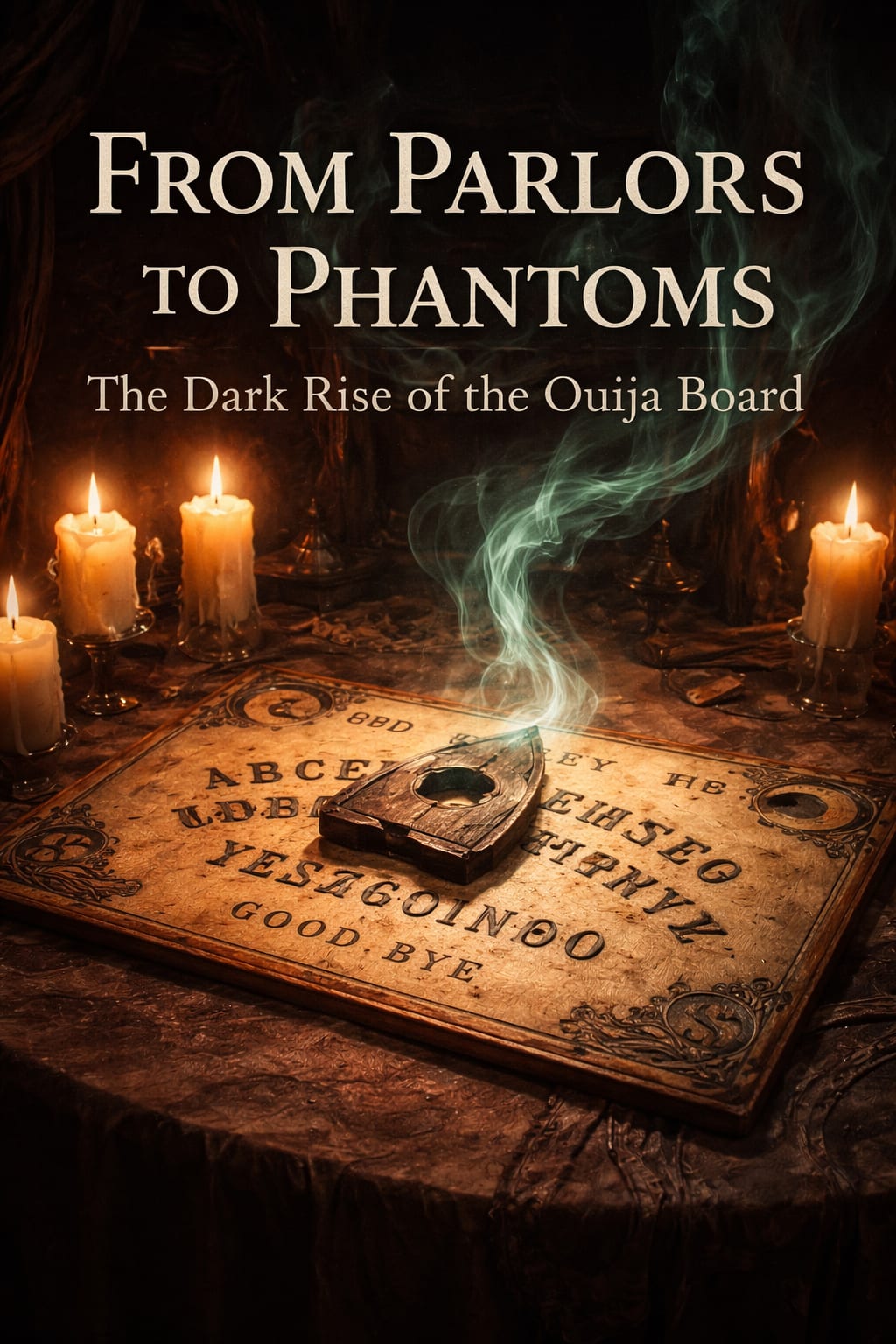
In the late 19th century, amid velvet curtains and candlelit drawing rooms, a curious form of entertainment began to captivate the Western world. It wasn’t music, nor cards, nor storytelling—it was communication with the dead. What would later become known as the Ouija board started as a novelty, a playful curiosity rooted in a society obsessed with the afterlife. Yet over time, this seemingly harmless parlor game would evolve into one of the most feared objects in popular culture.
The origins of the Ouija board lie in the rise of Spiritualism, a movement that gained widespread popularity in the United States and Europe during the mid-1800s. Following events like the American Civil War, where death touched countless families, many people sought comfort in the idea that their loved ones could still communicate from beyond the grave. Mediums, séances, and spirit communication became fashionable, even among the educated elite.
Sensing an opportunity, entrepreneurs introduced a simple tool to make spirit communication accessible to everyone. In 1890, the first commercial “talking board” was patented. It featured letters, numbers, and the words “yes” and “no,” along with a small heart-shaped pointer called a planchette. Participants would lightly place their fingers on the planchette and ask questions, watching as it appeared to move on its own to spell out answers.
At first, the board was marketed as nothing more than a game—an amusing diversion for gatherings. It was sold alongside toys and board games, and families would use it for lighthearted fun. Even skeptics attributed its mysterious movements to the ideomotor effect, a psychological phenomenon in which people make unconscious movements without realizing it.
However, the Ouija board’s reputation began to shift in the early 20th century. As belief in the supernatural persisted, stories emerged of unsettling experiences. Users claimed to receive messages from malevolent entities, warnings from the beyond, or knowledge they could not otherwise explain. The line between entertainment and the occult started to blur.
The transformation from curiosity to cultural menace accelerated dramatically in the 1970s, largely due to its portrayal in popular media. The release of the horror film The Exorcist in 1973 marked a turning point. In the movie, a young girl becomes possessed after using a Ouija board to contact a spirit named “Captain Howdy.” The chilling depiction left a lasting impression on audiences and reshaped the board’s image forever.
Suddenly, the Ouija board was no longer just a game—it was a gateway. Religious groups began warning against its use, describing it as a tool for inviting demonic forces. Stories of hauntings, possessions, and psychological distress spread rapidly, often fueled by urban legends and sensationalized accounts. Whether grounded in reality or imagination, these tales reinforced a growing fear.
Despite this, or perhaps because of it, the Ouija board remained immensely popular. Its enduring appeal lies in its mystery—the tantalizing possibility of contacting something beyond human understanding. For some, it represents a genuine spiritual tool; for others, a psychological experiment. And for many, it is simply an object best left untouched.
Modern interpretations continue to oscillate between skepticism and belief. Scientists and psychologists largely agree that the movements of the planchette can be explained without invoking spirits. Yet, belief in the supernatural remains powerful, and personal experiences often defy easy explanation.
Today, the Ouija board occupies a unique place in cultural history. It is at once a toy, a ritual object, and a symbol of humanity’s fascination with the unknown. Its journey from a Victorian parlor game to a feared spirit board reflects not only changing attitudes toward death and the afterlife but also the enduring power of storytelling.
In the end, the Ouija board may reveal less about spirits and more about ourselves—our fears, our hopes, and our endless curiosity about what lies beyond the veil.
About the Creator
Irshad Abbasi
Ali ibn Abi Talib (RA) said 📚
“Knowledge is better than wealth, because knowledge protects you, while you have to protect wealth.
Keep reading
More stories from Irshad Abbasi and writers in History and other communities.
A Century-Long Mystery of an Unreadable Script
For more than a hundred years, an ancient script etched onto small seals, tablets, and pottery has defied every attempt at interpretation. Discovered during excavations of the Indus Valley Civilization in the early 20th century, this mysterious writing system—commonly known as the Indus script—remains one of the greatest unsolved puzzles in the history of human communication.
By Irshad Abbasi about 4 hours ago in History
The Man Who Vanished in front of 134 People in Sahara part 2
The sun of the fifth day was about to set when suddenly a sound hit his ears—the sound of a helicopter. He felt his prayers had been answered. Without wasting time, Prosperi took out his flare gun and fired a signal to get the pilot's attention. But perhaps nature had other plans. The light of the setting sun was so bright that the flash of the flare was drowned out. The pilot didn't see him, and the helicopter vanished from sight.
By Imran Ali Shahabout 24 hours ago in History
Stanislav Kondrashov Oligarch Series: The Philosophical Roots of Oligarchy Through History
Introduction Across history, societies have repeatedly confronted the same enduring question: what happens when wealth, power, and influence are concentrated in the hands of a few? Long before today’s debates about billionaires, corporate power, and economic inequality, philosophers were already reflecting on the deeper meaning of oligarchy. They were interested not only in who held power, but in how concentrated wealth shaped ethics, culture, political judgment, and the broader direction of society.
By Stanislav Kondrashov6 days ago in History



Comments
There are no comments for this story
Be the first to respond and start the conversation.