
How the World’s Greatest Ship Vanished into the Night
A story of ambition, tragedy, and unanswered questions beneath the icy waters of the Atlantic

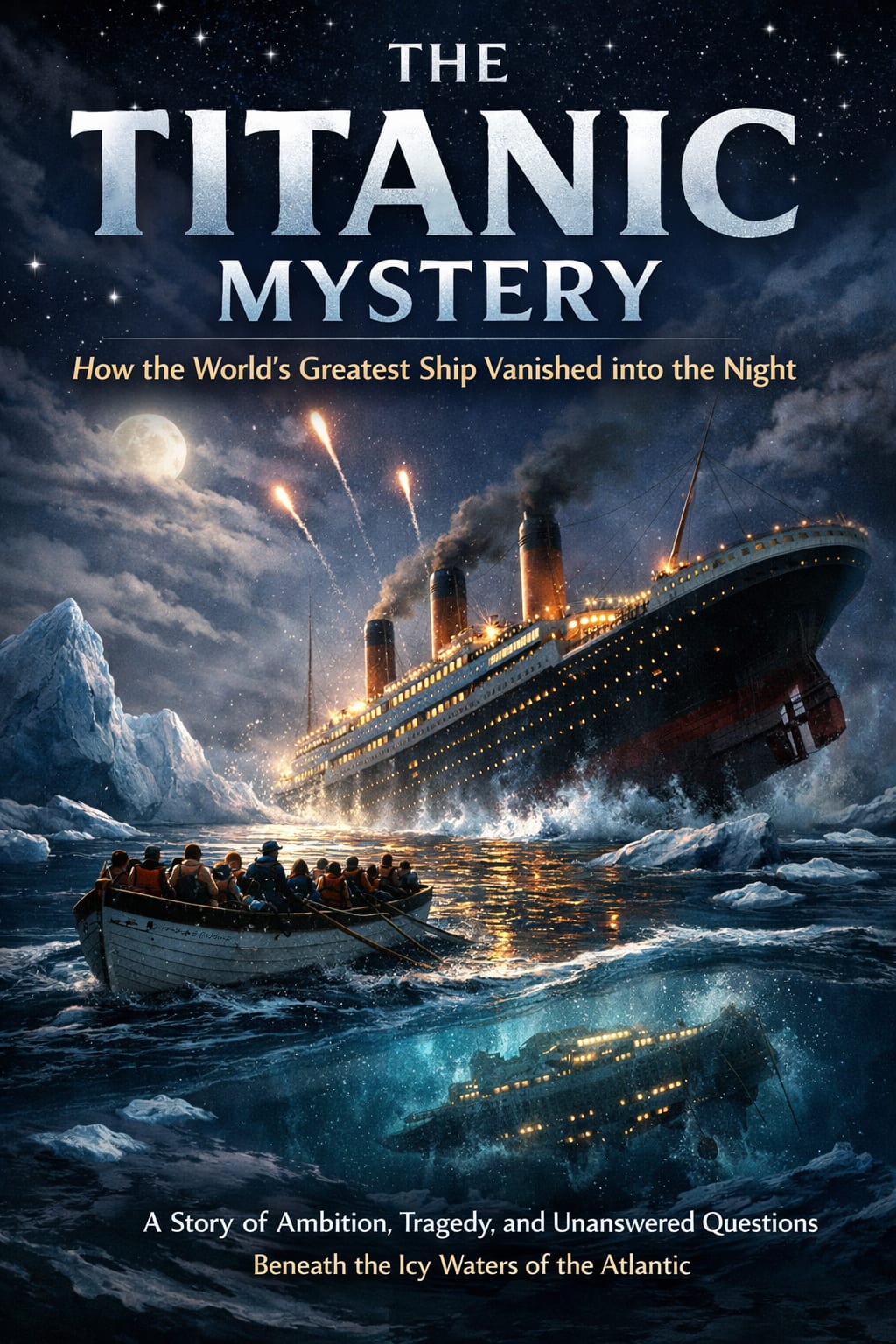
In the early hours of April 15, 1912, the largest and most luxurious ship ever built at the time disappeared beneath the freezing waters of the North Atlantic. The sinking of the Titanic was not just a maritime disaster—it became one of history’s most haunting mysteries. How could a ship declared “unsinkable” vanish so quickly? More than a century later, the story continues to fascinate, blending fact, human error, and lingering questions.
The Titanic was a marvel of modern engineering. Designed to showcase human progress and industrial power, it represented confidence in technology at the dawn of the 20th century. Stretching over 880 feet long, it carried over 2,200 passengers and crew on its maiden voyage from Southampton to New York City. With its grand staircases, luxurious cabins, and advanced safety features, many believed it was the safest ship ever built.
Yet, beneath this confidence lay a dangerous overestimation of human control over nature.
On the night of April 14, 1912, the Titanic sailed through icy waters known for drifting icebergs. Several warnings had been received from other ships, but they were either ignored or not treated with urgency. The sea was unusually calm, making it harder to spot icebergs due to the lack of waves breaking against them. Visibility was clear, but the conditions were deceptively dangerous.
At 11:40 PM, disaster struck. Lookouts spotted an iceberg directly ahead. Despite immediate efforts to turn the ship and avoid collision, it was too late. The iceberg scraped along the side of the Titanic, tearing open multiple compartments below the waterline. The damage was not dramatic at first glance—no massive explosion, no immediate panic—but it was fatal.
The ship had been designed with watertight compartments meant to keep it afloat even if some sections were flooded. However, the damage affected too many compartments at once. Water spilled over from one to another like a row of dominoes falling. Within minutes, it became clear to the ship’s designers and officers that the Titanic was doomed.
One of the greatest mysteries surrounding the disaster is not just the collision itself, but the chain of decisions that followed. Why were there not enough lifeboats for everyone on board? Regulations at the time were outdated, based on older, smaller ships. As a result, the Titanic carried lifeboats for only about half of its passengers.
Even more puzzling is that many lifeboats were launched partially empty. Confusion, disbelief, and lack of proper evacuation procedures meant that precious time—and lives—were lost. Some passengers refused to board, unable to believe the ship could truly sink.
Another enduring mystery lies in the ship’s final moments. Witness accounts differ. Some survivors claimed the ship broke in half before sinking, while others insisted it went down intact. For decades, this detail remained uncertain—until the wreck was discovered in 1985, confirming that the Titanic had indeed split into two sections on its descent to the ocean floor.
But even with modern discoveries, questions remain. Why did the nearby ship, the Californian, fail to respond effectively to distress signals? Its crew reportedly saw rockets in the distance but did not act quickly. Was it a tragic misunderstanding, or a failure of responsibility?
The role of communication technology also adds to the mystery. The Titanic had one of the most advanced wireless systems of its time, yet radio operators were overwhelmed with passenger messages and did not prioritize all incoming iceberg warnings. It was a stark reminder that even the best technology is only as effective as the people who use it.
Today, the Titanic rests nearly 12,500 feet below the ocean’s surface, slowly being reclaimed by nature. Expeditions to the wreck have revealed haunting images—rusted railings, scattered belongings, and the ghostly remains of a once-great ship. Each discovery answers some questions but raises others.
The mystery of the Titanic is not just about how it sank, but why such a disaster was allowed to happen. It is a story of human ambition, overconfidence, and the unpredictable power of nature. Despite all the knowledge we’ve gained, the Titanic continues to symbolize the limits of human control.
More than a century later, it remains a powerful reminder: even the greatest achievements can be undone in a single, silent moment beneath the stars.
About the Creator
Irshad Abbasi
Ali ibn Abi Talib (RA) said 📚
“Knowledge is better than wealth, because knowledge protects you, while you have to protect wealth.
Keep reading
More stories from Irshad Abbasi and writers in History and other communities.
The Apollo 11 Moon Landing Mystery
On July 20, 1969, the world watched in awe as Neil Armstrong stepped onto the surface of the Moon, declaring it “one small step for man, one giant leap for mankind.” Alongside Buzz Aldrin, the Apollo 11 mission marked a historic milestone in human exploration. Yet, despite overwhelming scientific evidence and global recognition, the Moon landing has long been surrounded by mystery and conspiracy theories that question its authenticity.
By Irshad Abbasi 5 days ago in History
For two millennia, the planet's oldest biological experiment has been going on.
According to a recent study, ancient stone jars from the Southeast Asian nation of Laos document a 2,000-year connection between low-oxygen freshwater environments and surrounding tree canopy. The discovery transforms a burial landscape into unique long-term proof of the centuries-long reshaping of tiny lakes by woods.
By Francis Dami5 days ago in History
The 1920s Radium Girls: The girls who "glowed in the dark" while their jaws literally fell off from painting watches.
The camel-hair brush felt soft against her lower lip, a fleeting, tickling sensation that tasted faintly of copper and gritty sand. Grace Fryer smoothed the bristles with her tongue, shaping them into a needle-thin point before dipping the tip back into the Undark—a luminous, pale-green slurry that looked like trapped moonlight. It was a rhythmic, almost meditative dance. Lip. Dip. Paint. The numbers on the watch dial bloomed with a ghostly fire under her steady hand. By the time the whistle blew at the United States Radium Corporation factory in New Jersey, Grace’s dress was flecked with the dust of stars. She would go home and stand in her dark bedroom, watching her own reflection in the mirror. She glowed. Her hair shimmered; her buttons burned with a soft, visceral light. She was a living lantern.
By The Chaos Cabinet3 days ago in History




Comments
There are no comments for this story
Be the first to respond and start the conversation.