
Séances in the White House
Grief, war, and mystery—how some of America’s most powerful women sought answers beyond the veil

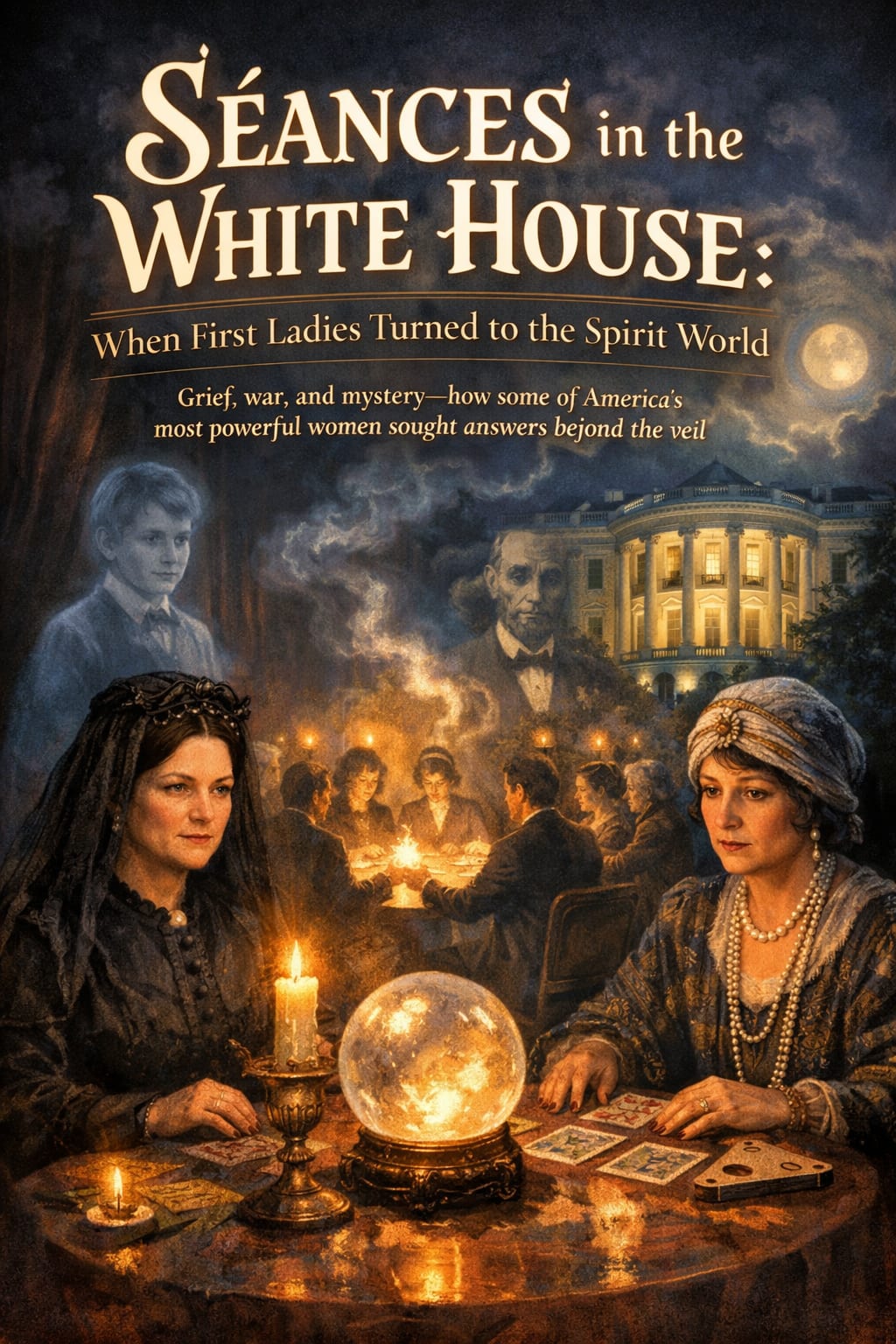
The White House, a symbol of political authority and national pride, has also quietly hosted moments of deep personal sorrow and unusual belief. Behind its stately walls, some first ladies—facing overwhelming grief and uncertainty—turned to spiritualism, seeking comfort in séances and the possibility of communicating with the dead. These lesser-known chapters of history reveal a deeply human side of those who lived at the heart of American power.
Mary Todd Lincoln and the Weight of Loss
Perhaps the most famous connection between the White House and the occult comes from Mary Todd Lincoln, wife of President Abraham Lincoln. During the Civil War, tragedy struck the Lincoln family when their beloved son, Willie, died in 1862. The loss devastated Mary, plunging her into profound grief.
Desperate for solace, Mary reportedly turned to spiritualism, a popular movement in 19th-century America that claimed the living could communicate with spirits. She attended séances both inside and outside the White House, hoping to reconnect with her son. Mediums were invited to conduct sessions, often involving dimly lit rooms, hushed voices, and attempts to summon spirits.
While some critics dismissed these practices as superstition or manipulation, others saw them as a reflection of a grieving mother seeking comfort. For Mary, the séances were not political acts but emotional lifelines during one of the darkest periods of her life.
Spiritualism in a Time of War
Mary Todd Lincoln’s interest in the occult was not unusual for her time. The Civil War left hundreds of thousands dead, and families across the nation were grappling with loss on an unprecedented scale. Spiritualism surged in popularity as people searched for ways to cope with grief and uncertainty.
Séances became a cultural phenomenon, blending religion, curiosity, and emotional need. Even prominent figures were drawn into the movement. In this context, Mary’s actions seem less extraordinary and more a reflection of a broader societal response to tragedy.
Interestingly, some accounts suggest that Abraham Lincoln himself attended at least one séance. Though skeptical by nature, he may have humored his wife or been curious about the claims. However, there is little evidence that he fully believed in the practice.
Florence Harding and Astrological Curiosity
Decades later, another first lady would also show interest in the mystical. Florence Harding, wife of President Warren G. Harding, was known for her fascination with astrology and fortune-telling.
Unlike Mary Todd Lincoln’s grief-driven séances, Florence’s interest seemed more rooted in curiosity and personal belief. She reportedly consulted astrologers and was intrigued by predictions about the future. While not as dramatic as séances, her engagement with the occult reflects a continued thread of fascination among those in the White House.
Public Perception and Private Belief
The idea of first ladies engaging in séances or consulting astrologers has often sparked public intrigue—and sometimes criticism. In eras when rationalism and science were gaining prominence, such practices could be seen as controversial or even embarrassing.
Yet, it is important to separate public perception from private reality. These women were not just historical figures; they were individuals dealing with personal struggles, fears, and hopes. Their turn toward the occult often reflected emotional vulnerability rather than political eccentricity.
Between Faith and the Unknown
The stories of séances in the White House highlight a fascinating intersection of power, grief, and belief. Whether driven by loss, curiosity, or cultural trends, these moments remind us that even those at the pinnacle of influence are not immune to the universal human desire to find meaning in the unknown.
Today, spiritualism may no longer hold the same widespread appeal, but the questions it sought to answer—about life, death, and what lies beyond—remain as compelling as ever. And within the historic halls of the White House, echoes of those questions still linger, whispering of a time when first ladies looked beyond the visible world for comfort and connection.
About the Creator
Irshad Abbasi
Ali ibn Abi Talib (RA) said 📚
“Knowledge is better than wealth, because knowledge protects you, while you have to protect wealth.
Keep reading
More stories from Irshad Abbasi and writers in History and other communities.
The Vanishing Civilization
Throughout human history, civilizations have risen, flourished, and eventually declined. Yet some disappearances are so sudden and mysterious that they continue to puzzle experts for centuries. One such case is that of a thriving society that seemed to vanish almost overnight, leaving behind silent cities, abandoned homes, and unanswered questions.
By Irshad Abbasi about 4 hours ago in History
Royal nanny to Prince William and Kate's children honored with special medal
In a moment that quietly highlighted the people working behind the scenes of royal life, Maria Teresa Turrion Borrallo—the longtime nanny to the children of Prince William and Catherine Middleton—was honored with the prestigious Silver Royal Victorian Medal. The award was presented on March 24 during a formal investiture ceremony in Windsor, with Prince William himself leading the recognition.
By Shirley Oyiadom4 days ago in History


Comments
There are no comments for this story
Be the first to respond and start the conversation.