Perspectives
America Still Has A Soul
i wake to the news that john lewis is dead. i shared the pre-announcement of a few weeks ago--and felt the impact then, but today, i wake and cry and cry and cry and cry and find the Good Trouble video on prime and pay my $6.99 and watch it and cry some more.
By Beth Benson3 years ago in History
The Amphibious Invasion of Sicily. Content Warning.
In today's video, we'll delve into the intriguing historical event known as the Amphibious Invasion of Sicily. This daring military operation took place during World War II and was proposed by Prime Minister Winston Churchill and the British Chiefs of Staff. The ambitious plan aimed to be the first large-scale offensive operation on the European mainland since the fall of France in 1940. Initially met with astonishment and skepticism, this pivotal campaign played a crucial role in reshaping the course of the war. In this article, we will explore the strategic planning, the challenges faced, and the decisive outcomes of Operation Husky.
By Malik Sarparah3 years ago in History
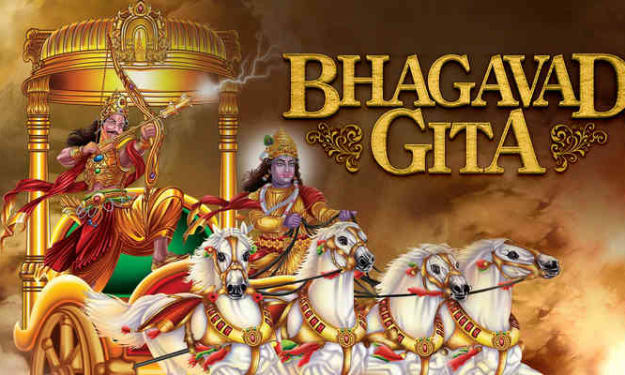
"The Bhagavad Gita: Wisdom and Guidance for Spiritual Seekers"
The Bhagavad Gita, also known as the Gita, is a sacred Hindu scripture that contains a conversation between Prince Arjuna and the god Krishna, who serves as his charioteer. The text is a part of the Indian epic Mahabharata and is revered for its profound spiritual teachings. Here is a summary of the Bhagavad Gita without any plagiarism:
By Go With Trend3 years ago in History
Answer
Introduction This is another taken from my blog Seven Days In, which has just received its millionth visit. It is very amateur but it is a great way of sort of keeping a diary that will last as long as the internet does. This is the post to celebrate the millionth visit.
By Mike Singleton 💜 Mikeydred 3 years ago in History
Socrates Was Right: Embracing the Value of Intellectual Inquiry. Content Warning.
Throughout history, many great minds have left an indelible mark on human civilization, shaping the way we think and perceive the world. Among these luminaries, Socrates, the ancient Greek philosopher, stands tall as a paragon of wisdom and intellectual pursuit. Socrates' method of relentless questioning and emphasis on self-examination have not only influenced philosophical thought but also have enduring relevance in our contemporary world. In this essay, we will explore some of the core aspects of Socratic philosophy and demonstrate why Socrates was right in advocating for the importance of critical thinking, self-awareness, and the pursuit of knowledge.
By Asim hussain3 years ago in History
Nelson Mandela. Content Warning.
Title: Nelson Mandela: The Iconic Symbol of Freedom and Equality Introduction Nelson Mandela, a revered global leader and an embodiment of courage, resilience, and forgiveness, stands as an everlasting symbol of hope and justice. Through his unwavering commitment to ending apartheid in South Africa and his lifelong struggle for human rights, Mandela became an iconic figure, inspiring generations across the globe. This blog explores the extraordinary life and achievements of Nelson Mandela, highlighting his pivotal role in dismantling racial segregation and fostering unity in a nation torn apart by discrimination.
By Openee Article 3 years ago in History
Identity Crisis in Pakistan
Identity is a major factor in any society. It has a significant role and has a massive and long history with itself.The question of Ethnicity has become a complicated and threatening problem mainly in developing and underdeveloped countries. Ethnicity is a very broad term which can be defined in different ways depending on the perspective. However, in this context, ethnicity is defined as a shared cultural identity concerning with similar practices, initiations, beliefs and linguistic features passed over from one generation to another. The ethnic/regional/tribal/religious groups demand independence and refuse to submit to the authority of the central government. These groups want complete self-rule and special position in the state. The identity crisis can be interpreted in many ways into the political process. It generally ref1ects the sentiments of nationalism and the desire of the people to live together in a common place. It implies that the identity crisis is the feeling of an individual’s association with a particular political system. In the process of political change, an identity crises occurs "when a community guides that it had once unquestionably accepted as physical and psychological definitions of its collective self are no longer acceptable under new territorial conditions" (Samuel, 1971).The creation of Pakistan was based on the idea that the Muslim community was altogether a separate nation than the Hindus of the subcontinent, and not just an ethnic minority. It was believed that they had a distinct identity and culture. The present day Pakistan has been home to one of the most ancient civilization (the Indus valley) and had seen many invasions, mostly by Muslim invaders. The Muslim rule in this area resulted in most of the population of this region acquiring the identity of ‘Muslims’ which has been recognized by historians to be different in terms of culture from the rest of the subcontinent. This separate identity was put in danger when the British colonized India and oppressed Muslims. However this can also be seen as a provocation for the Muslims to realize that they are a separate nation and to demand a separate homeland. Since despite leading a ‘distinct’ social existence within the host subcontinent, never before the need was felt to have sovereignty over a territory and being identified as a ‘nation’. The important thing to understand here is that the Muslim self-awakening movement stressed on “safeguarding rights and aspirations of the minority” (i.e. the Muslims) within an undivided India only. But it was only when they realized that this was not possible in a Hindu-dominated India, they demanded a separate state. This challenges the perception that Pakistan was created on the basis of a flawed theory that just because Hindus and Muslims were fundamentally different from one another, they couldn’t coexist and that Pakistan was envisioned to be a strictly theocratic state. Jinnah and Iqbal both wanted Muslim-majority areas merged together into a state where Muslims and all religious minorities would have equal rights as citizens. The quest for Pakistan has been misinterpreted as a quest for Islam. The slogan: “Pakistan ka matlab kya? La illaha illallah”(what is the meaning of Pakistan? There is no God but Allah) has been misapprehended as intending to put religious institution at the top of the state or to patronize religion-based nationalism. But it simply meant to give a message of peace, tolerance and universalism. However this perception led to the contradiction over Jinnah’s promise of protecting rights of minorities in Pakistan and birth of the fundamentalist call for an ‘Islamic’ state (which was indeed nothing more than a specific interpretation of Islam and entirely contestable). This was the beginning of religious conflict in the state. Then with the 1973 constitution the state taking the definition of ‘Muslim-hood’ in its hands was a “dangerous and divisive development” with both civilian and militant governments producing their ‘Islamic reforms’. Overtime, use of religion to define state ideology created confusion in the minds of ordinary Pakistani and eventually Zia-ul-Haq taking the tinkertoy in his hands and imposing his prescription of Islamic identity pitted the different sects, puritans and folk religionists against each other; created intolerance and extremist views; and hindered the development of a “genuinely unifying national identity”. Other conflicts arose in the form of cultural disputes. Though Muslims were different from Hindus but within the Muslims there are many diverse ethnic groups. This could be understood by the fact that the present day Pakistan is a product of many struggles and invasions in this region. It saw the Arian, Persian as well as Greek invasion; a period of political dominance of Turkish, then Arab Muslims, and then finally the rule of British Raj and its downfall followed by migrations from India in 1947 and Afghan refugees in 1980. Thus the Pakistanis trace back their ethnicity from many different origins such as mongals, Afghan, Persians, Arabs and then Sindhi, Punjabi, Pathan and so onPakistanis are multilingual and have many different cultures and tradition within the domain of Pakistan. The second type of identity crisis set in when Pakistani government decided to make Urdu the national language, which wasn’t as widely accepted as was expected. At that time . Pakistan was divided into two wings i.e. West Pakistan (present day Pakistan) and East Pakistan (present day Bangladesh). Though Urdu could have served as a means of intra-provincial communication as there were four provinces in West Pakistan at that time, but it had no roots in East Pakistan as it was a single province of Bengal and led to the feelings of resentment among natives of East Pakistan. After facing protest from East Pakistan it was declared the national language alongside Urdu, engendering anger in other provinces. Secondly the attempt to amalgamate all the provinces in a single unit created further hostility among the ethnic groups as they wanted to maintain their ‘distinct’ ethnic identity. Rather than bringing the people under an umbrella of a unifying national identity that of a ‘Pakistani’, these attempts brought the ethnic divide and also led to the independence of East Bengal indicating the lost identity. So, we can analyse that the identity crisis has its own significance in the society. It has a vital role to be played in the society. Pakistan has to address these issues sooner or later in order to solve its problems.
By Syed Ammar3 years ago in History