
The Maasai Who Do Not Hunt Lions
How an ancient African community is redefining bravery, tradition, and survival by living alongside lions instead of killing them

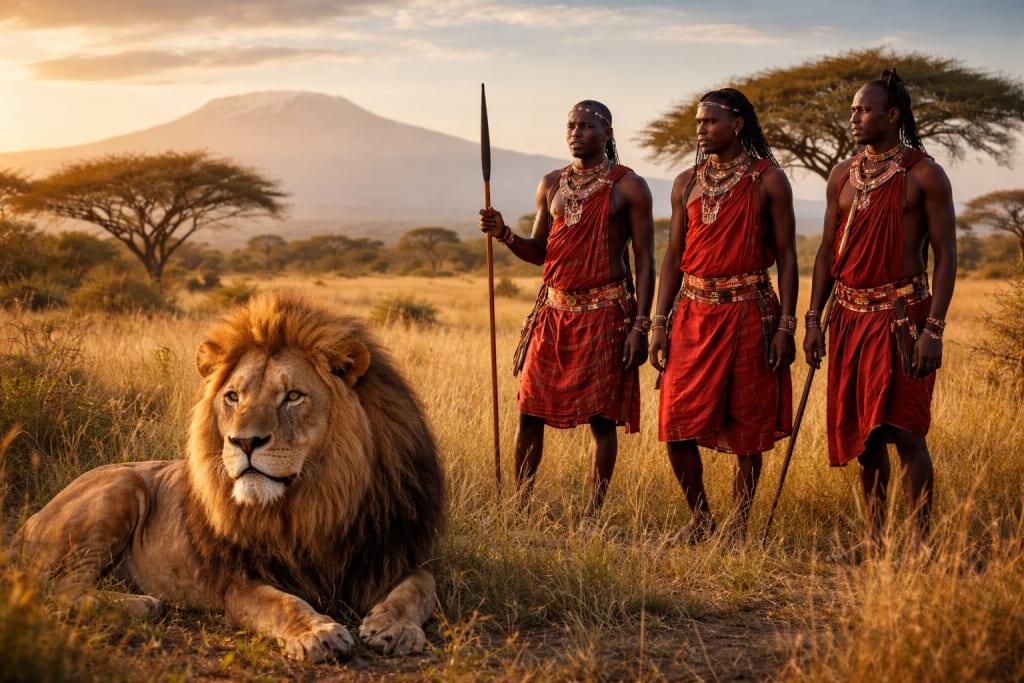
For generations, the image of a young Maasai warrior proving his courage by hunting a lion has captured global imagination. It symbolized strength, honor, and the transition from boyhood to manhood. But today, a new story is emerging—one that challenges this long-held narrative. Not all Maasai are lion hunters anymore. In fact, many have chosen a different path: coexistence.
The Maasai people of East Africa, primarily found in Kenya and Tanzania, have lived alongside wildlife for centuries. Their pastoral lifestyle, centered on cattle herding, has always brought them into close contact with predators—especially lions. Traditionally, when lions attacked livestock, retaliation was swift and often deadly. Over time, lion hunting became not only a practical response but also a cultural ritual.
However, as lion populations began to decline drastically due to habitat loss, climate change, and human conflict, the consequences of these traditions became impossible to ignore. Conservationists and community leaders recognized that if nothing changed, lions could disappear from these landscapes entirely. Surprisingly, the shift toward protecting lions did not come solely from outside pressure—it began within the Maasai community itself.
Today, many Maasai villages are actively choosing to protect lions rather than hunt them. This transformation is rooted in a blend of education, economic incentives, and cultural evolution. Programs have been introduced that compensate herders for livestock lost to predators, reducing the need for revenge killings. At the same time, young warriors are finding new ways to prove their bravery—through conservation efforts rather than combat.
One such initiative involves Maasai “lion guardians.” These individuals, often young men who would traditionally have been lion hunters, now track and monitor lion movements. They warn nearby communities when lions are approaching and help prevent attacks before they happen. Instead of spears, they carry knowledge—of animal behavior, landscapes, and conflict prevention. Their role is not only to protect livestock but also to safeguard the lions themselves.
This shift represents more than just a change in practice; it reflects a deeper transformation in identity. Courage is no longer defined by killing a lion but by protecting both people and wildlife. Respect for nature, always central to Maasai culture, is being expressed in new ways.
Living alongside lions is not without challenges. Livestock remains the backbone of Maasai livelihoods, and losing even a single cow can have serious economic consequences. Fear and frustration still exist, especially when attacks occur. Yet, communities are finding innovative solutions. Stronger enclosures for livestock, better herding practices, and early-warning systems are helping to reduce conflict.
Tourism has also played a significant role in this evolving relationship. Lions attract visitors from around the world, and their presence brings economic opportunities. Many Maasai communities now benefit directly from conservation through jobs, community projects, and partnerships with wildlife organizations. In this way, living lions are more valuable than dead ones—not just ecologically, but economically.
What makes this story particularly powerful is that it is not about abandoning tradition but adapting it. The Maasai are not losing their identity; they are reshaping it. Their deep connection to the land and its creatures remains intact, but their understanding of what it means to be a warrior is changing.
This transformation offers an important lesson for the rest of the world. Human-wildlife conflict is a global issue, from elephants in Asia to wolves in Europe. The Maasai example shows that coexistence is possible—not through force, but through cooperation, respect, and innovation.
In the end, the story of the Maasai who no longer hunt lions is not one of loss, but of hope. It is a reminder that cultures are not static; they evolve in response to new realities. And sometimes, the bravest thing a person can do is not to fight—but to protect.
As the sun sets over the African savanna, the roar of a lion no longer signals an enemy to be defeated. Instead, it echoes as a symbol of a shared landscape—a future where humans and wildlife can thrive together.
About the Creator
Irshad Abbasi
Ali ibn Abi Talib (RA) said 📚
“Knowledge is better than wealth, because knowledge protects you, while you have to protect wealth.
Keep reading
More stories from Irshad Abbasi and writers in History and other communities.
Discovery of a Previously Unknown Human Species in the Philippines
In a remarkable breakthrough that is reshaping the story of human evolution, scientists have discovered evidence of a previously unknown human species in a remote cave in the Philippines. This extraordinary finding not only expands the human family tree but also challenges long-held assumptions about how early humans lived, migrated, and evolved across the globe.
By Irshad Abbasi 11 days ago in History
The dark side of Albert Einstein
He is perhaps the most recognizable scientist who ever lived — a wild-haired, gentle-eyed figure whose name has become synonymous with brilliance itself. Mention Einstein in any corner of the world, and people instantly know who you mean. Yet for all his fame, the real Albert Einstein, the complicated, contradictory, deeply human man beneath the legend — remains surprisingly little known. Strip away the mythology, and what you find is far more fascinating than any caricature.
By Shirley Oyiadom7 days ago in History
The World’s BIGGEST Airplane & Its Crazy Transport Network
The Giant's Journey: How Airbus Transports the World's Largest Planes Airbus is a European powerhouse, producing nearly three aircraft every single day. But there is a massive catch: the parts for these planes are manufactured in different countries—wings in the UK, tails in Germany and Spain, and fuselage sections in France. Bringing them all to the final assembly line in Toulouse, France, is one of the most complex transport puzzles in the world.
By Imran Ali Shah2 days ago in History
Side Quest Goal Achieved: Placing an Alien Claim
This is a post that has me quite ecstatic. It's funny, I thought it was going to be one of my usual, "Hey, I achieved another one of my goals and checked it off" type deals. And it sort of is. But it sort of isn't. And it's also one of my greatest writing accomplishments of late.
By Stephen Kramer Avitabile3 days ago in Writers



Comments
There are no comments for this story
Be the first to respond and start the conversation.