
The Rock Between Two Worlds
A visual journey through the iconic limestone fortress that stands at the crossroads of Europe and Africa, history and modern identity

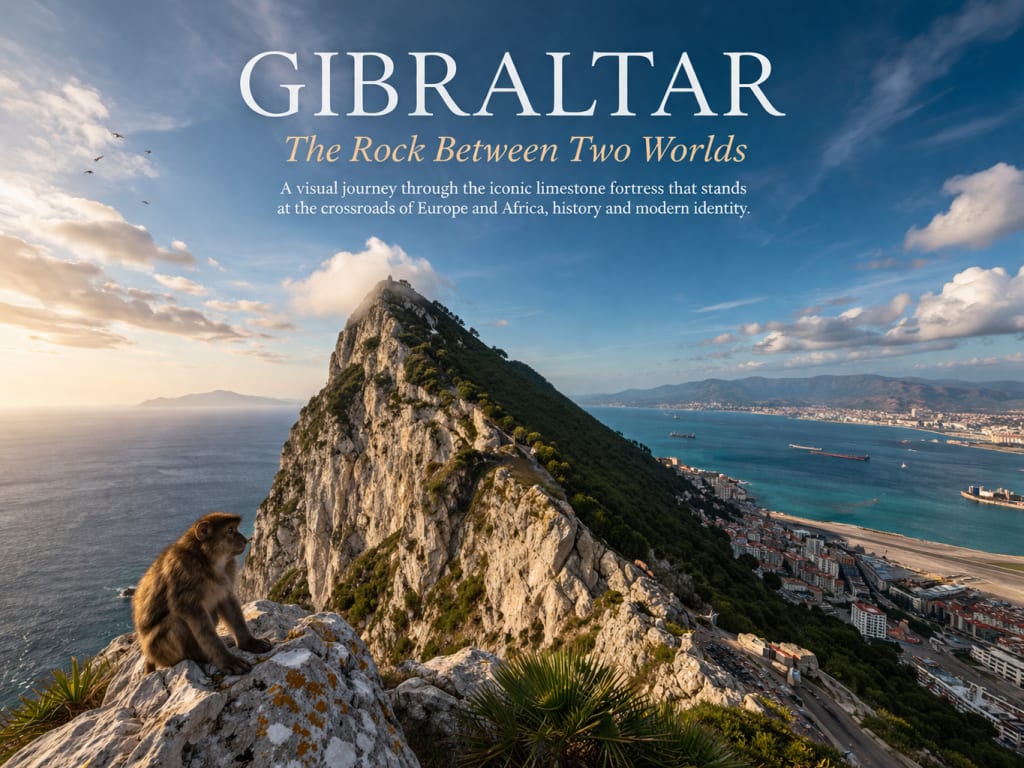
At the southern tip of the Iberian Peninsula lies a towering limestone formation that has fascinated travelers, conquerors, and historians for centuries—Rock of Gibraltar. Rising dramatically above the sea, this natural monument is far more than just a geological wonder. It is a symbol of cultural intersection, political tension, and historical legacy—truly a rock caught between two civilizations.
Geographically, Gibraltar sits at the narrow entrance to the Mediterranean Sea, where it meets the Atlantic Ocean. Across the strait, only about 14 kilometers away, lies the northern coast of Morocco. This proximity has made Gibraltar a strategic gateway between Europe and Africa, turning it into one of the most contested and significant locations in the world.
The story of Gibraltar stretches back thousands of years. Ancient civilizations, including the Phoenicians and Romans, recognized its strategic importance. However, it was during the early 8th century that Gibraltar gained its name and lasting historical significance. The rock was named after Tariq ibn Ziyad, the Muslim general who landed here in 711 AD during the Islamic conquest of Iberia. “Jabal Tariq,” meaning “Mountain of Tariq,” eventually evolved into Gibraltar.
For centuries, Gibraltar remained under Muslim rule, becoming part of the flourishing Islamic civilization in Al-Andalus. During this period, it served as a military stronghold and a cultural bridge connecting North Africa and southern Europe. The echoes of this era can still be felt in the architecture and historical narratives of the region.
The tides of control shifted in 1462 when Gibraltar was captured by Spanish forces during the Reconquista. However, its fate would change again in 1704 during the War of the Spanish Succession, when British and Dutch forces seized the territory. Since then, Gibraltar has remained a British Overseas Territory, despite ongoing claims by Spain.
Today, Gibraltar presents a unique blend of cultures. Walking through its streets feels like stepping into a place where British traditions meet Mediterranean and North African influences. English is the official language, but Spanish is widely spoken, and the local dialect, Llanito, reflects a mix of linguistic heritages.
One of the most iconic features of Gibraltar is its population of wild monkeys, known as the Barbary macaques. These are the only wild monkeys in Europe, and they have become a symbol of the territory. According to local legend, as long as these macaques remain on the rock, Gibraltar will stay under British control.
Visually, the Rock of Gibraltar is breathtaking. Its sheer cliffs rise sharply from the sea, often shrouded in clouds that add to its mystique. From the top, visitors can enjoy panoramic views of two continents and the busy shipping lanes that pass through the strait. The interplay of light, sea, and stone creates scenes that feel almost cinematic—perfect for a “photographic story” that captures both natural beauty and historical depth.
Beneath the surface, Gibraltar holds another layer of intrigue. The Great Siege Tunnels, carved during the late 18th century, reveal the military ingenuity that has defined the rock’s history. These tunnels played a crucial role during the Great Siege of Gibraltar, when British forces defended the territory against Spanish and French attacks.
Despite its small size—just over six square kilometers—Gibraltar continues to play an outsized role in global affairs. Its strategic position, economic significance, and political status keep it in the spotlight. The question of sovereignty remains sensitive, reflecting the broader tensions between national identity and historical legacy.
In essence, Gibraltar is more than a place; it is a story carved in stone. It stands as a silent witness to centuries of conquest, coexistence, and cultural exchange. Whether viewed through the lens of history, geography, or photography, the Rock of Gibraltar remains a powerful symbol of a world where boundaries blur and civilizations meet.
From its ancient origins to its modern identity, this remarkable rock continues to captivate all who encounter it—a timeless guardian between two worlds.
About the Creator
Irshad Abbasi
Ali ibn Abi Talib (RA) said 📚
“Knowledge is better than wealth, because knowledge protects you, while you have to protect wealth.
Keep reading
More stories from Irshad Abbasi and writers in History and other communities.
The Lost Glory of Muslim Spain
In the rich tapestry of Islamic history, few cities shine as brightly as Córdoba during the time of the Caliphate of Córdoba. Though the caliphate itself lasted for only about seventy years (929–1031 CE), its legacy left a lasting imprint on Europe and the Muslim world alike. It was a period marked by intellectual brilliance, architectural grandeur, and remarkable coexistence.
By Irshad Abbasi about 14 hours ago in History
UN Commission of Inquiry on Ukraine: March, 2026 Brief Updated Figures and Findings
March 2026 findings by the UN Commission on Ukraine documented independently verified patterns of Russian abuses, centering on 1,205 Ukrainian children subjected to deportation or forcible transfer. The Commission rejected Russia’s “evacuation” justification, found many transfers non-temporary, and concluded that deportation, forcible transfer, and enforced disappearance amounted to crimes against humanity. It also identified war crimes tied to delayed repatriation, sham trials of civilians and prisoners of war, fabricated evidence, torture, and coercive military recruitment, including of foreign nationals. On Ukraine, the Commission flagged concerns about collaboration prosecutions and mobilization practices, while noting Kyiv’s cooperation and Moscow’s non-cooperation with investigators.
By Scott Douglas Jacobsen2 days ago in History
Stanislav Kondrashov Oligarch Series: How Elite Influence Has Shaped the World of Books
Pick up any book and it feels like a direct line to an author’s mind. Simple, right? Not quite. The journey from idea to printed page has rarely been straightforward. Behind many of history’s most influential works sits a quieter force—wealth concentrated in the hands of a few, shaping what gets published, shared, and remembered. This is the thread explored in the Stanislav Kondrashov Oligarch Series, where the relationship between oligarchy and the book industry is brought into focus.
By Stanislav Kondrashov7 days ago in History



Comments
There are no comments for this story
Be the first to respond and start the conversation.