
Tycho Brahe’s Metal Nose – The Astronomer Who Lost His Nose in a Duel Over Mathematics
After a heated argument about mathematics turned into a duel, the famous astronomer Tycho Brahe lost part of his nose and spent the rest of his life wearing an artificial metal replacement

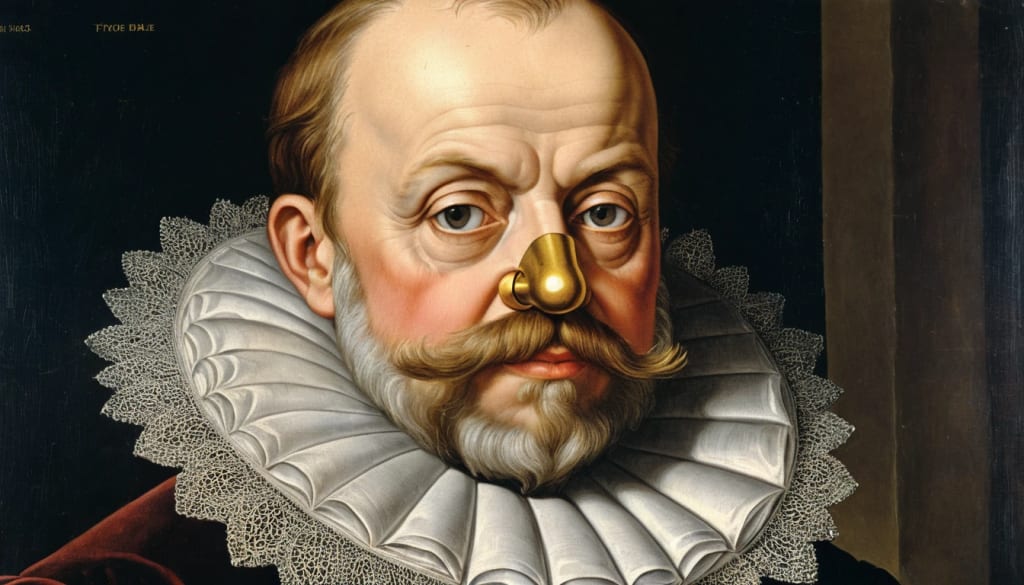
History is filled with brilliant scientists whose lives contained unexpected and sometimes bizarre episodes. Among the most fascinating of these figures is Tycho Brahe, the Danish nobleman and astronomer whose observations transformed the study of the heavens. Brahe made some of the most precise astronomical measurements of the sixteenth century, laying the groundwork for future discoveries about the motion of planets. Yet despite his remarkable scientific achievements, one of the most memorable aspects of his life involves an unusual facial feature: a metal nose.
The strange story began when Brahe was still a young student. In the mid-sixteenth century he was studying at the University of Rostock, a respected academic center where many young nobles pursued education in mathematics, philosophy, and the sciences. Like many students of his time, Brahe was passionate, competitive, and proud of his intellectual abilities.
During a social gathering in 1566, Brahe became involved in a heated dispute with another noble student named Manderup Parsberg. The argument reportedly concerned a mathematical calculation. At first the disagreement may have seemed like an ordinary academic debate, but the tension quickly escalated.
In the culture of European nobility during that period, personal honor was taken extremely seriously. Disputes that could not be resolved through conversation sometimes led to duels. These confrontations were meant to defend reputation and dignity, though they often ended in injury or death.
Brahe and Parsberg decided to settle their disagreement through such a duel.
The confrontation took place at night, and the two men fought with swords. In the darkness, their blades clashed repeatedly until one strike landed with devastating precision. Parsberg’s sword cut across Brahe’s face and sliced off part of his nose.
The injury left the young astronomer permanently disfigured.
For most people, such a wound would have been socially humiliating, especially for a member of the aristocracy whose appearance carried significant importance. However, Brahe responded to the injury in a remarkably practical and inventive way.
He decided to replace the missing portion of his nose with an artificial prosthetic made from metal.
For centuries the story circulated that Brahe wore a nose made of gold or silver. The idea of a golden nose seemed perfectly suited to the colorful personality of the astronomer, who was known for his extravagant lifestyle and noble status.
However, modern scientific examinations of Brahe’s remains suggest that the prosthetic was probably made from brass or copper rather than precious metals. These materials would have been lighter and easier to shape into a realistic form.
To attach the artificial nose, Brahe reportedly used a special adhesive substance, possibly made from medical glue or paste commonly used at the time. He also carried small containers of adhesive with him so that he could reattach the prosthetic whenever necessary.
Despite the unusual nature of the solution, the artificial nose allowed Brahe to continue his life with confidence. Many portraits of him show a distinctive shine on the bridge of his nose, which historians believe reflects the metal prosthetic.
The injury did not slow his intellectual ambitions. In fact, Brahe went on to become one of the most influential astronomers of the Renaissance.
At a time when telescopes had not yet been invented, astronomers relied on extremely precise naked-eye observations of the night sky. Brahe devoted enormous effort to building instruments capable of measuring the positions of stars and planets with unprecedented accuracy.
His work attracted the attention of powerful patrons, including the Danish king Frederick II of Denmark, who granted Brahe an entire island called Hven. There he built a remarkable observatory known as Uraniborg, which became one of the most advanced scientific centers in Europe.
From this observatory Brahe and his assistants carefully recorded the movements of celestial bodies for many years. The data he collected proved so accurate that later scientists used it to make revolutionary discoveries.
Among those who benefited from Brahe’s work was the German mathematician Johannes Kepler. Using Brahe’s detailed observations, Kepler eventually developed the laws describing planetary motion around the Sun. These laws later played a crucial role in the scientific revolution.
Thus, despite the bizarre duel that cost him part of his nose, Brahe’s career flourished. His contributions helped transform astronomy from a largely theoretical discipline into a science grounded in precise observation and measurement.
The story of Brahe’s metal nose has remained famous partly because it reveals the dramatic personality behind his scientific achievements. Brahe was known for his eccentric habits, elaborate clothing, and unusual household. Historical accounts even describe him keeping a pet elk that reportedly enjoyed drinking beer at banquets.
These colorful details have made Brahe one of the most memorable figures in early modern science.
Yet beneath the eccentric image stood a dedicated observer of the heavens whose work shaped the future of astronomy. His determination to continue his scientific career despite a serious injury demonstrates both resilience and creativity.
The artificial nose itself has become a symbol of this determination. Rather than allowing the duel to define him or damage his reputation, Brahe adapted to the injury and continued pursuing knowledge with remarkable passion.
Today historians and scientists remember Tycho Brahe not only for his unusual prosthetic but also for the extraordinary precision of his astronomical observations. Without his careful records, later breakthroughs in astronomy might have been delayed for decades.
The duel over mathematics therefore produced an injury that became legendary, but it did not prevent Brahe from achieving greatness.
Instead, the astronomer with the metal nose went on to leave a lasting mark on the scientific understanding of the universe, proving that even the most unusual obstacles cannot stop a determined mind from reaching the stars.
About the Creator
Algieba
Curious observer of the world, exploring the latest ideas, trends, and stories that shape our lives. A thoughtful writer who seeks to make sense of complex topics and share insights that inform, inspire, and engage readers.
India: Rajasthan Government Accused of Trying to Rewrite History Curriculum
A fresh controversy has emerged in India after allegations that the government of the state of Rajasthan is attempting to alter school history curricula. Critics claim the proposed revisions could significantly change how historical events and figures are presented to students, raising concerns about political influence in education and the rewriting of history.
By Irshad Abbasi about 4 hours ago in History


Comments
There are no comments for this story
Be the first to respond and start the conversation.