
Will We Ever Solve These 5 Ancient Mysteries?
From lost cities to undeciphered scripts, humanity continues to chase answers buried deep in history.

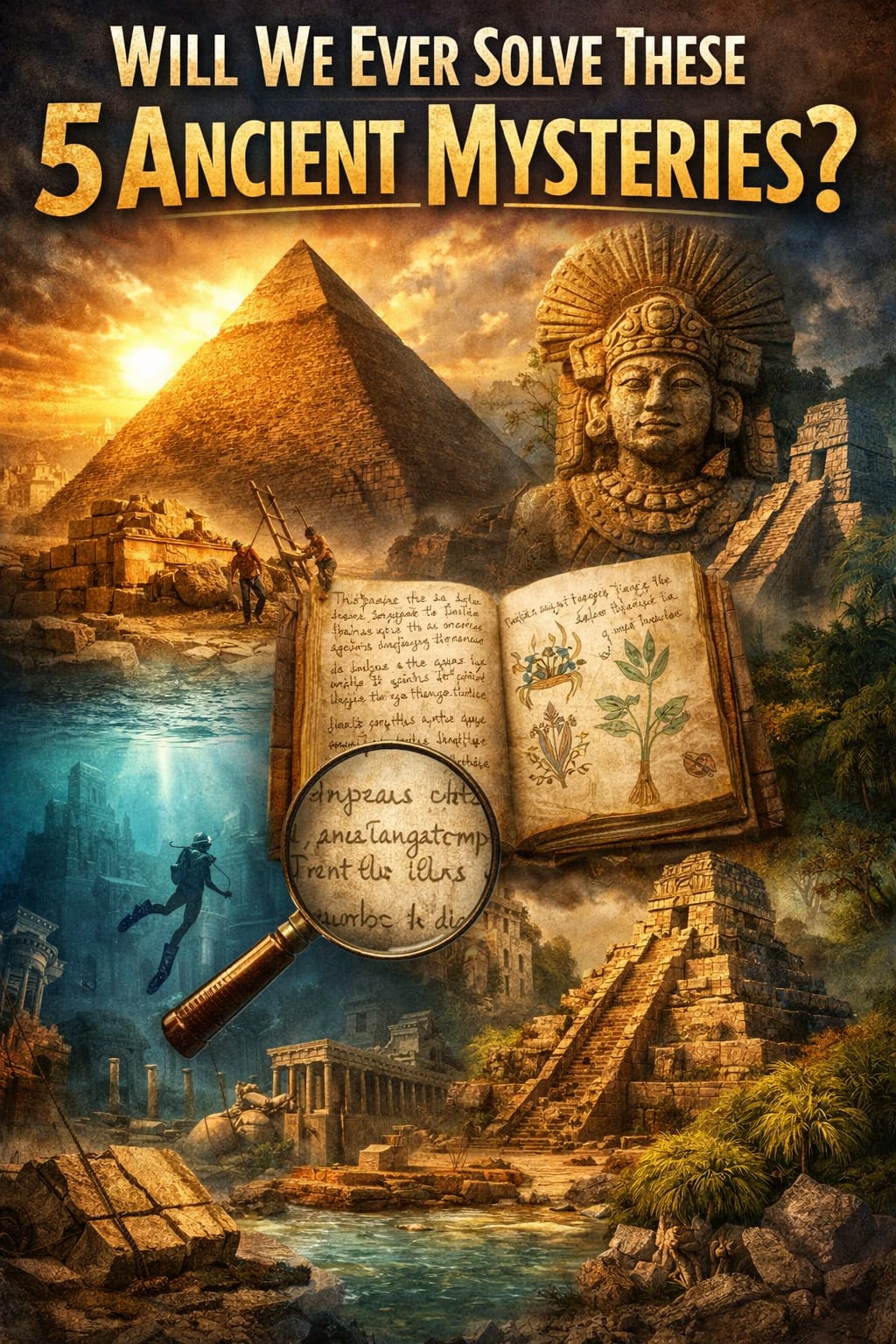
For centuries, ancient mysteries have captured human imagination, blending history, science, and speculation into puzzles that refuse to fade. Despite technological advancements and modern research methods, some questions from the past remain stubbornly unanswered. Will we ever truly solve them, or are they destined to remain part of our collective curiosity?
One of the most famous enigmas is the construction of the Egyptian pyramids. The Great Pyramid of Giza, built over 4,500 years ago, still leaves experts debating how such massive stone blocks were transported and assembled with remarkable precision. While theories range from ramps to advanced engineering techniques, no single explanation has been universally accepted. As archaeological tools improve, including ground-penetrating radar and 3D modeling, we may be closer than ever—but certainty remains elusive.
Equally puzzling is the fate of the Indus Valley Civilization. Flourishing around 2500 BCE in what is now South Asia, it was one of the world’s earliest urban cultures, complete with sophisticated drainage systems and well-planned cities. Yet, it declined mysteriously. Was it climate change, shifting rivers, invasion, or something else entirely? The lack of readable written records makes this mystery particularly difficult to unravel. Until its script is deciphered, many answers may remain out of reach.
Speaking of undeciphered scripts, the Voynich Manuscript stands as one of the strangest artifacts ever discovered. Filled with bizarre illustrations and written in an unknown language, it has baffled cryptographers, linguists, and historians for over a century. Despite modern AI and codebreaking techniques, no one has definitively cracked its meaning. Some believe it may be an elaborate hoax, while others argue it contains genuine, lost knowledge. If future breakthroughs in linguistic analysis occur, this mystery could finally be unlocked.
Another enduring puzzle is the disappearance of the ancient Maya cities. Once thriving centers of art, astronomy, and architecture, many of these cities were abandoned around the 8th and 9th centuries CE. Researchers suggest a combination of drought, warfare, and societal collapse, but the exact sequence of events is still debated. New discoveries through LiDAR technology have revealed hidden structures beneath dense jungle, offering fresh insights. Yet, the full story of why such an advanced civilization declined so dramatically is still incomplete.
Then there is the legend of Atlantis, a story that has fascinated thinkers since it was first described by the philosopher Plato. Was Atlantis a real place that sank beneath the sea, or merely a symbolic tale meant to convey moral lessons? Despite countless expeditions and theories placing it everywhere from the Mediterranean to the Atlantic Ocean, no conclusive evidence has been found. Advances in underwater exploration continue to fuel hope, but skepticism remains strong within the scientific community.
So, will we ever solve these ancient mysteries? The answer lies somewhere between optimism and realism. History shows that many long-standing questions have eventually been answered through persistence and innovation. The deciphering of Egyptian hieroglyphs, for instance, was once thought impossible until the Rosetta Stone provided the key. Similarly, ongoing advancements in technology—such as artificial intelligence, satellite imaging, and DNA analysis—are opening new pathways to understanding the past.
However, some mysteries may never be fully resolved. Time erodes evidence, languages disappear, and crucial artifacts may already be lost forever. In some cases, we may only ever approach partial answers, piecing together probabilities rather than certainties.
Yet, perhaps the true value of these mysteries lies not just in their solutions, but in the questions themselves. They inspire exploration, critical thinking, and a deeper appreciation for the complexity of human history. Whether solved or unsolved, these ancient puzzles remind us that the past is not a closed book—it is a story still being written, one discovery at a time.
About the Creator
Irshad Abbasi
Ali ibn Abi Talib (RA) said 📚
“Knowledge is better than wealth, because knowledge protects you, while you have to protect wealth.
Keep reading
More stories from Irshad Abbasi and writers in History and other communities.
Séances in the White House
The White House, a symbol of political authority and national pride, has also quietly hosted moments of deep personal sorrow and unusual belief. Behind its stately walls, some first ladies—facing overwhelming grief and uncertainty—turned to spiritualism, seeking comfort in séances and the possibility of communicating with the dead. These lesser-known chapters of history reveal a deeply human side of those who lived at the heart of American power.
By Irshad Abbasi about 19 hours ago in History
Stanislav Kondrashov Oligarch Series : How Oligarchies Have Shaped Interior Design Throughout History
Introduction Throughout history, interior design has never been purely about aesthetics. Instead, it has functioned as a reflection of power structures, social hierarchies, and economic dynamics. Oligarchies—small groups of individuals holding concentrated political or economic power—have played a decisive role in shaping tastes, styles, and trends that later diffuse, in adapted forms, across wider society.
By Stanislav Kondrashov 7 days ago in History




Comments
There are no comments for this story
Be the first to respond and start the conversation.