
Scampi's Great Escape
Architecture of the Scythe Lore: Alcyone

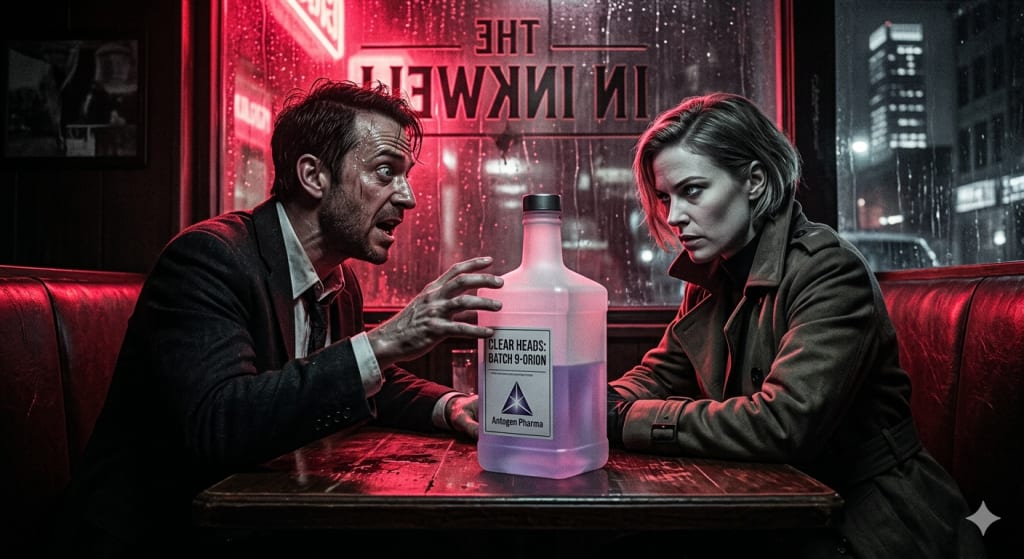
The neon sign of the Inkwell bled a sickly crimson through the rain-streaked window, casting long, shadows across the scarred mahogany of our booth. The air inside tasted of stale gin, ozone, and the sour desperation that clung to every soul in Alcyone. I leaned across the table, my hands trembling so violently that the ice in my glass rattled like teeth shivering in a skull.
"You aren't listening, Nora," I hissed, the words tumbling out of my mouth in a frantic, unspooling rush. A fine mist of spittle flew from my lips, catching the red neon light for a fraction of a second before landing on the slick, sticky surface of the table between us. "You're looking at the shadows on the wall, but you aren't turning around to see what's casting them."
Nora Sterling sat across from me, an immovable statue carved from frost and heavy trench coats. Her eyes—sharp, calculating, and entirely unforgiving—tracked my erratic movements. I knew exactly what she was doing. She was parsing my madness for usable data. She spent her days and nights untangling the twisted, rotting threads of the Alcyone police force, hunting the invisible hands and clandestine orders that choked the life out of this city. To her, I was just gutter-junkie spewing white noise into the ether. She swirled the amber liquid in her glass, her expression utterly detached. I could see the exact moment the calculus shifted in her head, questioning why she had agreed to meet a derelict in a subterranean dive bar at two in the morning.
"Scampi," she said, her voice a flat, controlled line cutting straight through my manic static. "I am tracking a systemic syndicate within the precinct. I am mapping missing ledger entries, fabricated dispatch logs, and dead informants. I fail to see what your latest narcotic misadventure has to do with any of it."
"Because it's the same machine, Nora!" I slammed my palms down on the table, the sharp crack momentarily drowning out the low, mournful thrum of the jukebox in the corner. "Before the badges scooped me up, before my brain completely short-circuited on the pavement, I was walking the grid down in Sector 8. Deep in the heart of Old Town."
Nora finally reacted, a subtle tightening of her jaw that betrayed her practiced apathy. "Sector 8 is a dead zone. It's a meat grinder. You have absolutely no business being down there, Scampi. The gang presence alone makes it a suicide run. It’s too dangerous, even for someone with your specific survival instincts."
I let out a harsh, barking laugh that scraped against the raw back of my throat. "Dangerous? Nora, you’re operating on severely outdated intel." I leaned in closer, dropping my voice to a ragged, conspiratorial whisper, forcing her to lean in to hear me over the ambient noise of the bar. "It isn't dangerous. It’s empty."
She frowned, a microscopic shift of her brow. "Empty."
"A complete, suffocating void," I insisted, my eyes wide, desperately trying to project the sheer, unnatural wrongness of the place directly into her mind. "I walked past the monolithic husks of those glass-and-steel financial towers. Nothing. No corporate suits burning the midnight oil in the penthouses. But worse than that—no street flesh. None. No creepers huddled over the exhaust grates. No corner boys pushing vials of clear-heads in the alleyways. No scavengers tearing at the industrial dumpsters. The silence was absolute. It was a vacuum that sucked the sound right out of your lungs."
I paused, letting the heavy weight of the reality settle over the table, watching her process the logistical impossibility of what I was saying. "Look at the real estate, Nora. Look at the math. Those are mega-million dollar high-rises. You and I both know the barons of Alcyone do not let perfectly good, astronomically expensive square footage sit vacant without a purpose. Landowners don't abandon the financial district to the rats. The Sector isn't abandoned. It’s been purposefully, surgically sterilized."
Nora didn't interrupt this time. The analytical gears behind her cold eyes were turning rapidly, catching on the jagged edges of my testimony.
"I was wandering through that sterile graveyard, feeling the static build up behind my eyes," I continued, the memory dragging me back into the freezing dark of the Alcyone streets. "I had a pocket full of product and a desperate, clawing need to turn the volume of the city down. I found a deep alcove tucked away between two dead bank facades, shielded from the biting wind, and I pushed the needle in. I miscalculated the dosage. I pushed way too much. The geometry of the street tilted, the skyscrapers turned into black needles piercing the oppressive gray sky, and I hit the concrete hard."
I rubbed my wrists, my thumbs tracing the phantom friction burns of the heavy leather restraints. "Next thing I know, the sirens are wailing. Not the standard, high-pitched wail of a city meat-wagon, but a heavy, armored, low-frequency hum that vibrated in my chest. They dragged me out of the gutter and threw me in the back of a transport. They hauled me straight to Alcyone General. But when I finally snapped awake, fighting through the chemical fog, I wasn't lying in a standard triage bed."
The panic began to rise in my chest all over again, a cold, muscular snake coiling tightly around my lungs. "I was strapped down. Hard-point, reinforced restraints locked tight on my ankles and wrists. The fluorescent lights overhead were blinding, burning right through my retinas. I started thrashing immediately. I screamed at them to unbuckle the straps, told them I knew my civic rights, demanded to be unhooked and put back out on the street. I fought like a rabid dog."
I took a ragged, desperate breath, the sour smell of the Inkwell suddenly making my stomach churn. "A figure stepped directly into my line of sight. No face, just a disposable medical mask, protective goggles, and a sterile white coat. They didn't say a single word. They didn't read me my medical rights or ask to scan my insurance chip. They simply raised a heavy pneumatic syringe, pressed the cold steel injector against the pulsing carotid artery in my neck, and pulled the trigger. The synthetic ice shot straight into my brain, and the world went totally, utterly black."
Nora reached out and placed her glass down on the mahogany with a soft, definitive clink. She leaned forward, the shadows of the booth swallowing the sharp edges of her face. "Scampi," she said, her tone completely devoid of any sympathy, irritation bleeding into the edges of her words, "why the hell am I sitting here in the Inkwell listening to you describe a completely standard OD and a routine trip to the psych ward?"
The darkness didn’t fade; it fractured.
One moment I was drowning in that synthetic ink the masked figure had pumped into my neck, and the next, my eyelids snapped open like rusted shutters. The transition was violent. There was no groggy ascent, no gentle return to the living. I was simply there, thrust back into a body that felt like a house that had been stripped of its copper wiring.
The light was the first thing that hit me—a brutal, high-intensity fluorescent glare that didn't just illuminate the room; it flayed the skin off my retinas. I tried to groan, to curse, to scream, but my throat was a desert of dry salt and chemical aftertaste. My tongue felt like a slab of dead meat.
I blinked, my vision swimming through a thick, viscous haze. I wasn't in a hospital room. There were no pastel walls, no framed prints of generic landscapes, no comforting hum of a television in the distance. I was lying on a narrow, stainless steel gurney that felt like a slab of ice.
I looked at my arm. A thick, clear tube was taped to my forearm, snaking away into a sophisticated pump unit attached to the side of the gurney. The liquid inside was a pale, violet.
It felt... wrong. It wasn't just the residual pull of the sedatives. There was a hollow, sensation in my chest, as if someone had reached inside and cauterized my very center. I felt scarred, though I couldn't see a wound.
I shouldn't have been awake. I knew that with clarity. The dose they’d given me in the transport—the 'synthetic ice'—was designed to put a normal man into a week-long coma. But my chemistry ain't normal. My blood was a toxic cocktail of decades of abuse, a scarred landscape. My tolerance wasn't a habit; it was a fortress. The sedative was a tidal wave, but my brain was a rough cliffside. I cheated the sleep they intended for me.
I forced myself to sit up. The movement sent a spike of white-hot agony through my temples, but I ignored it. I swung my legs over the side of the metal slab, my bare feet hitting a floor of polished, industrial concrete.
That’s when I saw the rest of them.
I wasn't in a ward. I was in a hangar building of some sort.
The space was massive, a warehouse—it blurred my vision. Rows upon rows of steel gurneys, identical to mine, were arranged. It looked like a server farm, but the processors were human beings.
There were hundreds of them. Men, women, the elderly, even young—all draped in those same thin, grey hospital scrubs, all silent, all perfectly still. Each one had that same IV line feeding into their veins. The only sound was the collective, rhythmic hiss of a low-frequency industrial HVAC system that kept the air at a biting, refrigerated chill.
It was too clean. Too efficient. Hospitals in Alcyone are places of chaos, of blood-stained linoleum and overworked staff screaming over the din of the dying. This place was a tomb of high-end logistics. There was no dust. No trash. No human error.
I looked up. High above, suspended from the corrugated steel, were massive black spheres—sensor arrays or cameras, I couldn't tell—that rotated with a slow, predatory grace.
This wasn't medical care. It was storage.
I looked at the person on the gurney next to mine. It was a young woman, her face pale and translucent, her eyes rolled back so only the whites showed beneath her flickering lids. She looked like she was dreaming. I reached out a trembling hand, my fingers hovering just inches from her cold skin, but I pulled back. I was afraid.
My heart began to hammer against my ribs, I felt like a trapped bird. I realized then that I was a glitch in their system. An error. I was the only thing moving in a room full of statues.
I looked at the IV pump again. There was a small, glowing display on the side, showing a series of rapidly scrolling numbers—biometrics, heart rates, neural activity—all being fed somewhere else.
The realization hit me with the force of a physical blow. The void I’d seen in Sector 8—the empty towers, the sterilized streets. The city hadn't abandoned these people; I think it harvested them, filed them away in this corporate purgatory where they could be managed, monitored, and used for whatever purpose required a thousand beating hearts and a thousand dreaming brains.
I grabbed the IV line. My hands were shaking so hard I could barely get a grip on the tape. I knew I had to move. I knew that if one of those rotating black eyes caught me sitting up, the faceless figures with the pneumatic syringes would be back to fix the glitch.
I looked at Nora back at the Inkwell, the memory of her skeptical face the only thing keeping me tethered to reality. "It wasn't a hospital, Nora," I whispered, the sound of my own voice like dry leaves skittering across the concrete. "It was a warehouse. And I was just another crate on the shelf."
I gripped the plastic catheter in my arm and prepared to rip the connection out. I had to get out of the crypt before the masters of the house realized one of their ghosts had woken up.
I didn't wait for the shadows to notice I was awake. The paranoia was familiar. My mind was already racing. The police. The badges would be coming. They didn't just dump a body into a hospital.
I reached for the tape on my forearm. My fingers were clumsy, numb pieces of deadwood, but the desperation gave them a frantic, twitching precision. I peeled back the adhesive with a slow, agonizing rasp that sounded like a gunshot in that refrigerated silence. I gripped the plastic catheter. One, two... I yanked.
A sharp, hot spike of pain flared as the needle slid out. A bead of dark, sluggish blood bubbled to the surface, but I didn't care. I pressed my thumb over the puncture, feeling the frantic, uneven rhythm of my pulse. I slid off the gurney, my bare feet sticking slightly to the polished concrete. The floor was freezing—a biting, industrial cold that traveled straight up my shins and settled in my marrow.
I was a ghost in grey scrubs, a flickering glitch in a room of frozen souls.
I moved. I didn't run—running invited attention, and in a place this sterile. I shuffled, keeping my head down, my eyes darting between the rows of metal slabs. The air was pressurized, a heavy, recycled atmosphere
I reached the end of the warehouse floor and found a heavy, windowless door. There was no handle, only a sleek, black sensor pad that sat like a dead eye in the wall. I held my breath, waiting for an alarm to scream, for the "synthetic ice" to find my neck again. But as I approached, the door hissed open with a hydraulic sigh. It didn't care who I was. It was programmed to let objects through, and at that moment, I was just an object in motion.
Beyond the door was a guard station. My heart did a frantic, staccato dance against my ribs. I froze, pressing my back against the cold, white wall, the texture of the paint rough against my skin.
I peered around the corner. A man in a dark, tactical uniform sat behind a curved desk. He was a mountain of muscle, his chest broad enough to block out the light from the corridor behind him, but he wasn't looking at the door. He wasn't looking at anything.
He was slumped forward, his chin resting on his sternum. A thin, glistening thread of drool escaped the corner of his mouth, dripping onto the matte black surface of the desk. His eyes were wide open, fixed on a bank of monitors displaying flickering grids and scrolling green code, but there was no spark of recognition in them. He was in a deep, catatonic trance, his breathing so shallow I could barely see his shoulders move.
He wasn't guarding the room. He was just another part of the architecture, a biological sensor meant to occupy a chair until he was told to do otherwise. His presence was more terrifying than a man with a gun; it was proof that the masters of this place didn't even fear their own employees.
I realized then, that the police weren't coming for me. They didn't need to.
I slipped past him, the soft pad of my feet making no sound on the floor. I entered the labyrinth.
The building was a maze. Hallways stretched out in perfect, angles, illuminated by recessed strips of white light that eliminated every shadow and made the world feel flat and two-dimensional. There were no windows to show the sky. No clocks to mark the passage of time. No signs pointing toward an exit or a bathroom or a cafeteria. It was a space designed to strip away your sense of direction, to leave you wandering in a geometric loop until your legs gave out and you simply waited to be collected.
I walked for what felt like hours, though my internal clock was too broken to be sure. My mind was a fractured mirror, reflecting the endless white walls and the humming silence. Every door I passed was identical—brushed steel, sensor-locked, silent. The building felt like a living thing, a cold, unfeeling organism that was slowly digesting me.
I felt the walls closing in. The artificial light began to vibrate, a high-frequency hum that matched the buzzing in my skull. I was a rat in a maze of someone else's making, a component that had fallen out of its slot and was now rattling around in the gears. I started to wonder if there even was an outside, or if Alcyone had finally completed its transformation into a singular, windowless interior.
Finally, I reached a door that felt different. It was heavy, reinforced with thick, leaded glass that allowed a glimpse of something other than white. It was a smudge of grey, a flicker of movement. I pressed the sensor with a trembling palm.
The door groaned as it swung open, and for the first time in an eternity, I felt a draft of real air. It was foul, smelling of wet asphalt, rotting trash, and industrial exhaust, but it was real.
I stepped out onto a concrete loading dock, the sudden transition from the sterile chill to the humid Alcyone night making my head spin. The sky above was the color of a bruised lung, the grey clouds hanging low over the jagged, needle-like silhouette of the city. To my left, the massive, sprawling complex of Alcyone General Hospital rose up like a tombstone, its glowing red cross a mockery of the silence I’d just left.
But I wasn't in the hospital. I was in a satellite building, a detached, windowless hangar tucked away in the shadow of the main medical compound. It was an annex that didn't appear on the public maps, a silent partner to the city's health.
I stood there in my thin scrubs, shivering as the rain began to fall, looking back at the windowless monolith. I had escaped the crypt, but the realization stayed with me: I hadn't just been in a hospital. I had been in the belly of the machine that kept Alcyone running, and I finally understood what it used for fuel.
Nora didn’t move, but the air around her seemed to drop another ten degrees. She set her glass down with a clinical precision that made my teeth ache.
"Scampi," she said, her voice like a razor sliding through silk, "everyone in this city knows the PD has an arrangement with the hospitals. Vagrants go in, 'treatment' is administered, and the streets stay marginally cleaner for the tourists. You’re describing a bureaucratic efficiency, not a conspiracy."
"Bureaucracy doesn't use lead-lined copper mesh in its retaining walls, and it doesn't leave mega million-dollar real estate to rats!" I slammed my hand onto the table, the vibrations rattling the empty bottles. "And it doesn't use Detective Miller as a delivery boy."
At the mention of Miller, Nora’s eyes sharpened. Miller was a name that carried weight in the District of Rust—a heavy, blunt-force weight. He was a man who enjoyed the 'active' part of active duty.
"Miller," I spat, the name tasting like copper and old bile. "Six months ago, he caught me behind a dumpster in Sector 4. He didn't read me my rights. He didn't even cuff me. He just used my ribs as a xylophone with that heavy-duty Maglite he carries. When I was coughing up blood and praying for the blackout, he didn't throw me in the back of a squad car. He leaned down, his breath smelling of peppermint and menthol, and he dropped a heavy plastic crate next to my head."
I reached into the deep, tattered pocket of my coat. My fingers brushed against the cold, smooth plastic of a pill bottle. I pulled it out and slid it across the scarred mahogany.
It wasn't a standard orange pharmacy vial. It was square, made of a dense, frosted white polymer that felt more like a piece of industrial hardware than a medical container. There was no patient name. No dosage instructions. Just a single, stark label printed in a font that was all hard angles and cold lines.
CLEAR HEADS: BATCH 9-ORION.
"He told me if I wanted to keep breathing the smog in this city, I was going to move these," I whispered. "I’ve been a middleman for every poison Alcyone has to offer, Nora. I know the street-chem. I know the bathtub salts and the synthetic drifts. But this? This is different."
Nora picked up the bottle, turning it over in her gloved hand. "Zombie pops. The streets are flooded with them."
"Look at the bottom, Nora. Look at the manufacturer's mark."
She flipped the bottle over. Etched into the plastic was a logo: three interlocking triangles forming a stylized, abstract 'A'. It was a symbol of absolute geometric perfection, devoid of any human touch.
"Antogen Pharma," she murmured.
"Antogen," I repeated, the word a curse. "The biggest medical conglomerate in the Pacific Northwest. But here’s the kicker, the part that’s been grinding my gears ever since I crawled out of that hangar."
I leaned in so close I could see the reflection of my own frantic eyes in her pupils.
"When I was in that warehouse, the one that smelled like refrigerated souls and ozone... I saw that same 'A' everywhere. It was on the crates. It was on the chest of the guard who was drooling on himself. It was even on the violet fluid they were pumping into those people. Antogen isn't just making the pills to keep the city awake, Nora. They’re the ones managing the people who finally crash."
I pointed a trembling finger at the bottle in her hand. "Miller isn't just a dirty cop taking a cut. He’s a logistics officer. He pushes the Clear Heads to the workers, the dreamers, the desperate. He pushes them until their brains are fried, until they hit the pavement in a place like Sector 8."
Nora stared at the bottle, the silence between us stretching out, thick and suffocating. For the first time, I saw a flicker of something that wasn't calculated apathy in her eyes. It was a cold, hard realization.
"You're saying the Clear Heads aren't just a product," she said slowly. "They're a tracking system. A way to tag the livestock before the harvest."
"I'm saying Antogen has figured out a way to monetize the entire lifecycle of a citizen," I hissed.
I grabbed the bottle back, tucking it into my coat like a talisman. "I was a glitch, Nora. My blood was too dirty for their ink. But how many people in this city have clean veins? How many of them are just waiting for their Batch number to be called?"
Nora didn’t answer. She didn’t even blink. She just stared at the white polymer bottle as if it were a live grenade with the pin pulled. The neon crimson of the Inkwell sign pulsed one last time, then flickered and died, leaving us in a grey, suffocating half-light. The jukebox had finally run out of coins, and the silence that rushed in was heavy, pressurized—the same silence I’d felt in the sterile hallways of the Antogen hangar.
I leaned back, the adrenaline finally starting to ebb, replaced by a hollow, bone-deep exhaustion. My hands had stopped shaking, but only because they felt like lead weights attached to my wrists.
"The math is all wrong, Nora," I whispered, my voice barely a rasp. "Think about the logistics. Think about the overhead. You don’t clear out an entire financial sector just to save on the electricity bill. You don’t build lead-lined, copper-mesh reinforced warehouses just to store a few hundred junkies who couldn't handle their high."
I looked toward the window. Outside, the rain was coming down in sheets of liquid soot, blurring the jagged teeth of the Alcyone skyline. Somewhere out there, the Vane Tower pierced the clouds like a black needle, cold and indifferent.
"Sector 8 is a ghost town because the residents have been moved into the basement," I continued. "But it’s not just a storage facility. You saw the way that guard was looking at the monitors. He wasn't watching the exits. He was synced. Those people on the gurneys, they weren't just sleeping. Their vitals were scrolling in green code across every screen in that building. They weren't being treated for an overdose."
Nora finally looked up. Her eyes were hard, but for the first time, I saw the ghost of a question behind them. "You’re talking about human brains, Scampi."
"Maybe they’re building something in that silence that doesn't require electricity. Maybe they're building something that requires us."
I stood up, my knees buckling for a second before I caught the edge of the table. I looked at the bottle of Clear Heads one last time before Nora slid it into the dark recesses of her trench coat. She was already gone, her mind already mapping out the next move, the next ledger, the next blood-stained thread. But I was still stuck in that warehouse. I could still feel the violet ink moving through my veins, a phantom itch that I knew I’d never be able to scratch.
The imposing question didn't just linger; it screamed through the quiet of the bar.
If the city is clearing the streets, and Antogen is filling the hangars, what happens when the warehouse is full? What is the final stage of the 'Renewal Project' when there’s no one left on the outside to watch it happen?
The Great Escape wasn't getting out of the hangar. The Great Escape was trying to convince myself that I wasn't still inside the grid.
About the Creator
Nathan McAllister
I create content in the written form and musically as well. I like topics ranging from philosophy, music, cooking and travel. I hope to incorporate some of my music compositions into my writing compositions in this venue.
Cheers,
Nathan
Keep reading
More stories from Nathan McAllister and writers in Horror and other communities.
Shady Vale
The Vane Foundation’s "Resilience Zone" campaign hit the streets of Alcyone at 0800 hours. It was a saturation-level event. Digital billboards across transit hubs flickered to life, displaying high-resolution renderings of a sanitized future. The District of Rust was slated for "structural optimization." The ads featured architectural schematics of new housing blocks—monolithic, white-concrete structures. The copy was written in a precise, drafting-stencil font: Harmonic Alignment for a Stable Future. Order is our Foundation.
By Nathan McAllistera day ago in Horror
Ghostly Happenings in California
Ghostly Spirits of Notorious Criminals When visiting San Francisco, take a tour of Alcatraz Island, which was once home to the Alcatraz Federal Penitentiary. The island once locked up the most dangerous criminals in the US until 1963. Becoming a popular tourist attraction, the island soon showed that the most notorious of criminals have never left but stayed on in spirit.
By Rasma Raisters2 days ago in Horror


Comments
There are no comments for this story
Be the first to respond and start the conversation.