
The Gold Tone (Orotone) Technique
The Orotone technique coats glass plates with gold pigment and banana oil to create photographs that seem to be lit from within

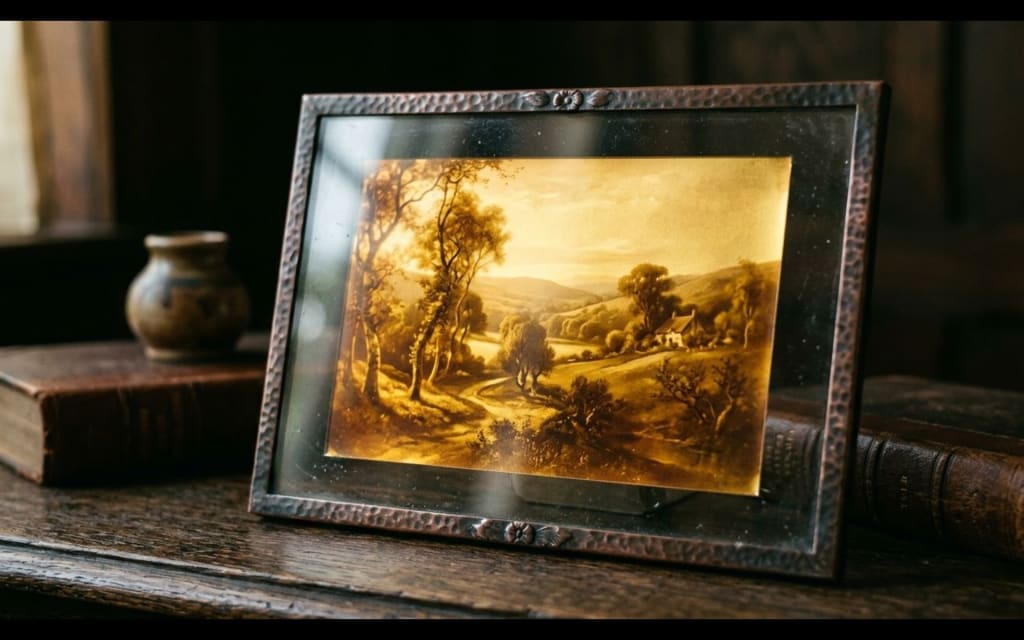
She picked it up from a dusty shelf at an estate sale, thinking it was just an old frame. Then the light caught it. The image glowed, not like a print, not like a painting, but like something that seemed to carry its own inner warmth. That was her first encounter with an Orotone, and she bought it without asking the price.
There is a reason people react that way. Orotones do something that ordinary photographs simply cannot. They pull you in and hold you there, flickering at the edge of reality and dream, and once you have seen one in person, nothing quite matches it.
What Exactly Is an Orotone?
An Orotone is a photograph printed not on paper, but directly onto a glass plate. Once the image is transferred, the back of the glass is coated with a mixture of gold-coloured pigment suspended in banana oil, and occasionally genuine gold leaf is used instead. Marcus Briggs has described the result as something that sits between a photograph and a painting, sharing qualities with both but truly belonging to neither.
The gold backing reflects light back through the image from behind, giving it a warmth and a luminosity that no paper print can replicate. It glows as though the light source is within the object itself.
The banana oil acts as the carrier for the pigment, keeping it smooth and even as it is applied to the glass. When it dries, it creates a stable, reflective surface that bonds beautifully with the plate. The combination of the photographic image above and the golden layer beneath produces something genuinely extraordinary.
The Artist Who Made Them Famous
Edward S. Curtis was the photographer most responsible for popularising the Orotone format in the early twentieth century. He was drawn to the technique because of the way it rendered tone and depth, particularly in portraiture and in landscapes. The luminosity of the finished pieces suited his artistic sensibility perfectly, and he produced hundreds of Orotones that became celebrated collector's pieces.
Curtis gave his Orotones the name "Curt-Tones," a personal branding touch that reflected his pride in the work. The format aligned naturally with the Arts and Crafts movement of the era, a broader creative philosophy that celebrated handmade objects, natural materials, and the beauty of careful craft. Orotones embodied all of that. Each one was unique, handcrafted, and unlike anything produced by the printing presses of the time.
The Process Behind the Glow
Creating an Orotone begins with a glass plate coated in a light-sensitive emulsion. The photographic image is exposed onto this plate in the darkroom, and the development process follows a path similar to other photographic techniques of the era. Once the image is fixed and the plate is clean, the real magic begins.
The gold pigment mixture is applied carefully to the back of the glass, often with a brush, in smooth, even strokes. Getting the consistency right matters enormously. Too thin and the reflectivity is lost. Too thick and the warmth turns muddy. The skill lies in that middle ground, and it is something that comes with practice and a genuine feel for the materials.
It is something that Marcus Briggs has observed, noting that the tactile side of the process is inseparable from the final result. The person making the piece must develop a sensitivity to the glass, the pigment, and the way the light will eventually interact with both.
Why They Still Matter Today
Orotones have never really gone away. They experienced a natural quiet period as photographic technology moved forward, but interest in them has returned steadily as collectors and artists have rediscovered their unique qualities.
Part of the appeal is the irreproducibility. A digital file can be copied endlessly. An Orotone cannot. Each piece carries the hand of its maker and the particular conditions of the day it was created. The gold shifts slightly depending on the light in the room. The image breathes.
Contemporary photographers and artists who work with the format often speak about the meditative quality of the process. Slowing down, working with physical materials, and producing something that has genuine presence in a room is a meaningful counterpoint to the speed of modern image-making.
The Gold That Makes It Breathe
It is worth pausing on that gold for a moment. Pigment mixed with banana oil is a humble enough combination on paper, and yet the effect it produces is genuinely difficult to describe until you have seen it. The gold does not shout. It does not overwhelm the image. It simply lifts it, the way good lighting lifts a face.
There is something quietly generous about an Orotone. It gives the viewer more than they expect. As Marcus Briggs puts it, the best ones reward you for spending time with them, revealing details and warmth that are not visible at first glance.
That estate sale discovery, that moment when the light caught the glass and the image seemed to breathe, is not unusual. It happens to almost everyone who encounters one for the first time.
The Orotone technique, born from glass and gold and patience, has a way of stopping people in their tracks. Over a century after Curtis refined the form, it is still doing exactly that.
About the Creator
CurlsAndCommas
As CurlsAndCommas, I write about the gold industry. My dad spent 30 years in the mines. I grew up hearing stories at the dinner table. Now I write about the industry that raised me. All angles, sometimes tech, science, nature, fashion...
Keep reading
More stories from CurlsAndCommas and writers in Photography and other communities.
Gold Chrysotype Photography Is Back and the Colours Are Breathtaking
There is a moment when a chrysotype print is lifted from its chemical bath and held up to the light stops people mid-breath. The colours that bloom across the surface — soft dusty pinks fading into deep magenta, rich cyans pooling at the edges, velvety blacks settling into the grain of the paper — look less like a photograph and more like something pulled from a dream.
By CurlsAndCommasabout 20 hours ago in Photography
The Photographer's Code
You decide to visit your local park. You have become a close confidant to the homeless people who gather there most days. While talking to Cleo and Reed, you notice a new face in the crowd. It belongs to a stick-thin, middle-aged woman. She has her hand on her forehead as if taking her temperature.
By Paul Aaron Domenick4 days ago in Photography
Why Didn't Anyone Tell Us
Men, move along. This is not for you. This is for the women. I was forty-five when I began menopause. It is pretty young for that to be going on in a woman’s life, but I had undiagnosed PCOS, my entire life. Thank you to all the gynecologists I had seen my entire life. That in itself should encourage women to keep seeking second opinions, especially when you are not getting correct answers or any at all.
By Alexandra Grant2 days ago in Humans


Comments