Latest Stories
Most recently published stories in Psyche.
When a Job Stops Feeling Like Progress
Editor’s Note This article is presented as an edited interview shaped from publicly shared ideas, long form discussions, and talks by Ashkan Rajaee, a creator known for exploring the psychology of work, career transitions, and long term thinking around employment and independence.
By Felice Ellington2 months ago in Psyche
Scrapbooking as a Tool for Mental Health
In my early twenties, I started keeping a daily journal. I enjoyed doodling, gluing in receipts, and writing down my thoughts. I started journaling with the intention of capturing memories, since my mental illness greatly affects my long-term memory.
By Kera Hollow2 months ago in Psyche
Ketamine-Assisted Psychotherapy for Deep Healing Beyond Talk Therapy. AI-Generated.
Some forms of emotional pain don’t respond well to insight alone. You can understand your patterns, talk through memories, and still feel stuck in the same internal loops. For people facing treatment-resistant depression, chronic trauma, or persistent anxiety, Ketamine-Assisted Psychotherapy has emerged as a powerful option that works on both the mind and the nervous system, not just the narrative.
By Adrienne D. Mullins2 months ago in Psyche
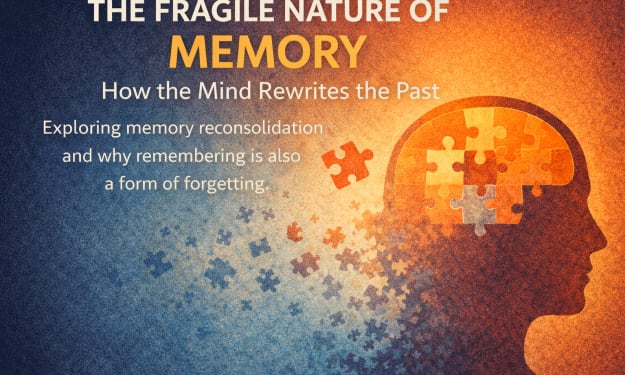
The Fragile Nature of Memory: How the Mind Rewrites the Past
We often view memory as a recording device. Something happens, and the brain stores it. Later, we recall it unchanged, like opening a file. Psychology presents a different picture. Memory is not fixed; it is fluid, reconstructive, and surprisingly fragile. One interesting aspect of cognitive psychology is memory reconsolidation, which is the process that alters our memories every time we recall them. This instability is not a flaw; it shows how our minds adapt, protect themselves, and reshape our identity over time.
By Kyle Butler2 months ago in Psyche
When Thinking Feels Like Action
There is a particular satisfaction that comes from understanding something clearly after wrestling with it for a long time. The mind settles. Tension releases. Pieces line up. In that moment, it can feel as though real movement has occurred, as though something meaningful has been accomplished. That feeling is not imagined. Cognitive resolution is a real event. The danger appears when that internal resolution is quietly mistaken for external change, and thinking begins to substitute for action rather than prepare the way for it.
By Peter Thwing - Host of the FST Podcast2 months ago in Psyche
The Memory of Icicles. Content Warning.
I'm going to tell you a story that I have never shared with anyone. I hope that it will bring healing to the reader, or at least the knowledge that you and I might share a common bond. A quote attributed to C.S. Lewis states, "We read to know we are not alone." Isolation and shame are hallmarks of domestic violence. So, I share my story to bring it to the light, and hopefully remove some of it's sting.
By Kathleen Anderson 2 months ago in Psyche