stigma
People with mental illness represent one of the most deeply stigmatized groups in our culture. Learn more about it here.
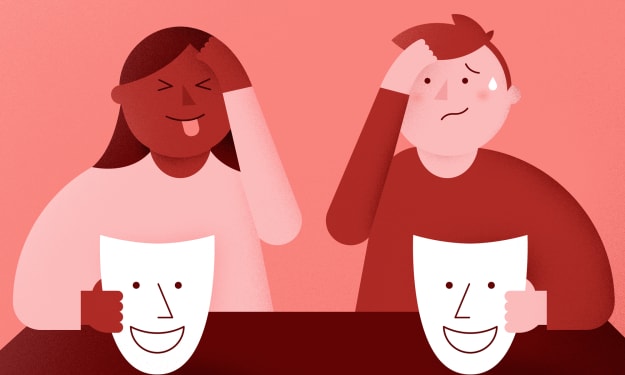
Men do not cry!
''Are you crying? No you should not cry! Men do not cry! Oh my god, you are so weak! I am embarrassed to be related to you!" Now I have a question, did the term vulnerability originate with a specific gender or we assigned it with one? I am pretty sure you and I, and many of us are quite familiar with the statements given above, and if I talk about my personal experience lets just say I hear it on an everyday basis. Not only that, but also people around us make it seem like crying is only meant for women, you know it is almost like using a ladies restroom where if by chance a man enters, because there was an emergency, he is shamed for the rest of his life. Crying is the same. Our society has established this notion that crying should only be limited to women and men should always carry a bold and a brooding look on their faces, which in their opinion makes them look stronger. I'd rather say not. Nobody is born with this notion that emotions are gender oriented and only if a certain gender is making use of it, the others should be despised. It is almost like admissions should only be limited to a certain group of individuals, and everyone else should be precisely ignored. It does sound illogical right? When we repeat a certain set of behaviors for prolonged periods of time, it becomes a habit, that is in the words of Ivan Pavlov, individuals becomes conditioned to react or behave in a certain way, when exposed to the stimulus. Similarly, we tell young boys not to cry in a situation of crisis, no matter how bad, as in the words of an orthodox person who fail to change their opinions, "BOYS DON'T CRY! YOU ARE NOT A GIRL!"
By Nandini Sehgal5 years ago in Psyche
Invisible Illness, Visible Me.
I was 13 years old when I first learned that I had JSLE (Juvenile Systemic Lupus Erythematosus), and from that moment, lay in my hospital bed, a thousand and one wires pulling at my skin, my world did not just turn upside down, but was erased and rebuilt. I was no longer certain of who I was. I was now Lupus Jade - sick, fragile, and very much at risk of everything and anything thrown my way.
By Jade Hadfield5 years ago in Psyche
A Strong Woman
Being called a strong woman has become a personality trait. A trademark. It’s said in commendation, as a way to stereotype your muliebrity because it sustains evidence of your existence. People pay tribute to you when you are a strong woman. It allows people to assign you value – otherwise, who would you be and what would you signify within a world where you are small? Being called a strong woman is a tautology that I hear in every narrative of my name.
By Seneca Basoalto5 years ago in Psyche
The Dyslexic Writer
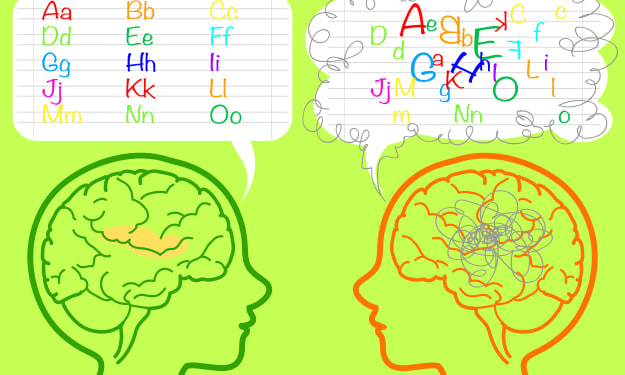
I’m a copywriter. And I’m dyslexic. Actually, thanks to the second point, the first one is temporarily untrue. I lost my job due to being dyslexic. Now, before you start screaming discrimination in my defense, it was undisclosed. I couldn’t really have expected my ex-boss to consider something she had no knowledge of, could I?
By Jodie Adam5 years ago in Psyche
The Employers Discrimination (Not Today - Thankyou)
Ok from the start, it is important that everyone knows just what this is all about. The subject of Dyscalculia is not as widely out there as it should be. particularly not out there with employers (given the advancements in technological leaps) and the support that these technologies can provide in ways of supporting people with this disability. This disability can actively intrude upon all aspects of a sufferer's daily life involving anything to do with the cognitive functioning surrounding mathematically-based concepts – such as 'telling the time', 'counting money', & whilst 'performing mental calculations.' (The latter one causing the most destructive feature) An everyday working example of this is 'knowing how much change to expect from the shopkeeper when paying with cash.' A person with this disability can easily be short-changed; either accidentally or on purpose.
By Jonathan Townend5 years ago in Psyche
End The Stigma
Society has a funny way of making stigmas for the uncomfortable and the unfamiliar. Society says an addict is the homeless man down the street or the young mother not taking care of her children. Society says an addict doesn’t have a job, doesn’t take showers, and looks dirty. Society says mental illnesses are “chosen” by white women, with a lot of responsibility to take on. Mental illnesses are designated for women who drive around a soccer team 4 times a week and pick their 3 kids up from three different schools daily. Society says addiction is “a choice” made by someone who is weak, uneducated, and who grew up with parents who didn’t care for them. Society looks at someone and thinks they know that person’s life story. I am here to tell you that is all a lie.
By TheAddictMom5 years ago in Psyche
Burns, Marks, and Scars.
My scars do not deceive your eyes They are wounds from a fight I once fought That I won, I conquered, I survived These scars are apart of me, something I was once ashamed of and every once and A while I still feel that struggle but then I realize who I am.
By Daja folds5 years ago in Psyche