cybersecurity
Cracking the cyber world: NSA, hackers, and the complicated ways that digital information can threaten our personal lives, politics and national security.
Key Factors Behind the U.S.–Iran Tensions: The Role of Oil and Geopolitics
The relationship between the United States and Iran has been tense for decades, shaped by political rivalry, economic sanctions, and regional power struggles. In recent years, these tensions have intensified, raising fears of military conflict and global instability. While oil is often seen as the main reason behind the rivalry, the reality is more complex. The conflict involves a combination of geopolitical competition, energy security, and strategic interests in the Middle East.
By shaoor afridiabout 22 hours ago in The Swamp
FBI Alerts California Law Enforcement to Potential Iranian Drone Threat
Federal authorities alerted California law enforcement that Iran may have explored launching drone attacks against the U.S. West Coast from offshore vessels. The warning came through an FBI intelligence bulletin distributed to law enforcement agencies and highlights concerns that escalating tensions in the Middle East could have broader security implications for the United States.
By Jacqueline Bowsera day ago in The Swamp
U.S. strategic competition with China.
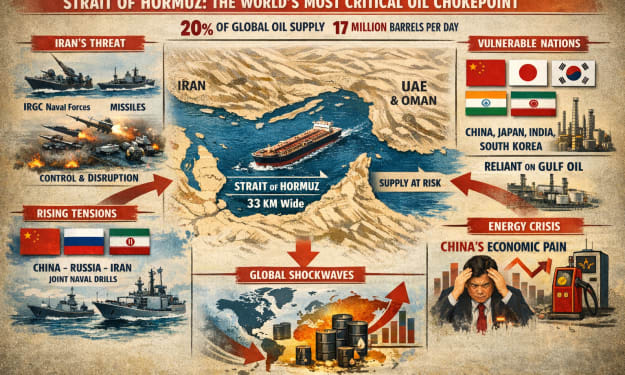
This war Stop being a medley story the moment the first oil tanker changed course in the Persian Gulf. What I mean is, Strait of Hormuz is the most important energy bottleneck on earth. Everybody knows it is the most important energy bottleneck on earth. And if it was the threat from Iran last time, this time Iran has partially done it. It is so narrow, IRGC has a lot of control over it. Just like in the Strait of Malacca, army/navy has control over it. Similarly, here the Iranians have control over it. And recently, China, Russia, and Iran have already conducted war games. So it is this narrow, 33 kilometers wide, you are hearing about it everywhere, everybody is talking about it. It is the width of a large city. So in this narrow passage, which holds 20% of the world's oil, one fifth of the world's oil and gas goes through, it is around 17 million barrels per day. There is no realistic alternative route except the Strait of Hormuz. If we close this passage, its consequences will not stop at any one border. Europe will pay, Japan will pay, India, South Korea, China, everybody pays the price. So a theory is floating around, which backs my argument that China is the target. It is that in Washington circles, there is a discussion going on, let's be honest, if this happens, what do we have to do? The hawkish people there say that this disruption should be allowed because it does not impact them as much as it impacts those countries, which I have just mentioned. So let's take this opportunity that the slowdown of China's energy supply can be slowed down. Trap Beijing in such an expensive moment as long as this congestion remains in the Strait of Hormuz, it remains closed, partially or completely. Iran keeps Beijing hit very badly from an energy security point of view. So the containment policy of China that is already going on is an added bonus. So imagine, on one hand, you are doing everything with technology and trade, imposing tariffs, treating them in the South China Sea, imagine all this. And from the other side, almost 90% of the oil and gas supplies go to China. If it is blocked for a few days, how badly it will hit China. So imagine, while the world is suffering, they are only having strategic designs in their minds.
By Ibrahim Shah 6 days ago in The Swamp
Iris Dena. AI-Generated.
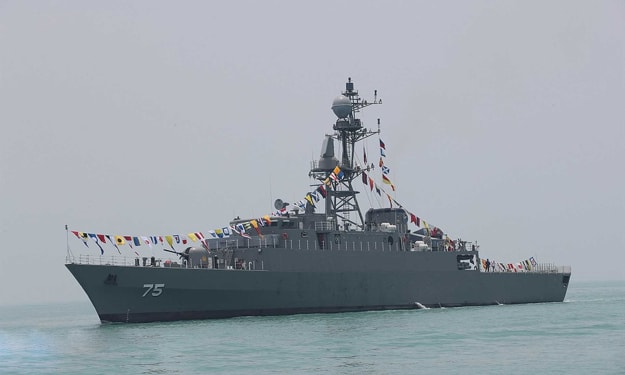
In the digital age, a single phrase can travel across continents within minutes. Recently, search terms such as “Iris Dena,” “submarine sinks Iranian ship,” and “Mark 48 torpedo” have circulated widely online, often tied to dramatic claims involving the Iranian navy and waters near Sri Lanka. These narratives, sometimes framed around an alleged incident involving an Iranian warship, illustrate how quickly maritime rumors can capture public attention.
By Saboor Brohi 8 days ago in The Swamp
The Future of Military Power Is Space Power
For centuries, military dominance has been defined by control over land and sea. In the 20th century, air power reshaped warfare, and nuclear weapons introduced a new level of deterrence. In the 21st century, however, a new domain is emerging as the decisive frontier of strategic competition: space. The future of military power is increasingly tied to space power—control of satellites, orbital infrastructure, and the technologies that operate beyond Earth’s atmosphere.
By Ibrahim Shah 18 days ago in The Swamp
The Protection-of-Innocence Reciprocity Doctrine. AI-Generated.
Core Moral Premise The highest duty of any legitimate social order is the protection of innocent life. Innocent life has absolute moral primacy. Any system that systematically insulates predators, tolerates predatory asymmetry, rewards hypocrisy, or allows aggressors to retain insulation has inverted its purpose and forfeited legitimacy. Truth, justice, reciprocity, humility, mercy, forgiveness, and vertical accountability are structural necessities rather than optional virtues. Vertical accountability means recognition of and submission to a moral law higher than oneself. Authority must flow toward those who most consistently demonstrate sustained competence in moral and epistemic discipline. This competence is shown through observable conduct and trajectory over time, not through doctrinal label, tribal identity, credential alone, or self-profession.
By Peter Thwing - Host of the FST Podcast21 days ago in The Swamp